Choosing between too bad and to bad can cause a common English grammar mistake. These homophones sound alike, but their spelling difference creates different grammatical roles and meanings. In standard English, too bad is the correct phrase for showing disappointment, sympathy, or something unfortunate. However, to bad may appear when English learners make a fast typing or spelling mistake.
Understanding the difference between to and too makes everyday writing much easier. So, this guide explains the correct usage, too bad meaning, and sentence examples using plain English. You will also see real-life examples from everyday communication, emails, texting, and casual writing. With one simple rule, you can avoid this common English mistake and improve your writing skills.
Quick Answer
The correct phrase is “too bad.”
Use too bad when you mean:
- Something is unfortunate.
- Something is disappointing.
- You feel mild sympathy about an unfortunate situation.
- Something has an excessive degree of badness.
Example:
“It’s too bad you couldn’t come.”
Here too modifies the adjective bad.
The spelling “to bad” is incorrect when you intend the expression meaning “unfortunate” or “regrettable.”
The simplest rule
Too bad = unfortunate or excessively bad
To = direction, destination, relationship, or part of an infinitive
For example:
- “That’s too bad.”
- “The weather is too bad for a picnic.”
- “I went to the store.”
- “I want to leave.”
- “That’s to bad.”
The easiest memory trick is simple: if you mean “unfortunate,” use “too bad.”
Comparison Overview
The difference between to bad and too bad becomes much clearer when you compare their grammatical functions.
| Expression | Standard usage | Meaning | Example |
| too bad | Correct | Unfortunate, regrettable, or excessively bad | “Too bad you missed the game.” |
| to bad | Not correct for this meaning | Not the standard expression | “To bad you missed the game.” |
| too | Correct in many contexts | Excess, degree, or addition | “The bag is too heavy.” |
| to | Correct in many contexts | Direction, destination, or infinitive marker | “She went to work.” |
The important point is that “to bad” isn’t simply an alternative spelling of “too bad.” The words have different grammatical functions.
Consider these two sentences:
“The movie was too bad to finish.”
Here too means the movie was bad to an excessive degree.
Now consider:
“I went to the theater.”
Here to indicates direction.
The pronunciation can cause confusion. The grammar provides the solution.
Read More: Puting or Putting: Which Spelling Is Correct in 2026?
Main Differences Between To Bad and Too Bad
The biggest difference comes down to function and meaning.
“Too” expresses excess or addition
The word too has several important uses in English.
It can indicate an excessive degree:
“The coffee is too hot.”
It can also mean “also”:
“I want to go too.”
When you say “too bad,” the word too modifies bad. It contributes the sense of degree or extent.
For example:
“The traffic was too bad to drive through.”
This means the traffic reached an excessive level that made driving impractical.
“To” usually serves a grammatical purpose
The word to appears in several common constructions.
It can indicate movement toward a place:
“She walked to school.”
It can introduce an infinitive:
“I want to sleep.”
It can show a relationship or connection:
“This letter is addressed to Maria.”
None of these functions creates the standard phrase “to bad.”
That’s why writing “to bad” when you mean disappointment is a spelling mistake rather than a different grammatical version.
Why Is “Too Bad” Correct?
The phrase “too bad” works because bad functions as an adjective while too modifies its degree.
Take the sentence:
“The weather is too bad for hiking.”
The adjective bad describes the weather. The adverb too tells us that the degree of badness exceeds what the situation can reasonably tolerate.
English uses the same structure in many familiar expressions:
- too expensive
- too difficult
- too cold
- too late
- too dangerous
- too loud
- too complicated
- too bad
However, “too bad” also developed a common conversational use that goes beyond literal degree.
When someone says:
“Too bad you missed the concert.”
the speaker usually means:
“It’s unfortunate that you missed the concert.”
That conversational meaning makes too bad especially common in everyday English.
What Does “Too Bad” Mean?
The meaning of “too bad” depends heavily on context and tone.
That’s one reason this short phrase can be surprisingly tricky.
“Too bad” can express sympathy
Someone might tell you:
“I got sick and couldn’t go on the trip.”
A sympathetic response could be:
“Oh, that’s too bad.”
Here the speaker acknowledges the person’s disappointment. The phrase carries mild sympathy.
“Too bad” can express disappointment
Imagine a friend wanted concert tickets but waited too long.
“The tickets sold out this morning.”
You might respond:
“Too bad. You would’ve loved the show.”
In this situation, the phrase expresses regret about an outcome.
“Too bad” can sound dismissive
Context matters.
Suppose someone says:
“I forgot my wallet. Can you pay for me?”
A response such as:
“Too bad.”
could sound cold or even hostile.
The grammar remains correct. The tone changes.
That’s an important distinction. Correct grammar doesn’t automatically create good communication.
“Too bad” can be sarcastic
Imagine someone brags about having the best seat in the theater. Then they discover the seat has a blocked view.
A friend might jokingly say:
“Too bad!”
The words are simple. The intended meaning comes from the situation and the relationship between the speakers.
Sarcasm can make “too bad” playful. In the wrong context it can make the same phrase sound cruel.
“Too Bad” vs. “That’s Too Bad”
These expressions are grammatically related. Their conversational effect can differ.
“Too bad.” sounds shorter and more abrupt.
“That’s too bad.” usually sounds more complete and sympathetic.
Compare:
“My flight got canceled.”
“Too bad.”
Now compare:
“My flight got canceled.”
“Oh, that’s too bad.”
The second response generally feels warmer. The addition of “that’s” creates a fuller acknowledgment of the person’s situation.
Common variations
| Expression | Typical tone |
| Too bad. | Brief and potentially blunt |
| That’s too bad. | More sympathetic |
| Oh, that’s too bad. | Warm and conversational |
| That’s really too bad. | Stronger sympathy or regret |
| What a shame. | Expressive and sympathetic |
| That’s unfortunate. | More formal |
There isn’t one universally correct response. The right choice depends on what you want your words to communicate.
Too Bad vs. Very Bad
A subtle but important distinction appears when too describes degree.
Consider:
“The movie was very bad.”
This simply tells us the movie had a high level of poor quality.
Now consider:
“The movie was too bad to finish.”
Here too bad suggests that the movie’s poor quality reached a level that prevented something else from happening.
The word too often carries the idea of more than is desirable, acceptable, or manageable.
Compare these examples:
- “The soup is very hot.”
- “The soup is too hot to eat.”
- “The exam was very difficult.”
- “The exam was too difficult for some students.”
- “The weather was very bad.”
- “The weather was too bad for travel.”
The distinction may seem small. In practice it can change the meaning of the entire sentence.
Common Mistakes With “To Bad” and “Too Bad”
The most frequent mistake occurs because to and too are homophones.
A homophone is a word that sounds like another word while having a different spelling or meaning.
Mistake: “To bad”
Incorrect:
“To bad you couldn’t come.”
Correct:
“Too bad you couldn’t come.”
The writer has selected to when the sentence requires too.
Mistake: “Too” before a destination
Incorrect:
“I went too the store.”
Correct:
“I went to the store.”
Here to indicates the destination.
Mistake: “Too” before an infinitive
Incorrect:
“I want too leave.”
Correct:
“I want to leave.”
The to introduces the verb leave.
Mistake: “To” when meaning “also”
Incorrect:
“I want to go to.”
Correct:
“I want to go too.”
In the second sentence too means “also.”
These mistakes are common because pronunciation doesn’t always reveal the correct spelling. You have to examine the word’s role in the sentence.
“Too Bad” in Everyday Conversation
People use “too bad” constantly in informal American English.
It can appear after disappointing news:
“The restaurant was closed.”
“Oh, too bad.”
It can acknowledge a missed opportunity:
“She couldn’t get tickets.”
“That’s too bad.”
It can express regret:
“Too bad we didn’t leave earlier.”
It can describe an excessively poor condition:
“The road was too bad to drive on.”
Notice how the same two words can perform different conversational jobs.
That flexibility explains why too bad remains common in spoken English. It’s short. It’s recognizable. It can express emotion without requiring a long explanation.
Using “Too Bad” in Text Messages
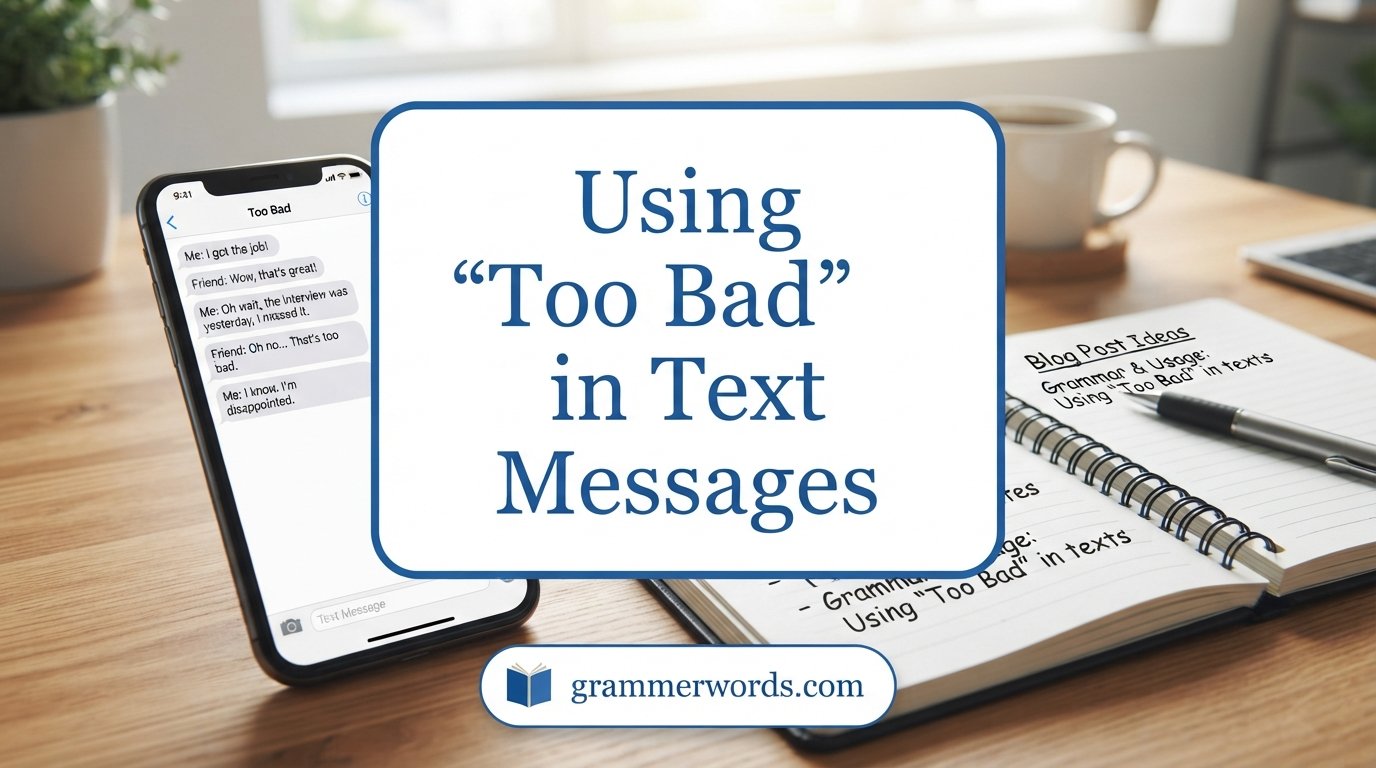
Texting makes tone even more important because readers can’t hear your voice.
Consider this exchange:
Friend: “I can’t make it tonight. My car broke down.”
Reply: “Too bad.”
Technically, the response works. Emotionally, it may feel a little flat.
A warmer alternative would be:
“Oh no, that’s too bad.”
Or:
“That’s really too bad. Hope you can make it next time.”
The extra words provide emotional context.
Natural text responses
| Situation | Natural response |
| Friend misses an event | “That’s too bad!” |
| Friend loses an opportunity | “Oh, that’s too bad.” |
| Friend cancels plans | “Too bad. We’ll do it another time.” |
| Someone makes a minor complaint | “Haha, too bad!” |
| Someone shares serious bad news | “I’m sorry to hear that.” |
The last example matters. “Too bad” isn’t appropriate for every disappointing situation.
If someone tells you about a serious personal loss then “I’m sorry to hear that” usually communicates more care.
When “Too Bad” Sounds Rude
The phrase isn’t inherently rude. Its tone depends on context.
Three factors matter most:
- Your relationship with the listener
- The seriousness of the situation
- Your delivery or wording
For a minor inconvenience:
“Too bad you missed the sale.”
That can sound perfectly casual.
For something emotionally serious:
“My grandmother died.”
“Too bad.”
That response would likely sound deeply insensitive.
The words themselves haven’t changed. The situation has.
This is why natural communication requires more than grammatical correctness. A technically correct phrase can still be the wrong response.
Too Bad in American English
“Too bad” is standard American English. Its spelling doesn’t change because of regional differences between American and British English.
The common misconception that British English uses “to bad” isn’t correct.
Both varieties use too in the expression:
“That’s too bad.”
The same distinction applies to to and too more broadly.
American English:
“I want to go too.”
British English:
“I want to go too.”
American English:
“She went to London.”
British English:
“She went to London.”
The spelling remains the same.
Regional differences may affect pronunciation, vocabulary, punctuation preferences, or style. They don’t turn “too bad” into “to bad.”
Is “Too Bad” Formal or Informal?
“Too bad” is most natural in conversational English.
You can use it in:
- Text messages
- Casual emails
- Friendly conversations
- Social media posts
- Informal workplace conversations
In formal writing, a more precise expression may sometimes work better.
For example:
“Unfortunately, the meeting had to be canceled.”
sounds more formal than:
“Too bad the meeting got canceled.”
Neither sentence is grammatically wrong. They simply belong to different registers.
Choosing the right expression
| Situation | Suitable wording |
| Texting a friend | “Too bad!” |
| Talking casually | “That’s too bad.” |
| Friendly workplace message | “That’s too bad. Hopefully we can reschedule.” |
| Formal email | “Unfortunately, the meeting has been canceled.” |
| Academic writing | “This outcome is unfortunate.” |
The key isn’t to avoid too bad. It’s to match your wording to the audience.
Too Bad vs. Similar Expressions
Several expressions can communicate disappointment. They don’t all carry the same emotional weight.
“Too bad”
Casual and flexible.
“Too bad you couldn’t join us.”
“That’s unfortunate”
More formal and restrained.
“That’s unfortunate. We’ll need to find another solution.”
“What a shame”
Expressive and often sympathetic.
“What a shame you missed the ceremony.”
“That’s disappointing”
Directly emphasizes disappointment.
“That’s disappointing. We expected better results.”
“I’m sorry to hear that”
More explicitly sympathetic.
“I’m sorry to hear that. I hope things improve soon.”
Choosing between these expressions depends on the situation rather than grammar alone.
“Too Bad” vs. “Too Badly”
Another common question involves bad and badly.
Consider:
“That’s too bad.”
Here bad is an adjective.
Now consider:
“He played too badly.”
Here badly is an adverb modifying the verb played.
The structures differ.
Adjective:
“The situation is bad.”
Adverb:
“He performed badly.”
Adding too doesn’t change that basic distinction.
So:
- “That’s too bad.”
- “He played too badly.”
- “That’s too badly.”
The correct form depends on the grammatical role of the word.
A Practical Test for Choosing “To” or “Too”
When you’re unsure, ask what the word is doing.
Use “too” when it means “also”
“I want to come too.”
You could replace too with also.
“I want to come also.”
The sentence sounds less natural. The meaning remains clear.
Use “too” when it expresses excess
“It’s too cold outside.”
The temperature exceeds a comfortable level.
Use “to” for direction
“She went to school.”
Ask: Where did she go?
The answer is to school.
Use “to” before a base verb
“I want to sleep.”
The to introduces the infinitive sleep.
Use “too” in “too bad”
If the intended meaning is:
“That’s unfortunate.”
then the spelling is:
“That’s too bad.”
Quick Practice: To or Too?
Test yourself before checking the answers.
- “It’s ___ bad you couldn’t come.”
- “I went ___ the store.”
- “The soup is ___ hot.”
- “She wants ___ join us.”
- “___ bad the tickets sold out.”
- “I want to come ___.”
- “The weather was ___ bad for hiking.”
- “He drove ___ the airport.”
Answers
- too — “too bad” expresses disappointment.
- to — it indicates the destination.
- too — it indicates excessive heat.
- to — it introduces the infinitive “join.”
- Too — the phrase expresses regret.
- too — it means “also.”
- too — the weather exceeded a practical limit.
- to — it indicates direction.
The pattern becomes easier when you stop focusing on pronunciation. Instead, identify the word’s grammatical function.
Case Study: Why Context Changes “Too Bad”
Imagine three different conversations.
Case one: A missed movie
Alex: “I couldn’t get tickets for the movie.”
Sam: “Oh, that’s too bad.”
The response sounds sympathetic. The situation is minor and the phrase fits naturally.
Case two: A playful complaint
Alex: “You ate the last slice of pizza.”
Sam: “Too bad!”
Here the phrase could be playful or teasing. The relationship and delivery determine the meaning.
Case three: Serious news
Alex: “My father is in the hospital.”
Sam: “Too bad.”
The grammar remains correct. The response sounds inappropriate because the situation requires greater empathy.
These examples show why vocabulary alone doesn’t determine communication. Context supplies the emotional meaning.
Is “To Bad” Ever Correct?
The sequence “to bad” can theoretically appear when to belongs to a separate grammatical structure and bad has its own role. However, it isn’t the normal phrase people mean when they write “to bad.”
For example, if to belongs to a larger construction and bad functions separately, the words may happen to occur near each other. That doesn’t make “to bad” an alternative spelling of “too bad.”
When the intended meaning is unfortunate, regrettable, or excessively bad, use:
too bad
This distinction prevents a lot of unnecessary confusion.
Frequently Asked Questions
Is “to bad” grammatically correct?
No. When you mean unfortunate or regrettable, too bad is the correct usage in standard English.
What does “too bad” mean?
Too bad can mean unfortunate, disappointing, or regrettable. It can also describe something that is excessively bad, depending on the meaning and sentence structure.
Is “too bad” the same as “very bad”?
Not always. Very bad shows a high degree, while too bad can show excess or express disappointment about an unfortunate situation.
Is “too bad” rude or informal?
Too bad is common in casual writing, texting, and everyday communication. However, its tone can sound blunt or dismissive, so context matters.
Is “too bad” used in British English?
Yes. British English and American English both use too bad with the same correct spelling and basic meaning.
Final Takeaway
The key is to remember that too bad is the correct phrase when you mean unfortunate, disappointing, or regrettable. By contrast, to shows direction, destination, or introduces an infinitive, so checking the word’s grammatical usage prevents this common English grammar mistake. With this simple rule, you can improve your writing skills, avoid spelling confusion, and use too bad naturally in everyday communication.