Many writers confuse take effect with take affect, but only one is the correct phrase. In English grammar, affect and effect have different grammatical roles and meanings. The phrase take effect means something begins to operate or produce a result. By contrast, take affect is an incorrect spelling error caused by mixing up words that can sound the same.
This commonly confused phrase creates grammar confusion in emails, reports, contracts, and medical notes. So, understanding affect meaning and effect examples makes proper usage much easier. This guide explains the take effect meaning, affect meaning, and key differences with clear practical examples.
Take Affect vs Take Effect: Quick Answer
Take effect is the correct standard expression when you mean that something begins to operate, apply, or produce a result.
For example:
- “The new law will take effect on January 1.”
- “The medicine should take effect within an hour.”
- “The changes took effect immediately.”
- “The agreement will take effect after both parties sign it.”
By contrast, take affect is generally incorrect when you mean “begin to operate” or “begin producing a result.”
The easiest way to remember the difference is this:
| Expression | Standard usage | Meaning |
| Take effect | Correct | Begin to operate or produce a result |
| Take affect | Generally incorrect | Usually a confusion between affect and effect |
| Affect | Correct in the right context | Usually influence or change |
| Effect | Correct in the right context | Usually a result or consequence |
So if you’re writing about a rule becoming active, a medication beginning to work, or a policy starting to apply, choose take effect.
Comparison Overview
The fastest way to understand take affect vs take effect is to compare the words by grammatical function and meaning.
| Word or phrase | Typical grammatical role | Basic meaning | Example |
| affect | Verb | Influence or change | “The weather affected our plans.” |
| effect | Noun | Result or consequence | “The weather had an effect on travel.” |
| take effect | Verb phrase | Begin to operate or produce a result | “The new rule takes effect Monday.” |
| effect | Verb | Bring about or cause | “The reforms effected major changes.” |
| affect | Noun | Observable emotional expression in technical contexts | “The patient displayed a flat affect.” |
The important point is that take effect uses effect as a noun.
Think about what the phrase describes. Something “takes effect” when its effect begins. A law starts producing its intended legal consequences. A medicine begins producing its physiological results. A policy begins influencing how people operate.
That structure explains why take effect makes sense while take affect normally does not.
Main Differences Between Take Affect vs Take Effect
The biggest difference comes down to the meaning of the two words.
Affect Usually Means “Influence”
In ordinary English, affect most often functions as a verb.
When something affects something else, it influences, changes, or has an impact on it.
Consider these examples:
- “The heat affected the equipment.”
- “The price increase affected customers.”
- “Lack of sleep can affect concentration.”
- “The delay affected the delivery schedule.”
In each sentence, something influences another thing.
You can often replace affect with “influence” without changing the basic meaning.
“The storm affected traffic.”
means roughly:
“The storm influenced traffic.”
That substitution provides a useful test when you’re uncertain.
Effect Usually Means “Result”
In everyday English, effect most often functions as a noun.
It refers to a result, consequence, or outcome produced by something.
For example:
- “The storm had a major effect on traffic.”
- “The medicine produced a noticeable effect.”
- “The decision had an unexpected effect.”
- “The policy had little effect on sales.”
Here, you can often replace effect with “result.”
“The decision had an unexpected effect.”
means that the decision produced an unexpected result.
Take Effect Means “Begin to Operate or Produce Results”
The phrase take effect combines these ideas.
When something takes effect, its operation or influence starts.
For example:
“The new workplace policy takes effect Monday.”
The policy already exists. Monday marks the point when the policy begins to apply.
Likewise:
“The medication took effect after about thirty minutes.”
The medicine existed before that point. Its noticeable action began later.
This distinction makes take effect much easier to understand.
Read More: Unphased or Unfazed: Which Spelling Is Correct? Meaning, Usage, and Examples
Why Is “Take Effect” Correct?

The phrase take effect has a long-established place in standard English.
Here, effect refers to the result or operation produced by something. The verb take creates the established expression meaning that the effect begins to operate.
You can see this clearly in several contexts.
Laws and Regulations
A law may be passed on one date while becoming legally operative on another.
For example:
“The new regulation will take effect on July 1.”
The sentence doesn’t mean the regulation suddenly appears on July 1. Instead, July 1 marks when its provisions begin applying.
Workplace Policies
Companies often announce policies before they become active.
“The revised vacation policy takes effect next month.”
The announcement happens first. The policy’s practical application begins later.
Medication
Medicine provides another common use.
“The medication should take effect within an hour.”
Here, take effect describes the point at which the medicine starts producing its intended physiological result.
Agreements
Contracts and other formal arrangements can also take effect.
“The agreement takes effect once both parties sign it.”
In this case, signing establishes the point at which the agreement becomes operative.
Affect vs Effect: The Grammar Behind the Confusion
The two words cause trouble because they differ by only one letter. Their pronunciation also varies depending on the word and dialect.
Still, their most common grammatical roles give you a strong starting point.
Affect is usually a verb.
Effect is usually a noun.
Consider this pair:
“The noise affected my concentration.”
“The noise had an effect on my concentration.”
The meaning remains closely related. The grammatical structure changes.
In the first sentence, the noise influences concentration.
In the second, the noise produces a result that concerns concentration.
This distinction isn’t an absolute rule. English has exceptions. That’s why treating “affect is always a verb” and “effect is always a noun” as ironclad rules can eventually cause new mistakes.
The shortcut works well for everyday writing. It simply shouldn’t replace an understanding of how the words actually function.
Can “Affect” Ever Be a Noun?
Yes.
This is one of the most important exceptions to the common affect-versus-effect rule.
In psychology, psychiatry, and related fields, affect can function as a noun referring to the observable expression of emotion.
For example:
“The clinician observed a restricted affect.”
This technical meaning differs from the ordinary verb affect.
It doesn’t make take affect an alternative to take effect.
That’s because the specialized noun affect doesn’t carry the meaning required in the established phrase. If you’re talking about something beginning to operate or produce a result, take effect remains the appropriate expression.
This is a good example of why grammar can’t always be reduced to one tiny mnemonic.
Can “Effect” Ever Be a Verb?
Yes. Effect can also function as a verb.
As a verb, effect means to bring about, cause, or make something happen.
For example:
“The new leadership effected significant changes.”
This doesn’t mean the leadership merely influenced the changes. It means the leadership brought those changes about.
That’s different from affect.
Compare these sentences:
- “The policy affected employee behavior.”
- “The policy effected a major transformation.”
The first describes influence.
The second describes bringing about a result.
The verb effect appears less often in casual conversation. It occurs more frequently in formal, academic, legal, business, and professional writing.
“Take Affect” vs “Take Effect” in Everyday Examples
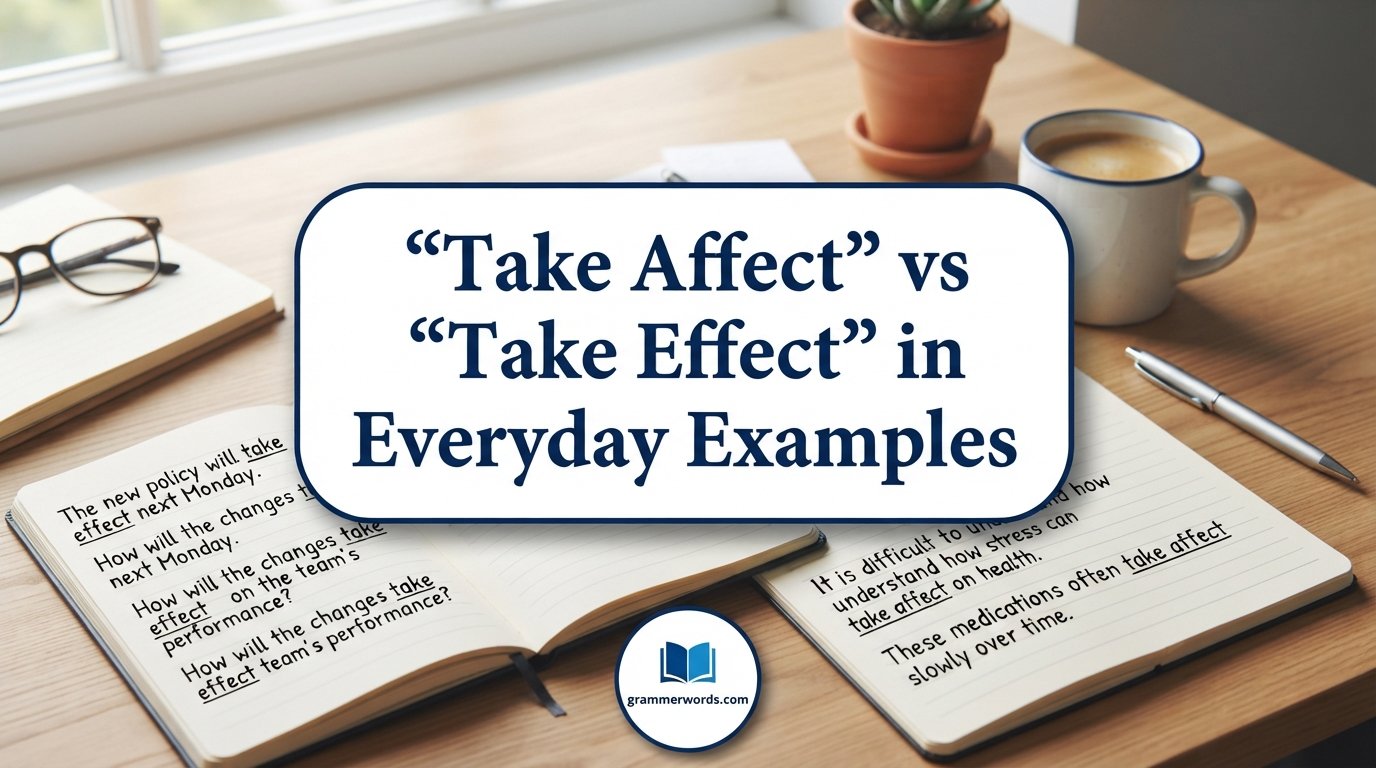
Context makes the difference much easier to see.
Example 1: A New Law
Incorrect:
“The new law will take affect next month.”
Correct:
“The new law will take effect next month.”
Why?
The law will begin operating next month. It won’t “take influence.”
Example 2: Medication
Incorrect:
“The medicine should take affect soon.”
Correct:
“The medicine should take effect soon.”
The intended meaning is that the medicine will begin producing a result.
Example 3: Company Policy
Incorrect:
“The updated policy takes affect on Monday.”
Correct:
“The updated policy takes effect on Monday.”
The policy becomes active on Monday.
Example 4: A Contract
Incorrect:
“The contract takes affect after signing.”
Correct:
“The contract takes effect after signing.”
The agreement becomes operative after the required condition occurs.
Example 5: A Direct Influence
Here, affect is correct:
“The new schedule will affect employees.”
The schedule influences employees. It doesn’t “take effect” in the grammatical sense of influencing them.
Both phrases can appear in the same topic:
“The new schedule takes effect Monday and will affect employees across every department.”
That’s a useful sentence to remember because it puts both words in their proper roles.
Common Mistakes With “Take Effect”
Writing “Take Affect”
This is the most obvious mistake.
People often hear the words as similar and choose the spelling they associate with the verb affect.
However, the established expression is take effect.
Confusing Influence With Result
Ask yourself what you’re describing.
If you’re describing an influence, you probably need affect.
If you’re describing a result, you probably need effect.
Compare:
“The pressure affected the machine.”
The heat influenced the machine.
“The heat had an effect on the machine.”
The vibration produced a result involving the machine.
Assuming British English Uses “Take Affect”
It doesn’t.
Take effect is standard in both American and British English.
This isn’t one of those spelling differences where American English and British English choose different forms. The distinction between affect and effect remains relevant in both varieties.
For example, British English may use spelling differences such as colour instead of color. That doesn’t mean British English changes take effect to take affect.
Confusing “Effect” With “Effective”
These words are related but aren’t interchangeable.
Effect is commonly a noun meaning a result.
Effective is an adjective describing something that works successfully or has the intended impact. It can also describe something that is legally or officially operative in certain contexts.
Compare:
“The rule takes effect on Monday.”
with:
“The rule is effective on Monday.”
The first emphasizes the starting point.
The second emphasizes the rule’s status or operation.
Take Effect vs Go Into Effect
You may also encounter go into effect.
This phrase is standard and often means essentially the same thing as take effect.
For example:
“The new regulations take effect July 1.”
and:
“The new regulations go into effect July 1.”
Both sentences indicate that the regulations become operative on July 1.
The choice often depends on style and context rather than correctness.
Take effect can feel particularly natural when something begins producing a result:
“The medication took effect quickly.”
Go into effect commonly appears when discussing rules, laws, policies, and regulations:
“The new regulations went into effect last week.”
Neither expression requires affect.
Take Effect vs Come Into Effect
Another established expression is come into effect.
For example:
“The revised rules came into effect in January.”
Again, the meaning centers on something becoming operative.
The three expressions can overlap:
- take effect
- go into effect
- come into effect
However, take effect has a particularly broad range of applications. It works naturally for laws, policies, agreements, medication, treatments, changes, and other situations where something begins producing its intended effect.
Take Effect vs Affect: A Practical Case Study

Imagine a company announces a new attendance policy.
The company publishes the policy on September 10. Employees receive the document that same day. The company states that the policy becomes active on October 1.
Now consider three sentences:
“The company announced the policy on September 10.”
“The policy takes effect on October 1.”
“The policy will affect employees across the company.”
Each sentence performs a different job.
The first describes the announcement.
The second identifies when the policy becomes operational.
The third describes whom the policy will influence.
This small example captures the distinction better than memorizing isolated definitions.
| Sentence | Correct word | Reason |
| The policy takes effect October 1. | Effect | The policy becomes active. |
| The policy will affect employees. | Affect | The policy will influence employees. |
| The policy will have an effect on attendance. | Effect | Attendance will experience a result. |
| Managers hope to effect meaningful changes. | Effect | They hope to bring changes about. |
How to Remember Affect vs Effect
A simple memory device can help.
Think:
Affect = Action or influence
Effect = End result
This isn’t a complete grammar rule. It’s a practical shortcut for common situations.
When you see:
“The new policy will ___ employees.”
You’re describing influence. Affect fits.
When you see:
“The new policy will have an ___.”
You’re describing a result. Effect fits.
When you see:
“The new policy will ___ next month.”
If you mean “become active,” the established phrase is take effect.
Another useful question is:
“Am I describing what something does to another thing or the result it produces?”
If you’re describing what something does to something else, consider affect.
If you’re describing the result, consider effect.
Take Effect in Different Tenses
The phrase remains the same while the verb take changes according to tense and subject.
| Tense or construction | Example |
| Present | “The rule takes effect today.” |
| Past | “The rule took effect yesterday.” |
| Future | “The rule will take effect tomorrow.” |
| Present perfect | “The rule has taken effect.” |
| Past perfect | “The rule had taken effect before the meeting.” |
| Modal | “The rule may take effect soon.” |
| Infinitive | “The company plans for the rule to take effect next month.” |
Notice something important: effect doesn’t change.
The verb changes because take carries the tense.
That’s why you write:
“The policy took effect.”
rather than trying to alter effect itself.
Real-World Uses of “Take Effect”
The phrase appears across many areas of everyday life.
Government and Law
Legal language frequently uses take effect to describe when legislation or regulations become operative.
“The revised regulation will take effect next quarter.”
Employment
Businesses use the phrase when discussing changes to internal policies.
“The updated benefits policy takes effect at the beginning of the year.”
Finance
Financial institutions may use take effect when describing new rates, fees, limits, or terms.
“The revised fee structure will take effect next month.”
Education
Schools and universities can use the expression for new rules and academic policies.
“The revised attendance requirements take effect next semester.”
Healthcare
Medical writing and everyday conversation both use take effect when describing the beginning of a treatment’s action.
“The medication began to take effect after several minutes.”
Technology
Software and system changes can also take effect.
“The configuration changes will take effect after the system restarts.”
These examples demonstrate why take effect remains such a useful expression. Its meaning adapts to the situation while retaining the same central idea: something begins operating or producing a result.
A Quick Decision Guide for Take Affect vs Take Effect
When you’re editing a sentence, run through these questions.
Does the sentence mean “influence”?
Use affect.
“The weather affected our plans.”
Does the sentence mean “result”?
Use effect.
“The weather had an unexpected effect on our plans.”
Does the sentence mean “begin operating”?
Use take effect.
“The new schedule takes effect tomorrow.”
Does the sentence mean “bring about”?
Consider effect as a verb.
“The reforms effected substantial changes.”
That final use requires more care because effect as a verb is less common in ordinary conversation. Still, it’s a legitimate and useful construction.
Frequently Asked Questions
Is “take affect” grammatically correct?
No. When you mean something begins to operate or produce a result, take effect is the correct phrase.
What does “take effect” mean?
Take effect means something begins to operate, apply, or produce a result. For example, “The new policy takes effect Monday.”
What is the difference between “affect” and “effect”?
Affect usually means to influence or change something, while effect usually means a result or consequence. This difference helps prevent common writing errors.
Is “take effect” used in both American and British English?
Yes. Take effect is the standard use in both forms of English. Take affect is not a British English alternative.
Should I use “take effect” or “go into effect”?
Both are correct phrases and can mean that something becomes active or operative. However, take effect also works naturally when something begins producing a result.
Final Takeaway
Once you understand the take effect meaning, the difference becomes simple: use take effect when something begins to operate or produce a result. Use affect when something influences or changes something, while effect usually names the resulting outcome. This clear English usage rule can prevent common writing errors and improve writing clarity.