When you type nosy or nosey, you wonder which spelling is correct. Both spellings share the same meaning, but their usage can differ. For most readers, nosy is the standard spelling in American English. Still, nosey remains an accepted and recognized spelling as an alternative spelling. This guide explains their differences, examples, and best choice for everyday writing.
The word describes a person showing excessive curiosity about private matters or personal questions. In daily English, it often suggests prying, meddlesome behavior, or unwanted interest. However, context matters when choosing a correct spelling for emails or professional writing. We will compare Cambridge, Oxford, and Dictionary.com guidance with real world examples. This approach helps English learners and native speakers write with confidence.
Quick Answer
Nosy and nosey are both correct spellings.
In American English, nosy is the preferred everyday spelling. Nosey is an accepted variant that readers will understand immediately.
Both words mean someone is too interested in other people’s affairs. The word usually carries a mildly negative or teasing tone. Cambridge classifies nosy as disapproving and gives nosey as an alternative form. Oxford likewise lists both spellings.
| Question | Answer |
| Is nosy correct? | Yes |
| Is nosey correct? | Yes |
| Which is better for US English? | Nosy |
| Do they have different meanings? | No |
| Are they pronounced differently? | No |
| Is nosey simply a typo? | No |
| Can either appear in informal writing? | Yes |
| Which form should you use consistently? | Nosy is the safest US-English default |
A simple rule works well: If you’re writing for an American audience and have no reason to choose otherwise, use “nosy.”
Comparison Overview
The difference between nosy and nosey is much smaller than many spelling questions suggest.
Neither spelling creates a separate definition. Never changes the adjective into another part of speech. Neither signals a different kind of curiosity.
The real distinction lies in spelling preference and usage context.
| Feature | Nosy | Nosey |
| Meaning | Too interested in other people’s affairs | Too interested in other people’s affairs |
| Part of speech | Adjective | Adjective |
| Pronunciation | Same | Same |
| American English | Common default | Accepted variant |
| British English | Used | Used |
| Formality | Informal | Informal |
| Tone | Usually disapproving or teasing | Usually disapproving or teasing |
| Comparative | Nosier | Noseier can occur, but usage varies |
| Superlative | Nosiest | Noseiest can occur, but usage varies |
| Noun form | Nosiness | Nosiness remains the standard noun form |
Oxford’s American dictionary specifically records nosy as an informal and disapproving adjective. It also lists nosey as an alternative spelling.
That makes one point especially important: “nosey” isn’t an error simply because “nosy” is more familiar in American English.
Main Differences Between Nosy and Nosey
There is no major difference in meaning between nosy and nosey. The distinction is mainly orthographic, meaning it concerns how the word is written.
Nosy Is the Best Default for US English
For American readers, nosy is the spelling to reach for first.
You’ll see it in dictionaries, ordinary conversation, journalism, books, and everyday online writing. Dictionary.com labels nosy as American and gives nosey as an alternative. Oxford’s American English dictionary follows the same basic pattern.
Examples include:
- My nosy neighbor always asks where I’m going.
- Don’t be so nosy.
- She asked a few nosy questions about my salary.
- His nosy behavior became irritating after a while.
Nothing about the spelling makes the word especially formal. In fact, nosy remains an informal adjective.
Nosey Is Also a Real Word
Nosey isn’t a fabricated variant or a careless typo.
Oxford lists nosey with the definition associated with nosy and identifies nosy as the alternative. Cambridge also gives nosey as an alternative spelling.
You might therefore encounter sentences such as:
- My aunt can be a little nosey sometimes.
- That was a rather nosey question.
- The nosey neighbor wanted to know everything.
The meaning stays intact.
Think of the two spellings as two roads leading to the same destination. The scenery changes slightly. The destination doesn’t.
The Pronunciation Does Not Change
Cambridge gives the US pronunciation of nosy as /ˈnoʊ.zi/ and the UK pronunciation as /ˈnəʊ.zi/. The alternative spelling nosey follows the same pronunciation pattern.
The spelling therefore does not create a meaningful pronunciation contrast.
For American English, the word has two syllables. The first syllable carries the main stress.
Read More: Bougie or Boujee: Which Spelling Is Correct and What Does It Mean?
What Does Nosy Mean?
Nosy describes someone who shows too much interest in matters that don’t concern them.
That usually means asking overly personal questions, prying into private conversations, checking on someone’s affairs, or trying to discover information that the person hasn’t offered.
Oxford defines nosy as being too interested in things that don’t involve you, particularly other people’s affairs. Cambridge gives a closely related definition that emphasizes wanting to discover too much about what other people are doing.
For example:
My neighbor is incredibly nosy. She always wants to know who visits my house.
The issue isn’t simply curiosity. The problem is where the curiosity crosses a social boundary.
Someone might ask, “How was your vacation?” That’s normal conversation.
Someone might ask, “How much did the vacation cost?” That could be more personal.
A person who continues with questions about your bank balance, relationship problems, family disputes, or private plans may start sounding nosy.
Common Situations Where People Act Nosy
A person might seem nosy when they:
- Ask about someone’s salary without a clear reason.
- Question someone about their relationship status repeatedly.
- Listen to conversations that don’t involve them.
- Ask intrusive questions about family problems.
- Want details about someone’s medical situation.
- Gossip about private matters.
- Look through another person’s belongings.
- Demand information after someone has declined to share it.
- Keep asking personal questions simply because they want to know.
The word focuses on unwanted curiosity rather than curiosity itself.
What Does Nosey Mean?
Nosey means essentially the same thing as nosy.
It describes someone who takes excessive interest in other people’s private affairs. It can describe the person, their behavior, or the questions they ask.
For example:
- She’s being nosey again.
- That was a pretty nosey question.
- His nosey behavior annoyed everyone at dinner.
Oxford’s entry for nosey identifies it as an informal and disapproving adjective and gives nosy as the alternative form.
This matters because a common mistake is to assume that the extra e must create a different meaning. It doesn’t.
Why Are There Two Spellings?
The word has an obvious visual connection to nose. That’s probably one reason nosey looks intuitive to many writers.
English also frequently creates adjectives with -y. Think of words such as:
- messy
- rainy
- cloudy
- sleepy
- funny
- noisy
With nose, however, writers encounter two established patterns.
The spelling nosy removes the final e before adding -y. The spelling nosey keeps the base word visually closer to nose.
Dictionary.com dates the first recorded use of nosy to 1880–85 and gives its formation as nose + -y.
That etymological detail helps explain why the word can feel slightly unusual. The meaning clearly comes from the idea of sticking one’s nose into other people’s business. Yet the conventional spelling doesn’t have to preserve the entire base word.
Is Nosey a British Spelling?

Nosey is strongly established in British English, but calling it exclusively British would be too simplistic.
Both Cambridge and Oxford recognize the spelling. Cambridge’s British entry uses nosy as the main headword while explicitly identifying nosey as an alternative. Oxford also gives both forms.
At the same time, nosy is not restricted to the United States.
That means this rule is more accurate:
Nosy and nosey both exist in English. Regional and editorial preferences influence which spelling appears more often.
For an American-focused article, nosy remains the straightforward choice.
For British-focused writing, either spelling can be encountered. If a publication has a house style, follow that style consistently.
Is Nosy More Correct Than Nosey?
Not in the sense of “correct versus incorrect.”
Nosy is generally the better default for US English. Nosey remains a legitimate variant.
That distinction matters because English has many accepted spelling variants. A dictionary may list one form as its primary headword while treating another as an alternative. That doesn’t automatically make the alternative wrong.
Cambridge explicitly gives nosey as an alternative to nosy. Oxford does the same.
So these two sentences are both understandable and grammatically sound:
- Don’t be so nosy.
- Don’t be so nosey.
If the goal is polished American English, however, Don’t be so nosy is the natural default.
How to Use Nosy in a Sentence
The easiest way to understand nosy is to see how its tone changes across situations.
Everyday Conversation
Don’t be nosy.
This is direct and familiar. Depending on the speaker’s tone, it can sound playful or irritated.
I don’t mean to be nosy, but are you okay?
Here, the speaker acknowledges that the question might feel personal.
My little brother is always nosy about my phone.
This describes repeated curiosity without necessarily suggesting serious wrongdoing.
Personal Questions
That’s a pretty nosy question.
This sentence directly challenges the question rather than attacking the person.
She asked some nosy questions about my relationship.
The adjective modifies questions, which makes the focus the behavior rather than the person’s entire character.
Friends and Family
Among people who know each other well, nosy can be teasing.
You’re so nosy! You already know everything about everyone.
A smile or playful tone can make the same words affectionate rather than hostile.
Context does a lot of work here.
Workplace Situations
Calling a coworker nosy can sound blunt.
Instead of:
You’re being nosy.
a softer workplace response might be:
I’d rather keep that private.
The second sentence establishes a boundary without labeling the other person.
How to Use Nosey in a Sentence
The spelling nosey works in the same grammatical positions.
Describing a Person
He’s always been a little nosey.
Describing a Question
That feels like a nosey question.
Describing Behavior
Her nosey behavior made the conversation uncomfortable.
Informal Conversation
I wasn’t trying to be nosey. I was just curious.
Notice what doesn’t change: the meaning, grammatical role, and conversational tone.
Only the spelling changes.
Nosy vs Curious: They Aren’t Quite the Same
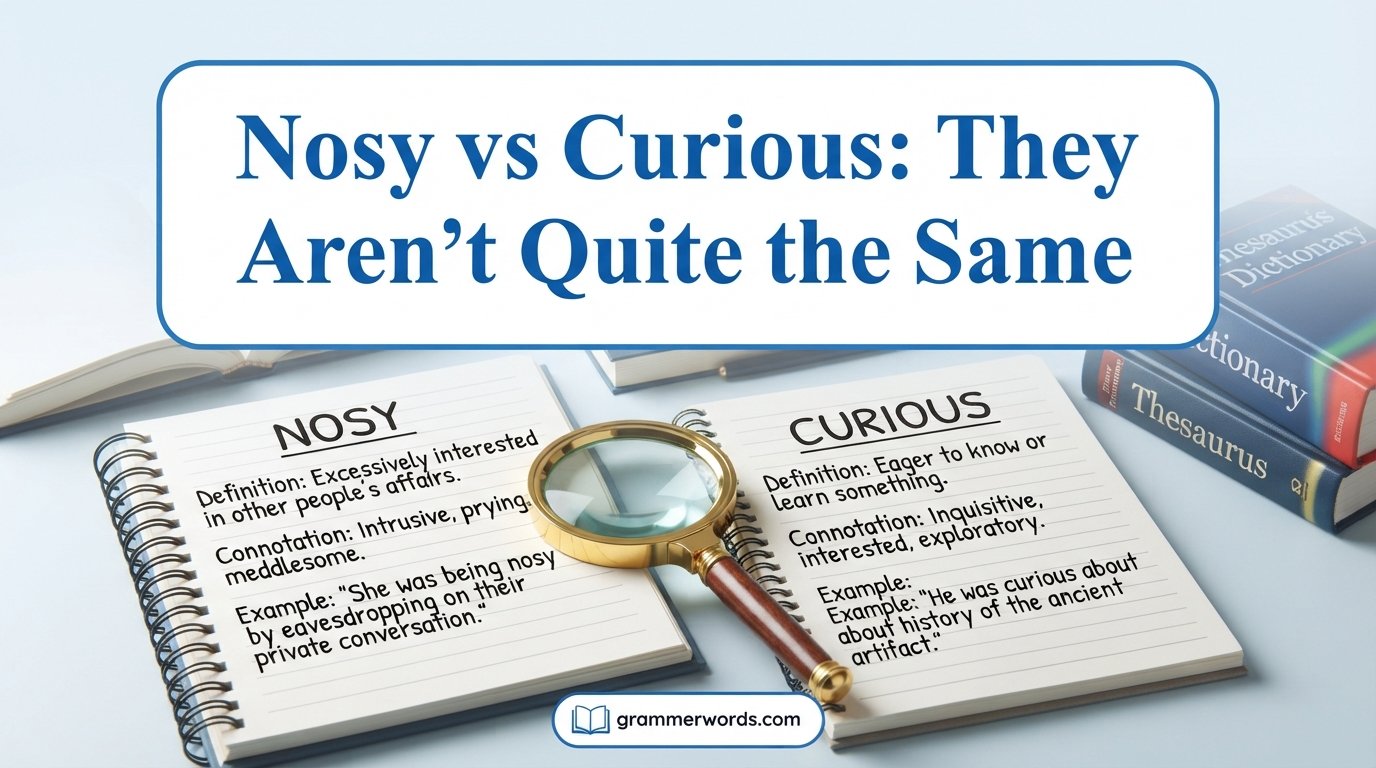
This distinction is more important than the spelling difference.
Curious can be neutral, positive, or negative. Nosy usually carries a negative judgment.
Consider these two sentences:
I’m curious about your new job.
I’m nosy about your new job.
The first sentence sounds like ordinary interest. The second suggests an inappropriate level of interest.
Cambridge’s thesaurus places curious, inquisitive, and nosy within the broader area of curiosity. Yet the examples and definitions show that nosy carries the idea of going too far.
Here’s a useful distinction:
| Word | Typical meaning | Tone |
| Curious | Interested in learning something | Neutral to positive |
| Inquisitive | Eager to ask questions or learn | Often positive or neutral |
| Nosy | Too interested in someone else’s affairs | Negative or teasing |
| Intrusive | Unwelcome involvement in private matters | More strongly negative |
| Prurient | Excessively interested in private or sexual matters | Strongly negative and formal |
For example, a journalist investigating a public issue might be inquisitive.
A friend asking how your vacation went might be curious.
A stranger demanding to know your salary may come across as nosy.
Nosy vs. Intrusive vs. Inquisitive
These words overlap, but they aren’t interchangeable in every situation.
Inquisitive often describes a person who asks questions because they genuinely want to understand something. A curious student may be inquisitive without being annoying.
Nosy implies that the curiosity concerns someone else’s private business. It also tends to sound casual.
Intrusive carries more weight. It suggests that someone has crossed a personal boundary.
Compare:
- She’s inquisitive about how the machine works.
- She’s nosy about everyone’s relationships.
- She’s intrusive when she demands private medical details.
The distinction comes down to subject, boundary, and tone.
Common Mistakes With Nosy and Nosey
Most mistakes involve assuming that one accepted spelling must be wrong.
Mistake 1: Calling Nosey Incorrect
Nosey is a recognized variant.
Major dictionaries support that point.
Mistake 2: Assuming the Spellings Have Different Meanings
They don’t.
Nosy and nosey describe the same general behavior.
Mistake 3: Treating the Word as a Synonym for Curious
The words overlap, but nosy usually implies excessive curiosity.
Someone can be curious without being nosy.
Mistake 4: Confusing Nosy With Noisy
These words are completely different.
Nosy relates to excessive curiosity.
Noisy relates to sound.
Cambridge defines noisy as something that makes a lot of noise.
Compare:
The nosy neighbor asked about my visitors.
The noisy neighbor played music all night.
One person asks too many questions. The other creates too much sound.
Mistake 5: Switching Spellings Randomly
If an article begins with nosy, continuing with nosey can look like an editing error.
Pick one spelling based on the audience and style. Then stick with it.
Nosy vs. Noisy: An Easy Spelling Trap
These two words deserve special attention because they look remarkably similar.
| Word | Meaning | Example |
| Nosy | Too interested in other people’s affairs | The nosy neighbor asked personal questions. |
| Nosey | Variant of nosy | Her nosey questions made me uncomfortable. |
| Noisy | Making or producing a lot of sound | The restaurant was extremely noisy. |
A useful memory trick is simple:
Nosy → nose → other people’s business.
Noisy → noise → sound.
That connection can prevent an embarrassing typo.
Grammar and Related Forms of Nosy
Nosy functions primarily as an adjective.
You can describe:
- a nosy neighbor
- a nosy coworker
- a nosy child
- a nosy question
- a nosy reporter
- a nosy relative
The word also has related forms.
Nosier
Nosier is the comparative form.
He’s getting nosier every time we talk.
Nosiest
Nosiest is the superlative form.
She’s the nosiest person in the office.
Dictionary.com lists nosier and nosiest as the comparative and superlative forms.
Nosiness
Nosiness is the noun form.
His nosiness eventually annoyed everyone.
Oxford defines nosiness as the state of being too interested in matters that don’t involve you, especially other people’s affairs.
Nosily
Nosily functions as an adverb.
She looked around nosily.
Oxford’s American dictionary lists both nosily and nosiness among the related forms of nosy.
When Should You Use Nosy Instead of Nosey?
The easiest choice depends on your audience.
Choose Nosy When:
- You’re writing for an American audience.
- You’re writing school or workplace content.
- You want the most straightforward US-English spelling.
- You’re writing an article for a broad American readership.
- Your publication uses American spelling conventions.
- You want consistency with major American dictionary entries.
Choose Nosey When:
- You’re preserving someone’s original wording.
- Your publication specifically prefers the variant.
- You’re writing in a context where that spelling is established.
- You’re deliberately following a particular house style.
Either Spelling Works When:
- You’re writing an informal message.
- Your audience understands both variants.
- The spelling isn’t central to the purpose of the text.
For most US-focused content, though, nosy removes unnecessary uncertainty.
Is Calling Someone Nosy Rude?
Sometimes.
The word itself isn’t a severe insult. Dictionary.com notes that nosy is often mildly negative and can be playful.
Still, context determines the impact.
Calling your sibling nosy after they ask who you’re texting may sound harmless.
Calling your manager nosy after a question about your personal life could sound confrontational.
The same word can therefore land very differently depending on:
- Your relationship with the person
- Your tone of voice
- The subject of the question
- The setting
- Whether the behavior keeps happening
- Whether the other person has crossed a clear privacy boundary
A useful rule is this: Use “nosy” when you want to label the behavior. Use a boundary-setting sentence when you want to stop the behavior.
Polite Alternatives to “Don’t Be Nosy”
Sometimes the best response isn’t another label.
If someone asks something too personal, you can say:
- I’d rather keep that private.
- I’d rather not get into that.
- That’s a little personal.
- I’ll share if I’m comfortable talking about it.
- I’d prefer to keep that between us.
- I appreciate your concern, but I’d rather not discuss it.
- That’s not something I’m comfortable sharing.
These responses work especially well in professional settings because they establish a boundary without escalating the conversation.
A Practical Case Study: One Question, Three Different Tones
Imagine a coworker asks about your salary.
Neutral curiosity
If you don’t mind me asking, what does your role typically pay?
The question may still feel personal. However, the wording gives you room to decline.
Nosy behavior
How much do you make? Come on, just tell me.
The repeated pressure makes the interaction feel more intrusive.
Boundary-setting response
I’d rather keep compensation details private.
This response avoids calling the coworker nosy while still closing the door.
The lesson is useful beyond this particular word. Language doesn’t just describe social behavior. It also shapes the temperature of a conversation.
Frequently Asked Questions
Is nosy or nosey the correct spelling?
Both nosy and nosey are correct spellings with the same meaning. However, nosy is the preferred default in US English, while nosey is an accepted variant.
Is nosey a spelling mistake?
No. Nosey is a recognized alternative spelling, not a spelling mistake. Major dictionaries such as Cambridge and Oxford recognize both forms.
What is the difference between nosy and nosey?
There is no real difference in meaning. Both describe someone who shows too much interest in other people’s private affairs or asks overly personal questions.
Which spelling should I use in professional writing?
For professional writing aimed at American readers, nosy is the safest choice. However, the word is informal, so a more neutral term may suit formal writing.
What is the difference between nosy and curious?
Curious can describe neutral or positive interest, while nosy usually suggests excessive curiosity about someone else’s private matters.
Final Takeaway
In short, nosy and nosey share the same meaning, and both are accepted spellings in English. For US English, nosy is the safest standard spelling, while nosey remains a recognized alternative spelling. Therefore, choose nosy for clear, consistent writing, but do not treat nosey as a spelling mistake. More importantly, remember that nosy describes excessive curiosity, while curious can simply show friendly interest.