If you ask thier or their, their is the correct spelling in standard English. This spelling question often causes confusion because both forms look similar in writing. However, thier is a misspelling, while their is a possessive adjective showing ownership or association. Understanding its meaning, difference, and usage can help prevent common spelling mistakes.
The confusion often comes from familiar i/e spelling patterns and similar pronunciation. So, learning the correct letter order makes this correct word easier to remember. This guide explains their with simple examples from daily English sentences, school work, emails, and conversations. It also covers there, they’re, and theirs to help you write clearly and improve your writing skills.
Quick Answer
Their is the correct spelling.
Thier is a common misspelling of their. It isn’t an accepted alternative spelling in standard American English or standard British English.
| Spelling | Correct? | Meaning |
| Their | Yes | Shows possession or association |
| Thier | No | Common misspelling of their |
For example:
Their dog is sleeping in the yard.
Here, their tells you that the dog belongs to or is associated with the people being discussed.
Another example:
The employees returned to their desks.
Again, their shows a relationship between the employees and the desks.
Why Is “Thier” Wrong?
The letters appear in the wrong order.
The standard spelling is:
t-h-e-i-r
The incorrect version is:
t-h-i-e-r
That small switch between e and i turns a correctly spelled English word into a spelling error.
Comparison Overview
The easiest way to understand thier or their is to compare the words people commonly confuse.
| Word | Function | Example |
| Their | Shows possession or association | They brought their books. |
| Thier | Misspelling | They brought thier books. |
| There | Refers to a place or introduces a statement | The books are over there. |
| They’re | Short for “they are” | They’re bringing the books. |
| Theirs | Possessive pronoun | The books are theirs. |
These words can sound similar in ordinary speech. Their grammatical jobs are completely different.
Consider this sentence:
They’re leaving their bags over there.
Each word has a distinct purpose.
- They’re = they are
- their = possession
- there = a place
That distinction matters because spelling errors involving these words can change the meaning of an entire sentence.
Main Differences Between Thier or Their
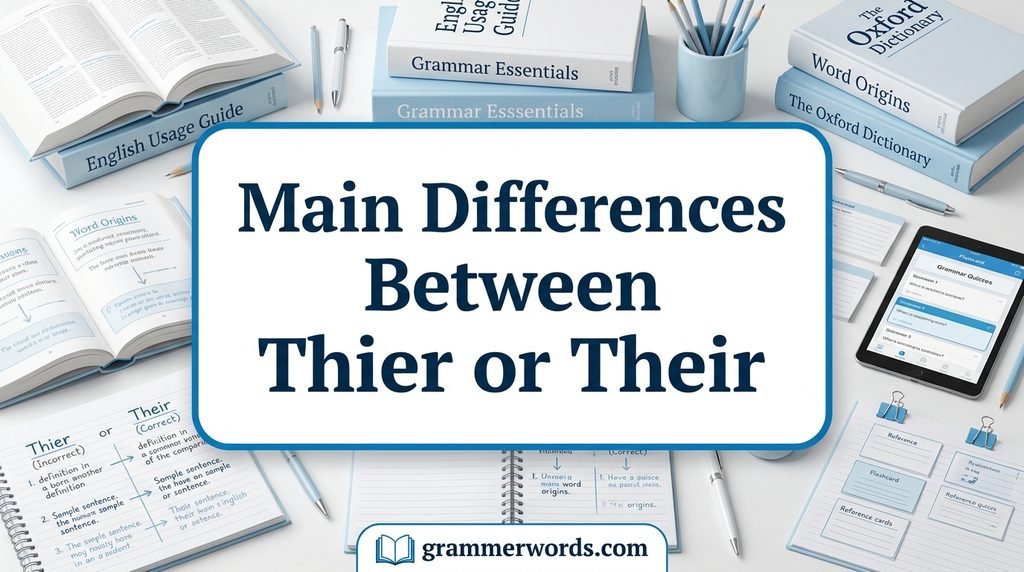
The central difference is simple: their is a standard English word, while thier is generally an incorrect spelling.
However, understanding why their works makes the distinction much easier to remember.
| Feature | Their | Thier |
| Standard English word | Yes | No |
| Correct spelling | Yes | No |
| Shows possession | Yes | No |
| Used in American English | Yes | Not as a standard spelling |
| Used in British English | Yes | Not as a standard spelling |
| Common online typo | Sometimes | Yes |
| Appears in dictionaries as the standard possessive word | Yes | No |
Their Shows Possession
The primary job of their is to identify ownership or association.
For example:
The children packed their lunches.
The lunches belong to or are associated with the children.
Another example:
The company changed their policy.
Here, their connects the policy with the company.
Possession doesn’t always mean literal ownership. The relationship can involve responsibility, association, membership, or connection.
The students completed their project.
The project belongs to the students in the sense that they created or are responsible for it.
Thier Doesn’t Have a Standard Meaning
When someone writes thier, readers normally understand that the writer intended their.
For example:
The students finished thier work.
The intended sentence is:
The students finished their work.
The error doesn’t create a new possessive word. It simply introduces a spelling mistake.
What Does “Their” Mean?
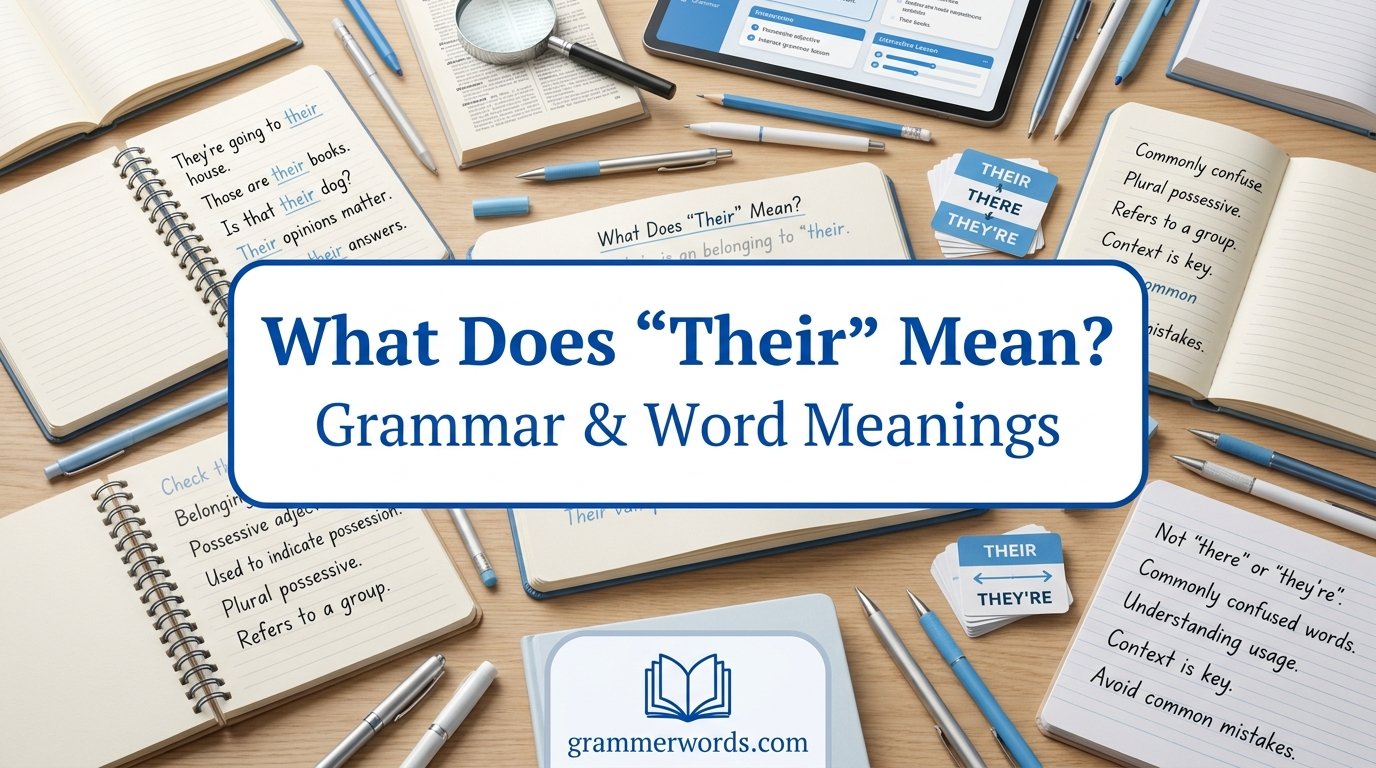
Their is a possessive determiner. Traditional grammar also calls it a possessive adjective, although possessive determiner is a more precise term in many modern grammatical descriptions.
It normally appears before a noun.
their house
their car
their opinion
their family
their decision
In each example, their establishes a relationship between people and something connected to them.
Their With Plural Subjects
The most familiar use of their occurs with plural subjects.
The players put on their uniforms.
The teachers collected their papers.
The neighbors parked their cars outside.
In each sentence, several people have a relationship with the noun that follows.
Their With Singular They
Modern English also uses their with singular they.
This happens when the person’s gender isn’t known, when gender isn’t relevant, or when a person uses they/them pronouns.
For example:
Someone left their umbrella at the door.
The word someone refers to one person. Yet their works naturally because the person’s identity or gender isn’t specified.
Another example:
If a customer has a question, they can speak with their manager.
This construction has become a normal part of contemporary English usage.
Their Does Not Always Mean Ownership
One subtle point deserves attention: their can describe association rather than strict ownership.
Consider:
The students met with their teacher.
The students don’t own the teacher. Instead, the teacher has an established relationship with them.
Likewise:
The team celebrated their victory.
The victory belongs to the team in an abstract sense.
So when you see their, think broadly about possession, connection, or association.
Why Do People Spell “Their” as “Thier”?
The error usually comes from reversing the e and i.
That seems minor. Yet English spelling contains enough conflicting patterns to make this particular mistake surprisingly persistent.
Words such as their, weird, foreign, and height don’t all behave according to the simplified spelling rule many people learn as children.
The familiar phrase “i before e except after c” doesn’t reliably predict every English spelling. In fact, their itself is a useful reminder that English spelling has many historical exceptions and irregular patterns.
The Letter Order Is the Key
Compare the two forms carefully:
- their → ei
- thier → ie
The correct word contains ei.
A quick proofreading trick is to mentally isolate those two letters:
th + ei + r
That gives you their.
Fast Typing Can Make the Error Worse
Typing quickly can also cause letter transpositions. Your brain knows what word you intend, so it may process the familiar word as a whole rather than checking every character.
That’s why thier can appear even when someone knows perfectly well that their is correct.
Spell-checking helps catch the error. Still, knowing the correct spelling remains useful because not every writing environment flags every mistake.
How to Remember the Spelling of “Their”
A good memory trick should be simple enough to use when you’re writing quickly.
Remember the “EI”
Focus on the middle:
th-EI-r
The key sequence is EI.
You can also connect their with heir. Both words contain the same ei sequence.
- their
- heir
That doesn’t mean the words have related meanings. It’s simply a spelling association.
Don’t Trust “I Before E” Blindly
The old spelling rhyme can create more confusion than clarity when applied mechanically.
English has many exceptions and irregular spellings. Their is one of the words that doesn’t fit the simplified version of that rule.
Instead of trying to force every word into a spelling formula, memorize the specific spelling of frequently used words.
That’s especially useful with high-frequency words such as:
- their
- there
- they’re
- where
- weird
- either
- neither
Use the “They Own It” Test
When you aren’t sure whether you need their, ask:
Does the word show that something belongs to or is associated with them?
If yes, their may be the correct choice.
They forgot their keys.
The keys belong to them.
The students submitted their assignments.
The assignments are associated with the students.
This test helps with word choice as well as spelling.
Their vs. There vs. They’re
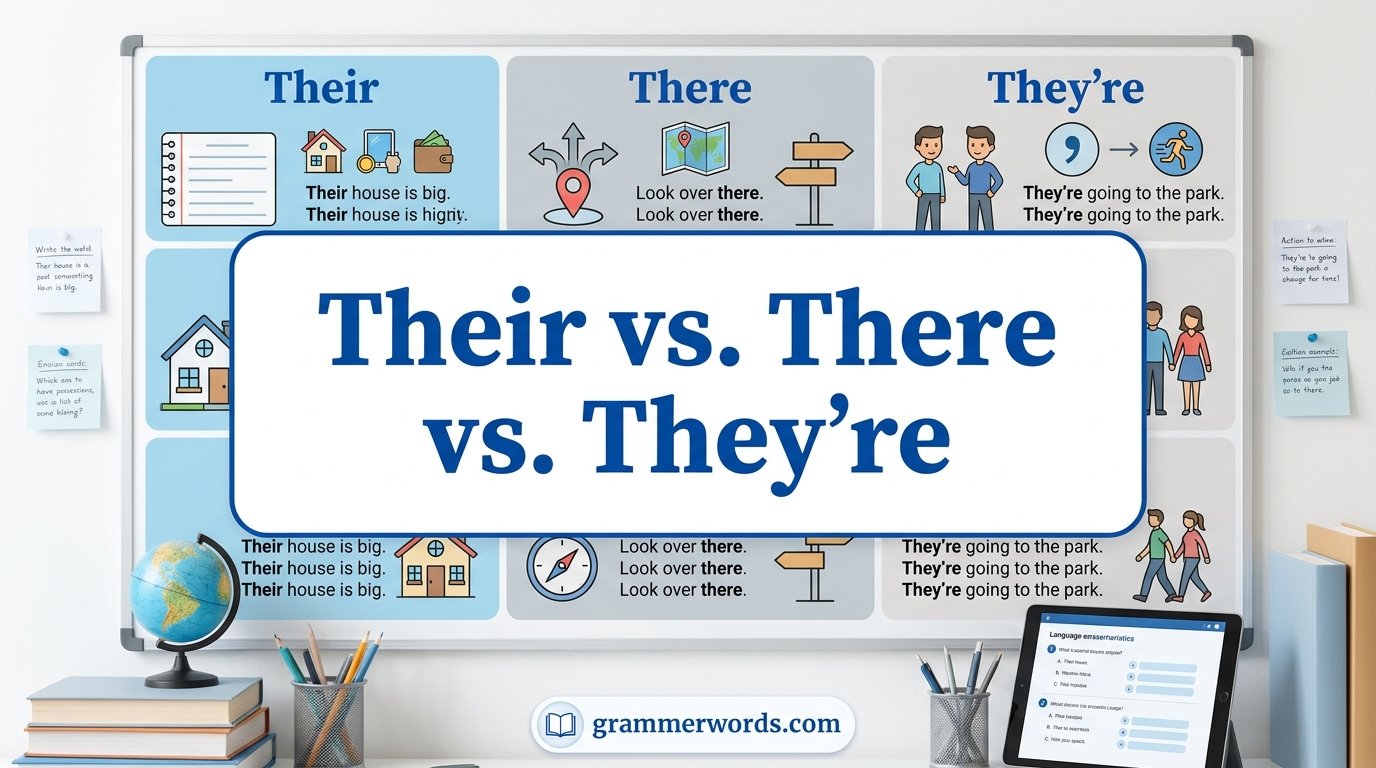
Few English words cause as much everyday confusion as these three.
The easiest approach is to test what each word means.
Their = Possession
Use their when you mean something belongs to or is connected with people.
The children found their toys.
There = Place or Introduction
Use there when referring to a location.
The children are over there.
There can also introduce a sentence.
There are several books on the table.
Here, there doesn’t identify a physical location. It helps introduce the existence of something.
They’re = They Are
Use they’re when you can replace it with they are.
They’re ready.
Expand it:
They are ready.
The sentence still works.
Try the same test:
They’re going home.
becomes:
They are going home.
That confirms the contraction.
A Simple Three-Word Test
When you’re unsure, ask three questions:
- Does it show possession? → their
- Does it refer to a place or introduce something? → there
- Can you replace it with “they are”? → they’re
This method works remarkably well in everyday writing.
Their vs. Theirs
Another related confusion involves their and theirs.
Both words express possession. They don’t occupy the same grammatical position.
Their Comes Before a Noun
That is their car.
We visited their house.
I read their article.
The noun follows their.
Theirs Can Stand Alone
That car is theirs.
The house is theirs.
The article is theirs.
You wouldn’t normally say:
That is theirs car.
You would say:
That is their car.
A useful pattern is:
their + noun
versus:
theirs without the noun immediately following it.
See Also: Affend or Offend: Which Spelling Is Correct? Meaning, Examples, and Common Mistakes
Common Mistakes With “Thier” or “Their”
Understanding the most frequent errors makes proofreading much faster.
Mistake: Writing “Thier”
They parked thier car outside.
Correct:
They parked their car outside.
This is a spelling error.
Mistake: Using “There” for Possession
They parked there car outside.
Correct:
They parked their car outside.
The word there doesn’t indicate ownership or association.
Mistake: Using “They’re” for Possession
They parked they’re car outside.
Correct:
They parked their car outside.
They’re means they are, so the incorrect sentence effectively says:
They are car outside.
The substitution test exposes the problem immediately.
Mistake: Confusing Their and Theirs
That is theirs car.
Correct:
That is their car.
Or:
That car is theirs.
The noun determines which form fits.
Their in Everyday Examples
The word their appears constantly in ordinary English. Seeing it in different settings helps make the spelling automatic.
Everyday Conversation
“They left their phone on the table.”
“The kids are putting away their toys.”
“My friends brought their own food.”
School
“The students handed in their assignments.”
“Each child chose their own topic.”
“The teachers discussed their plans.”
Workplace
“The employees received their schedules.”
“The managers reviewed their team’s results.”
“Each applicant submitted their résumé.”
Online Communication
“Someone forgot their password.”
“The users can update their profiles.”
“Everyone should check their messages.”
These examples show why their is such an important word to spell correctly. It appears in almost every kind of everyday writing.
Is “Thier” Ever Correct?
For ordinary English usage, no. If the intended word means possession or association, use their.
You might encounter the sequence thier in an unusual context such as a username, invented name, brand, fictional term, or deliberately altered spelling. That doesn’t make it a standard spelling of the possessive word their.
Context matters here.
For ordinary prose, formal writing, schoolwork, business communication, and published content, use:
their
not:
thier
British English vs. American English: Is There a Difference?
There is no British-versus-American spelling difference between their and thier.
Both standard American English and standard British English use:
their
The incorrect form remains:
thier
This distinction matters because English does have genuine spelling differences between the two major varieties.
For example:
| American English | British English |
| color | colour |
| center | centre |
| organize | organise |
| traveled | travelled |
Those differences are legitimate spelling variations.
Thier isn’t one of them.
So if someone tells you that thier is British English, that claim is incorrect.
Grammar and Usage Rules for “Their”
The word their looks simple. Its grammatical behavior becomes more interesting when you examine how English uses it.
Their Usually Modifies a Noun
In standard usage, their typically appears before a noun or noun phrase.
their car
their new car
the new electric car
The noun can be modified by adjectives and other words without changing the role of their.
Their Can Refer to Different Numbers of People
Traditionally, their was strongly associated with plural antecedents.
The boys brought their books.
Modern English also commonly uses their with singular they.
Someone forgot their coat.
This isn’t simply a spelling convenience. It reflects the broader development and established use of singular they in contemporary English.
Their Can Refer to an Unspecified Person
Consider:
If anyone calls, tell them to leave their name.
The identity of the person remains unknown.
Using their avoids assigning a gender that the sentence doesn’t provide.
That makes the construction useful in everyday instructions, customer service language, workplace writing, and general communication.
A Practical Case Study: Fixing a Realistic Paragraph
Consider this short paragraph:
“The students forgot thier books because they’re teacher changed there classroom. The teacher told them to collect there things before they left.”
Several errors appear close together.
A corrected version reads:
“The students forgot their books because their teacher changed their classroom. The teacher told them to collect their things before they left.”
Now examine each correction:
| Incorrect | Correct | Reason |
| thier | their | Spelling error |
| they’re | their | Possessive relationship |
| there | their | Possessive relationship |
| there | their | Possessive relationship |
This example shows why proofreading isn’t only about catching thier. The larger challenge involves distinguishing several words that sound similar.
How to Proofread “Thier or Their” Errors
When editing an essay, email, article, or assignment, search specifically for thier.
That’s an efficient first pass because thier almost always indicates a spelling mistake when it appears in ordinary English prose.
Then check every instance of:
- their
- there
- they’re
- theirs
Don’t stop after correcting one spelling error. A document can contain the correctly spelled their while still using there or they’re incorrectly.
Use the Replacement Test
For they’re, replace it with they are.
For their , ask whether it expresses possession or association.
and For there, ask whether it refers to a location or introduces an existence statement.
and For theirs, check whether it stands independently without a following noun.
This method turns proofreading into a quick grammatical check rather than a guessing game.
“Thier” or “Their” in Formal Writing
In professional or academic writing, spelling errors can distract readers from the actual message.
A single thier typo rarely destroys an otherwise strong document. Repeated errors can make the writing appear less carefully edited.
This matters particularly in:
- Resumes
- Cover letters
- Academic assignments
- Business proposals
- Reports
- Emails
- Website copy
- Applications
- Professional profiles
The solution isn’t complicated. Search for thier before submitting the document.
Then review their, there, they’re, and theirs according to meaning.
Quick Practice: Choose the Correct Word
Test yourself with these examples.
Example One
The players packed ___ equipment.
Correct answer: their
The equipment belongs to or is associated with the players.
Example Two
___ going to visit the museum tomorrow.
Correct answer: They’re
Replace it with they are:
They are going to visit the museum tomorrow.
Example Three
Put the boxes over ___.
Correct answer: there
The sentence refers to a location.
Example Four
The blue bags are ___.
Correct answer: theirs
The possessive word stands independently.
Example Five
Someone forgot ___ jacket.
Correct answer: their
Here, their refers to an unspecified individual.
Frequently Asked Questions
Is “thier” a correct spelling of “their”?
No. Thier is a misspelling of their, which is the correct spelling in standard English.
What does “their” mean?
Their is a possessive adjective that shows ownership or association. For example, “They brought their books” shows that the books belong to or are connected with them.
Why do people spell “their” as “thier”?
People often reverse the letters “e” and “i” when writing quickly. This common spelling mistake can happen because of confusing i/e spelling patterns in the English language.
What is the difference between “their,” “there,” and “they’re”?
Their shows possession, there refers to a place or introduces something, and they’re means “they are.” These commonly confused words have different meanings and uses.
Can “their” refer to one person?
Yes. Modern English commonly uses their with singular they, especially when a person’s identity or gender is unknown or not relevant. For example, “Someone left their phone here.”
Final Takeaway
When choosing thier or their, remember that their is the correct spelling for showing possession or association. Keep the ei letter order in mind, and use there, they’re, and theirs according to their meanings. With this simple check, you can avoid common spelling mistakes, improve your writing skills, and write with greater confidence.