If you wonder about suing or sueing, the correct spelling is suing. This spelling difference follows common English spelling rules for verbs ending with a final letter e. When adding -ing to sue, English normally removes the final e before adding the suffix. Therefore, suing is the standard English spelling used in formal writing and everyday communication.
This simple e dropping rule also explains the present participle of sue and its gerund form. So, sueing is a common misspelling, while suing is the accepted standard English form. You will see suing in legal writing, business documents, school assignments, and everyday messages. Understanding this spelling rule can help you avoid similar grammar errors and write more accurately.
Quick Answer
Suing is the correct spelling.
Sueing is not the standard spelling of the -ing form of sue.
The basic transformation is:
| Base verb | Correct -ing form | Incorrect form |
| sue | suing | sueing |
| argue | arguing | argueing |
| move | moving | moveing |
| take | taking | takeing |
| write | writing | writeing |
The final e in sue disappears before -ing is added.
So:
sue + ing = suing
Not:
sue + ing = sueing
The same spelling principle appears in many English verbs that end in a silent e.
Comparison Overview
The easiest way to understand the difference is to put the two forms side by side.
| Feature | Suing | Sueing |
| Standard English spelling | Yes | No |
| Base verb | sue | sue |
| Suffix | -ing | -ing |
| Correct present participle | Yes | No |
| Correct gerund | Yes | No |
| Used in standard US English | Yes | No |
| Used in standard British English | Yes | No |
| Example | They are suing the company. | They are sueing the company. |
| Reason for form | Final e is removed | Incorrectly retains e |
There isn’t a standard American-versus-British spelling difference here. Both major varieties of English use suing.
That point is worth remembering because spelling differences between US and UK English can sometimes create confusion. Words such as color/colour and organize/organise genuinely differ across varieties. Suing/sueing doesn’t.
Main Differences Between Suing and Sueing
The biggest difference is simple: suing is correct while sueing is not the standard spelling.
Still, understanding why the difference exists makes the rule easier to remember.
Suing Follows the Standard -ing Spelling Pattern
English commonly drops a final silent e before adding -ing.
Consider these examples:
- make → making
- write → writing
- take → taking
- move → moving
- use → using
- argue → arguing
- sue → suing
The change doesn’t alter the basic meaning of the verb. It simply reflects a conventional spelling pattern.
The word sue follows this pattern even though its ending can look unusual. The spelling ue doesn’t give sue a special exemption from the rule.
Sueing Keeps an E That Should Disappear
The form sueing results from treating the spelling mechanically:
sue + ing
That approach looks logical at first glance. English spelling, however, doesn’t always work by simply attaching a suffix to the unchanged base word.
The standard form removes the final e:
sue → suing
This is why sueing can look plausible while still being incorrect.
The Difference Isn’t About Meaning
Another important point: suing and sueing don’t represent two different meanings.
A writer who types sueing usually intends the same meaning as suing. The problem lies in the spelling rather than the underlying word.
For example:
Correct:
The customer is suing the retailer.
Incorrect:
The customer is sueing the retailer.
The intended meaning remains clear in the second sentence. Standard edited English still requires suing.
Why Does the E Disappear in Suing?
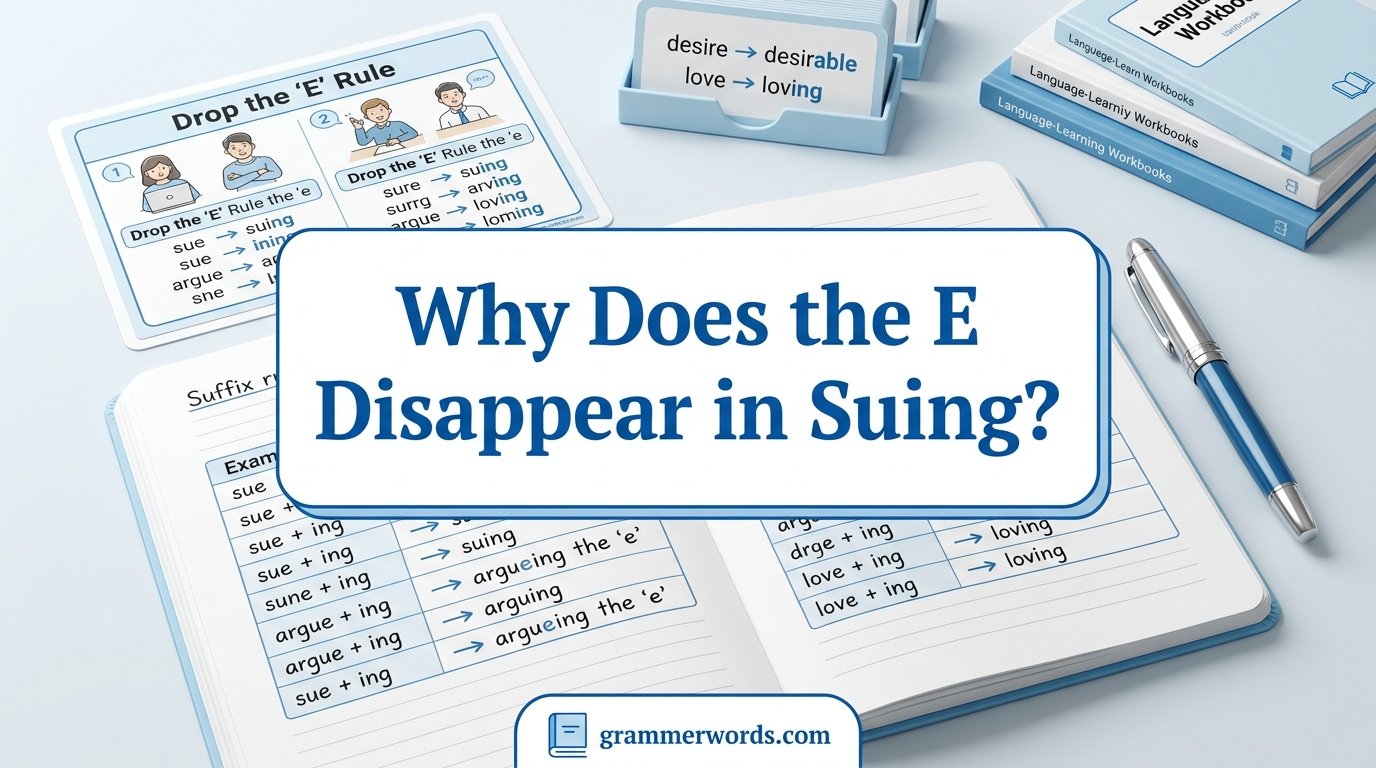
The answer comes down to the spelling behavior of verbs ending in a silent e.
When many such verbs take -ing, English drops the final e.
For example:
- hope → hoping
- drive → driving
- save → saving
- close → closing
- dance → dancing
- use → using
The same principle gives us:
sue → suing
The spelling may seem unusual because sue ends in ue rather than a more familiar pattern such as make or drive. Nevertheless, the final e still disappears before -ing.
A Simple Memory Trick
Think of the final e as a letter that steps aside when -ing arrives.
sue
becomes
su + ing
which produces:
suing
That mental picture isn’t a formal grammar rule. It simply makes the spelling easier to remember.
Why Isn’t It “Suing” With Two Vowel Sounds?
The spelling suing can initially look strange because readers may wonder whether the letters create one syllable or two.
In standard English, suing is normally pronounced as two syllables. The spelling therefore represents a sequence that differs from what a quick visual scan might suggest.
This is one reason people sometimes write sueing. They try to preserve the appearance of the base word rather than applying the normal spelling convention.
Is Sueing Ever Correct?
For the verb sue, sueing isn’t the standard spelling of its -ing form.
If you’re writing formal English, academic work, professional correspondence, journalism, or edited online content, use suing.
Why Do People Write Sueing?
Several factors can cause the error.
First, sue has an unusual visual shape. Writers may naturally assume that adding -ing means keeping every letter of the original word.
Second, English contains plenty of words where adding a suffix doesn’t produce an obvious spelling change. That can make the rule feel inconsistent.
Third, people often write quickly. A spelling such as sueing can look reasonable enough to survive a casual proofreading pass.
Search engines and spell-checkers may also expose readers to misspelled forms. Seeing a word repeatedly doesn’t make it standard.
Does British English Use Sueing?
No standard British spelling changes suing into sueing.
British English uses:
suing
American English also uses:
suing
So this isn’t one of those cases where both spellings are acceptable because different English-speaking countries follow different conventions.
What Does Suing Mean?
Suing is the present participle of the verb sue.
In ordinary legal usage, to sue means to bring a legal claim against another party in court.
For example:
The homeowner is suing the contractor.
This sentence means the homeowner has brought or is pursuing a civil legal action against the contractor.
The exact legal procedure depends on the jurisdiction and the type of claim. The word itself doesn’t tell you whether the plaintiff will win.
That’s an important distinction.
Saying that someone is suing another person describes a legal action. It doesn’t establish that the underlying allegations are true or that the claimant will succeed.
Suing Isn’t the Same as Threatening to Sue
These phrases can describe very different situations.
Threatening to sue means someone has warned that they may start legal proceedings.
Suing means the person is actually pursuing a legal claim.
For example:
The customer threatened to sue the company.
This tells you about a warning or proposed action.
Compare it with:
The customer is suing the company.
That sentence describes an actual lawsuit or legal proceeding.
The distinction matters in professional communication and reporting because a threat of litigation isn’t necessarily the same thing as litigation itself.
How to Use Suing in a Sentence
The word suing can appear in several grammatical structures.
Simple Present Progressive
The company is suing its former supplier.
Here, suing forms part of the present progressive construction is suing.
Present Progressive With a Plural Subject
Several homeowners are suing the developer.
The auxiliary verb changes from is to are because the subject is plural.
As a Gerund
Suing a former business partner can become expensive.
Here, suing functions as a noun-like form. It serves as the subject of the sentence.
After a Preposition
They talked about suing the manufacturer.
The -ing form follows the preposition about.
In Formal Writing
The claimant is considering suing the contractor over the alleged breach of contract.
This sentence uses suing naturally in a more formal setting.
Suing in Everyday Examples
Understanding the word becomes much easier when you see it in realistic sentences.
Example 1: Business
The supplier is suing the company over an unpaid invoice.
The sentence says that the supplier has brought legal action concerning the alleged unpaid amount.
Example 2: Employment
The former employee is considering suing the employer.
Here, considering suing indicates a possible future legal action. The sentence doesn’t say that a lawsuit has already been filed.
Example 3: Property
The homeowners are suing the developer over alleged construction defects.
The phrase are suing indicates an ongoing legal action. The word alleged is important because it avoids presenting an accusation as an established fact.
Example 4: News Writing
The family is suing the company after the incident.
News reports often use suing when describing civil litigation. Professional reporting generally distinguishes allegations from proven facts.
Example 5: Conversation
If they keep refusing to fix it, she’s talking about suing.
This is more informal. It describes someone discussing the possibility of legal action.
See Also: Etc or Ect: Which Spelling Is Correct? Meaning, Usage, and Examples
Common Mistakes With Suing
The spelling sueing isn’t the only mistake people can make with this word.
Mistake 1: Writing Sueing
Incorrect:
The customer is sueing the store.
Correct:
The customer is suing the store.
This is the central spelling mistake.
Mistake 2: Confusing Suing and Sued
These forms refer to different grammatical situations.
They are suing the company.
They sued the company last year.
The first uses the -ing form. The second uses the past tense.
Mistake 3: Using Sue After “Is”
The construction is sue doesn’t work when you intend the present progressive.
Incorrect:
She is sue the company.
Correct:
She is suing the company.
The auxiliary is requires the present participle in this construction.
Mistake 4: Assuming Suing Means Winning
The word suing doesn’t imply success.
Someone can sue another party and later lose the case. The parties can also settle before trial.
Therefore:
The company is suing its competitor.
doesn’t mean:
The company has proved its case.
Those are completely different claims.
Mistake 5: Treating a Legal Threat as a Lawsuit
Consider these two sentences:
The customer threatened to sue.
The customer is suing.
The first describes a potential legal action. The second describes litigation.
Using the wrong expression can change the factual meaning of a sentence.
Suing, Sue, Sued, and Lawsuit: What’s the Difference?

These related words often appear together. Their grammatical roles aren’t interchangeable.
| Word | Function | Meaning | Example |
| sue | Base verb | Bring a legal claim | They may sue the company. |
| suing | Present participle / gerund | The -ing form of sue | They are suing the company. |
| sued | Past tense / past participle | Took legal action in the past | They sued the company last year. |
| lawsuit | Noun | A legal action brought in court | They filed a lawsuit. |
The distinction becomes especially useful when you’re editing legal or business writing.
For example:
The employee may sue.
This describes a possible action.
The employee is suing.
This describes ongoing action.
The employee sued.
This places the action in the past.
The employee filed a lawsuit.
This uses a noun to describe the legal proceeding.
Is Suing a Gerund or a Present Participle?
It can be either, depending on how the sentence uses it.
This distinction often confuses learners because the form looks identical.
A present participle commonly works with an auxiliary verb to form a progressive construction:
The company is suing the supplier.
Here, suing forms part of the verb phrase is suing.
A gerund functions more like a noun:
Suing can be expensive.
Here, suing acts as the subject of the sentence.
Another example:
They discussed suing the contractor.
In this sentence, suing follows the verb discussed and functions in a noun-like role.
The spelling stays exactly the same. Its grammatical function changes according to the sentence.
Suing vs. Threatening to Sue
This distinction deserves extra attention because ordinary conversation often blurs it.
| Expression | What it communicates |
| thinking about suing | Considering legal action |
| planning to sue | Intending to pursue legal action |
| threatening to sue | Warning that legal action may follow |
| suing | Pursuing a legal claim |
| sued | Having brought a legal claim in the past |
| settling a lawsuit | Resolving litigation without continuing to trial or judgment |
Imagine a customer has a dispute with a business.
The customer might first say:
I’m thinking about suing.
Later, the customer might say:
I’m going to sue.
After legal proceedings begin, the appropriate description may become:
I’m suing the company.
These expressions represent different stages or descriptions of the situation. Choosing the right one keeps the sentence precise.
Pronunciation of Suing
Suing is commonly pronounced as two syllables.
The pronunciation can seem surprising because the spelling contains several consecutive vowels. English spelling doesn’t always map neatly onto individual sounds.
The important point for learners is that suing isn’t pronounced by simply reading each written letter independently.
It also shouldn’t be treated as though the spelling were sue-ing with an extra written e.
The word’s pronunciation follows the established pronunciation of sue combined with the -ing ending.
Is Suing Different in American and British English?
No. The standard spelling is suing in both American and British English.
That makes this word different from genuine regional spelling pairs.
| Meaning or form | American English | British English |
| Present participle of sue | suing | suing |
| Past tense | sued | sued |
| Base verb | sue | sue |
| Legal noun | lawsuit | lawsuit |
There can be differences in legal terminology between jurisdictions. Those differences don’t change the spelling of suing.
For example, legal systems may use different procedural terminology. That is a separate issue from English spelling.
The Spelling Rule Behind Suing
The broader spelling lesson is useful beyond this one word.
Many verbs ending in a silent e drop that letter before -ing.
Common Examples
| Base verb | + -ing | Result |
| make | making | making |
| write | writing | writing |
| drive | driving | driving |
| hope | hoping | hoping |
| use | using | using |
| move | moving | moving |
| argue | arguing | arguing |
| sue | suing | suing |
However, English spelling contains exceptions and special patterns. The safest approach is to learn common word families rather than assume that one rule explains every verb.
For sue, though, the standard form is firmly established:
sue → suing
A Useful Case Study: Why Sueing Looks Right at First
Consider a learner who knows that the base verb is sue.
They want to write:
The company is ___ the contractor.
Their first instinct might be:
The company is sueing the contractor.
Why does that feel plausible?
The writer may simply attach -ing to the visible word. This works with some forms in English but fails with many verbs ending in silent e.
Now apply the standard spelling pattern:
sue → remove final e → su → add -ing → suing
The sentence becomes:
The company is suing the contractor.
That tiny spelling change produces the standard form.
This example illustrates a broader lesson: English suffixation often changes the spelling of the base word rather than simply adding letters to it.
Quick Decision Guide: Suing or Sueing?
When you’re unsure, use this checklist.
- Need the -ing form of sue? Use suing.
- Need the base verb? Use sue.
- Need the past tense? Use sued.
- Need the noun for the legal action? Use lawsuit.
- Writing for a US audience? Use suing.
- Writing for a British audience? Use suing.
- See sueing in your draft? Correct it to suing.
A useful memory formula is:
sue → suing → sued
Once that sequence becomes familiar, the spelling becomes much harder to forget.
Frequently Asked Questions
Is suing or sueing the correct spelling?
Suing is the correct spelling and the standard English spelling of the -ing form of sue. Sueing is a common misspelling and is not the standard written form.
Why is suing spelled without the e?
The final e in sue drops before adding the -ing ending. Therefore, the correct spelling pattern is sue → suing, following common English spelling rules for verbs ending in silent e.
Is suing a present participle or a gerund?
Suing can be both a present participle and a gerund, depending on how it works in a sentence. In “They are suing the company,” it is a present participle, while “Suing can be expensive” uses it as a gerund.
Do American and British English spell suing differently?
No. American English and British English both use suing as the standard spelling. Therefore, suing vs sueing is not a regional spelling difference.
What is the difference between suing, sue, and sued?
Sue is the base verb, suing is its present participle, and sued is the past tense. In legal writing, these forms describe different stages or uses of legal action.
Final Takeaway
The correct spelling is suing, while sueing is a common spelling mistake. The final e drops before the -ing ending, giving the standard form sue → suing in both American English and British English. So, whether you are writing in legal contexts, formal communication, or everyday English, use suing for clear and accurate writing.