If you wonder puting or putting, the correct spelling is putting. The word putting follows a simple English spelling rule for this common verb. When you add -ing to put, the final t doubles, creating putting with two t’s. Therefore, puting is an incorrect spelling and represents a common spelling mistake.
This small spelling distinction often causes spelling confusion, especially when people type quickly. However, learning the double consonant rule makes the correct form easy to remember. Understanding this verb spelling rule can improve writing clarity, spelling accuracy, and confidence in everyday and professional writing.
Puting or Putting Quick Answer
Putting is correct. Puting is incorrect in standard English.
The word putting comes from the verb put with the -ing ending.
| Spelling | Correct? | Example |
| putting | Yes | She is putting the dishes away. |
| puting | No | She is puting the dishes away. |
The important point is simple: don’t remove one of the t’s.
Oxford’s dictionary gives the verb forms as put, puts, put, put, putting. Its entry specifically identifies putting as the -ing form.
Cambridge reaches the same conclusion. It defines putting as the present participle of put.
So if you’re writing a sentence such as:
“I’m putting the keys on the table.”
the spelling you want is putting.
Not puting.
Why Does “Puting” Look Plausible?
English spelling can be deceptive. When you see put, it may feel natural to add -ing directly:
put + ing = puting
That visual calculation looks logical at first glance. Standard spelling doesn’t work that way here.
The accepted form is:
put + ting = putting
The extra t is part of the established spelling pattern.
This is one reason English learners often find consonant doubling frustrating. The written form doesn’t always behave like a simple mathematical equation. Instead, English uses spelling conventions that reflect pronunciation patterns and historical development.
Comparison Overview
The distinction between puting and putting is much easier once you compare the two forms directly.
| Feature | Puting | Putting |
| Standard English | No | Yes |
| American English | No | Yes |
| British English | No | Yes |
| Present participle of put | No | Yes |
| Gerund form of put | No | Yes |
| Suitable for formal writing | No | Yes |
| Common reason it appears | Misspelling | Standard spelling |
| Dictionary-recognized form | No | Yes |
The distinction doesn’t involve geography. It involves standard spelling.
That matters because English contains plenty of genuine American-British spelling differences. For example, American English generally uses color while British English uses colour. American English uses center while British English uses centre.
Putting isn’t one of those differences.
Whether your audience lives in New York or London, the standard spelling remains putting.
Read More: Time Flies or Time Flys? The Correct Spelling, Meaning, Grammar, and Examples
Main Differences Between Puting and Putting
Putting Is the Standard Form
The biggest difference is straightforward: putting is the established English form.
Dictionaries don’t treat the two spellings as competing variants. Cambridge identifies putting as the present participle of put. Oxford lists putting under the verb’s forms.
That gives you a reliable rule for everyday writing:
Use putting whenever you need the -ing form of put.
For example:
- I am putting my phone away.
- She is putting the groceries in the refrigerator.
- They were putting together a new presentation.
- He keeps putting off the decision.
- We are putting more effort into the project.
Puting Is Normally a Spelling Error
Puting doesn’t represent another standard form of the verb.
You may encounter it online. Someone might type it in a message. A poorly edited page might contain it. That doesn’t turn it into an accepted spelling.
Search engines can index misspellings. User-generated websites can contain typos. Social media posts can contain rushed writing. None of those situations changes the standard form.
Think of it like a missing puzzle piece. The sentence may still be recognizable. The completed spelling still needs both t letters.
The Difference Is Only One Letter
Ironically, this tiny difference creates the entire problem.
- puting = one t
- putting = two t’s
That makes proofreading especially easy. If you see puting in your document, check whether you intended the -ing form of put. If you did, change it to putting.
Why Is Putting Spelled With Two Ts?
The spelling becomes easier to understand when you examine the base verb.
The base form is:
put
The -ing form is:
putting
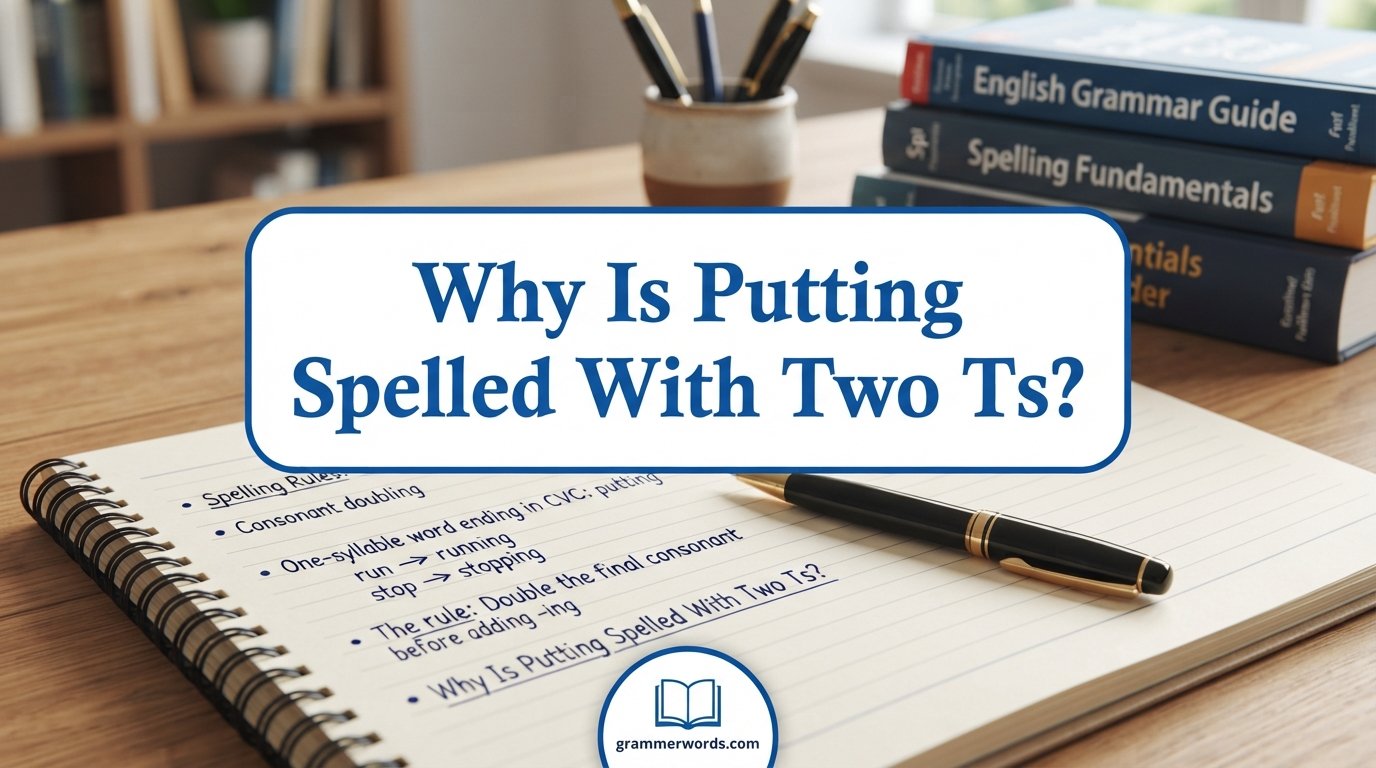
English spelling uses consonant doubling in several short verbs when the -ing ending is added. Familiar examples include:
- sit → sitting
- run → running
- hit → hitting
- cut → cutting
- shut → shutting
- get → getting
The pattern isn’t simply “double every final consonant.” English has several spelling rules and exceptions. The exact rule depends on factors such as syllable structure and vowel patterns.
For put, the important practical fact is that the standard -ing form is putting.
You don’t need to reinvent the spelling each time. Learn the established form and recognize it as a single word.
A Useful Memory Trick
Try connecting putting with cutting and hitting.
All three have the familiar doubled-consonant shape:
- cutting
- hitting
- putting
Once that pattern becomes visually familiar, puting starts to look noticeably incomplete.
That’s useful when proofreading quickly.
Is “Puting” a British English Spelling?
No.
British English does not use puting as a standard spelling of the -ing form of put.
British English uses:
putting
American English uses:
putting
Oxford’s American English dictionary also lists putting as the -ing form.
This distinction is worth remembering because English genuinely does have many regional spelling differences. The existence of those differences can create false assumptions.
Consider these examples:
| American English | British English |
| color | colour |
| center | centre |
| organize | organize |
| traveling | traveling |
| putting | putting |
Some words vary. Putting does not.
Where Does “Puting” Come From?

Most examples of puting arise from a straightforward spelling mistake.
Someone knows the verb put. They know the -ing ending. They combine the two without recognizing that the standard spelling doubles the t.
That produces:
put + ing → puting
The correct written form is:
putting
Several situations can make this mistake more likely.
Fast Typing
When people type quickly, repeated letters are easy to miss. This happens especially in informal messages.
Learning English
English learners often apply a familiar pattern too broadly. If they learn that many verbs simply take -ing, they may initially assume that put behaves the same way.
Visual Confusion
The word putting contains repeated letters. Repeated letters can disappear during proofreading because the eye tends to process familiar word shapes as a whole.
Autocorrect and Spell-Checking
Digital tools can catch many spelling errors. They aren’t a substitute for knowing the correct form. A typo may slip through depending on the software, dictionary, language settings, or context.
The important distinction is that these factors explain why people make the mistake. They don’t make puting an accepted spelling.
Putting in Everyday Sentences
The word putting appears constantly in ordinary English because put itself has a remarkably broad range of meanings.
Oxford lists meanings involving placing something somewhere, attaching something, expressing an idea, creating a condition, assigning value, and several other uses.
That makes putting useful in dozens of everyday contexts.
Placing Something Somewhere
She is putting the books on the shelf.
Here, putting means moving something into a particular place or position.
Moving Something Into Storage
I’m putting the dishes away.
The phrase putting away means placing something where it belongs or storing it.
Adding Something
He is putting sugar in his coffee.
The action involves adding one thing to another.
Making an Effort
We’re putting a lot of work into the project.
Here, the word appears in a broader expression about effort and investment.
Cambridge also documents expressions such as putting in and putting into for spending time or effort on something.
Delaying Something
She keeps putting off the appointment.
Here, putting off means delaying something.
Expressing an Idea
Putting it simply, the plan needs more time.
This construction uses putting to introduce a way of expressing or explaining something. Oxford documents related expressions such as “put it another way” and “putting it bluntly.”
Putting vs. Put: When Should You Use Each Form?
This distinction causes another common source of confusion.
Use put when the sentence requires the base form.
Please put the bag here.
Use putting when the sentence requires the -ing form.
She is putting the bag here.
The difference becomes especially obvious with progressive tenses.
| Form | Example |
| Present simple | I put the keys here every day. |
| Present progressive | I am putting the keys here now. |
| Past simple | I put the keys here yesterday. |
| Past progressive | I was putting the keys here when you called. |
| Gerund | Putting things away keeps the room tidy. |
There is another interesting feature here. Put keeps the same written form in its base, past, and past participle forms.
Oxford lists:
- Present: put
- Past: put
- Past participle: put
- -ing form: putting
So putting stands out because it is the form that visibly changes.
Putting as a Gerund
The word putting can function as a gerund when the -ing form acts like a noun.
Consider this sentence:
Putting things off can make a difficult task even harder.
Here, putting things off functions as the subject of the sentence.
Compare it with:
She is putting things off.
Now putting forms part of a progressive verb construction.
The spelling stays exactly the same. The grammatical role changes according to the sentence.
That distinction can sound technical. In practice, you only need to recognize that putting can perform different grammatical jobs without changing its spelling.
Putting in American English
American English uses putting in everyday conversation, formal writing, journalism, education, business communication, and technical writing.
Oxford’s American English entry lists putting as the verb’s -ing form.
You’ll encounter the word in expressions such as:
- putting together
- putting away
- putting on
- putting off
- putting in
- putting out
- putting forward
- putting pressure on
- putting something into practice
For example:
The team is putting together a new proposal.
She is putting on her jacket.
They are putting forward a different approach.
He is putting pressure on the supplier.
These expressions may carry very different meanings. The spelling of putting never changes.
Putting in British English
British English uses the same spelling.
She is putting the kettle on.
They are putting together a new plan.
He keeps putting the meeting off.
Oxford and Cambridge both document putting without treating puting as a British alternative.
British English does have its own vocabulary and spelling conventions. However, this particular word doesn’t create a US-versus-UK spelling issue.
If you’re writing for a British audience, use putting.
If you’re writing for an American audience, use putting.
It’s one of those rare spelling questions where the answer crosses the regional divide without a detour.
Putting and the Different Meanings of Put
One reason putting appears so frequently is the flexibility of put.
The verb can describe physical placement:
She is putting the cup on the desk.
It can describe attaching something:
They are putting new locks on the doors.
It can describe creating a condition:
The mistake is putting the company under pressure.
It can describe expressing an idea:
You’re putting that argument very clearly.
It can also appear in idiomatic and phrasal expressions.
Cambridge documents examples involving putting in and putting into, including uses connected with spending time, effort, or money.
That range gives the word a surprisingly large footprint in everyday English.
Putting in Sports: A Different “Putt”
There is one detail worth watching because it can create another spelling confusion.
In golf, putt is a separate verb.
Oxford lists putt as the golf verb for hitting the ball gently toward the hole. Its -ing form is also putting.
So these two verbs converge in their -ing spelling:
- put → putting
- putt → putting
The pronunciation and meanings differ even though the -ing forms look identical.
For example:
She is putting the books away.
versus:
He is putting for birdie.
The first sentence uses put. The second uses the golf verb putt.
This is a useful reminder that spelling alone doesn’t always tell you everything about a word’s meaning.
Common Mistakes With Puting and Putting
A quick error check can prevent most problems.
Mistake: Puting
She is puting the files away.
Correct: Putting
She is putting the files away.
The same correction applies everywhere:
- puting together → putting together
- puting away → putting away
- puting off → putting off
- puting on → putting on
- puting in → putting in
- puting pressure → putting pressure
If the word comes from put or putt and you need its -ing form, write putting.
Puting or Putting: A Simple Proofreading Test
Here’s a practical test that takes only a few seconds.
Step one: Find the word.
Step two: Remove -ing mentally.
And Step three: Ask whether the base verb is put or putt.
If the answer is yes, the standard -ing form is:
putting
For example:
They are putting the equipment away.
Remove -ing and you’re left with put.
The spelling checks out.
This method works better than relying on visual memory alone. It gives you a quick grammatical reason for the spelling.
Is “Puting” Ever Correct?
In standard English writing, puting should not be used as the spelling of the -ing form of put or putt.
You may find the form in online content. That usually reflects a typo or an unedited spelling error.
There is an important distinction between being found online and being standard English.
The internet contains billions of words. Not all of them follow dictionary spelling conventions.
A search result therefore shouldn’t be treated as a language authority simply because it exists.
For spelling questions, established dictionaries provide much stronger evidence. Cambridge explicitly defines putting as the present participle of put. Oxford lists putting as the -ing form.
Google Trends and Usage Data
Search interest can tell you that people are uncertain about a spelling. It cannot by itself determine which spelling is grammatically correct.
That distinction matters with puting or putting.
Someone searching for “puting or putting” may be trying to verify the correct spelling. Another person may have encountered puting and wondered whether it was legitimate. A third person may simply be checking a sentence before submitting an assignment.
Therefore, raw search frequency shouldn’t be interpreted as proof that both spellings are equally valid.
For this question, dictionary evidence provides the more direct answer.
Putting is the documented form.
Dictionary Evidence for Putting
The evidence from major learner dictionaries is unusually clear.
Oxford’s entry for put lists the verb’s forms and identifies putting as the -ing form. The same entry gives the pronunciation and explains several meanings of the verb.
Oxford’s American English entry likewise lists putting as the -ing form.
Cambridge defines putting directly as the present participle of put.
That gives us three useful facts:
- Putting is a recognized English word.
- Putting is the -ing form of put.
- The spelling applies in American and British English.
As Oxford’s entry states, the verb’s “-ing form” is “putting.”
Quick Reference: Puting vs. Putting
| Question | Answer |
| Which spelling is correct? | Putting |
| Is puting correct? | No in standard English |
| Is putting American English? | Yes |
| Is putting British English? | Yes |
| Is puting a British variant? | No |
| What is the base verb? | Put |
| What is the -ing form? | Putting |
| Can putting be a gerund? | Yes |
| Can putting be a present participle? | Yes |
| Does the spelling use two Ts? | Yes |
| Is the spelling related to pronunciation? | Yes, though spelling conventions are more complex than simply writing sounds |
Frequently Asked Questions
Is “puting” a word?
Puting is an incorrect spelling in standard English. The correct spelling is putting, the -ing form of the verb put.
Why does putting have two Ts?
Putting follows a double consonant rule when forming the present participle. Therefore, put + -ing becomes putting, not puting.
Is putting correct in American English and British English?
Yes. Putting is the standard spelling in both American English and British English. It is not a regional alternative.
What is the difference between put and putting?
Put is the base verb, while putting is its -ing form. For example, “Please put it here” uses put, while “She is putting it here” uses putting.
Is putting also used in golf?
Yes. In golf, putting comes from the verb putt, which means hitting the ball gently toward the hole. The spelling remains putting, although the meaning differs.
Final Takeaway
When choosing between puting and putting, always use putting as the correct spelling in standard English. The -ing form of put uses a double consonant, so the correct form has two t’s. This spelling works in both American English and British English, making it easy to remember for clear, accurate writing.