When asking a spelling question, many writers wonder whether “goodmorning” follows standard English. The correct expression is “good morning,” while “goodmorning” is an incorrect spelling in standard English writing. This spelling difference comes from how English treats common greetings as separate words. Understanding the proper form helps you avoid writing mistakes and improve correct usage.
Moreover, “good morning” works as an everyday expression in daily conversations, school, work, and social media. Although both forms may sound similar in spoken English, their written form differs clearly. Learning this grammar distinction can strengthen writing clarity and help English learners recognize the correct form naturally. It also answers a common spelling confusion with a simple rule.
Quick Answer
“Time flies” is correct. “Time flys” is incorrect in standard English.
The reason is simple:
- Fly is the base form of the verb.
- Flies is the third-person singular present-tense form.
- Time is a singular noun.
- Therefore, we write “Time flies.”
For example:
Time flies when you’re having fun.
You would not write:
Time flys when you’re having fun.
The spelling flys doesn’t follow the standard English rule for verbs ending in a consonant followed by y.
The basic rule
When a verb ends in consonant + y, the y usually changes to i before adding -es for a third-person singular subject.
| Base verb | Third-person singular |
| fly | flies |
| try | tries |
| cry | cries |
| carry | carries |
| hurry | hurries |
| study | studies |
So the correct progression is:
fly → flies
Not:
fly → flys
Comparison Overview
The two forms look almost identical. Their grammatical status isn’t.
| Expression | Correct? | Explanation |
| Time flies | ✅ Yes | Correct third-person singular verb |
| Time flys | ❌ No | Incorrect spelling |
| Time fly | ❌ No | Base verb doesn’t agree with singular “time” |
| Time fly’s | ❌ No | Incorrect apostrophe |
| Time flies’ | ❌ No | Unnecessary possessive apostrophe |
| Times flies | ❌ Usually | Doesn’t express the intended phrase |
The most important distinction is between flies and flys.
Flies can serve as a verb:
Time flies.
It can also function as a plural noun:
Several flies landed near the window.
That makes the spelling particularly useful. The same written form can represent different grammatical roles depending on the sentence.
See Also: Goodmorning or Good Morning: Which Is Correct? Meaning, Spelling, and Usage
Main Differences Between Time Flies and Time Flys
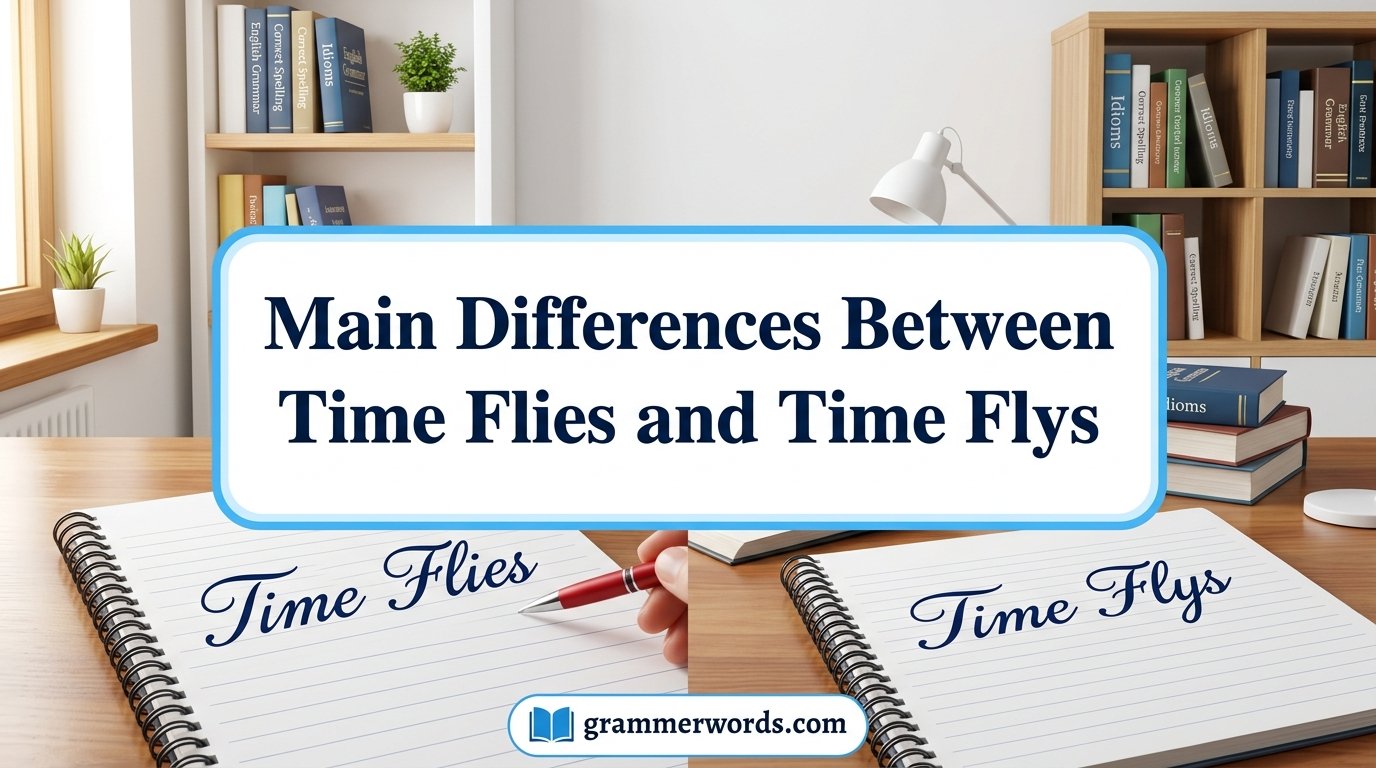
The difference isn’t a matter of American versus British English. Both American English and British English use “time flies.”
Instead, the difference comes from English verb conjugation.
| Feature | Time flies | Time flys |
| Standard English | Yes | No |
| Correct verb form | Yes | No |
| Subject | Singular “time” | Singular “time” |
| Verb | “flies” | “flys” |
| Third-person agreement | Correct | Incorrect |
| Suitable for formal writing | Yes | No |
| Suitable for casual texting | Yes | No |
A common misconception says flys might be an American spelling while flies might be British. That’s not the case.
English speakers in both major varieties normally write flies.
Why Is “Time Flies” Correct?
The answer lies in subject-verb agreement.
English verbs often change form depending on their subject. With the present tense, a third-person singular subject generally requires a verb ending in -s or -es.
Consider these examples:
- I fly.
- You fly.
- We fly.
- They fly.
- He flies.
- She flies.
- It flies.
- Time flies.
The word time behaves like a singular third-person subject.
That’s why we say:
Time flies.
The same pattern appears in:
The bird flies.
My brother flies to Chicago every month.
The plane flies overnight.
However, plural subjects use the base form:
Birds fly.
Planes fly.
My brothers fly frequently.
The distinction becomes much easier when you compare singular and plural subjects side by side.
Why does “y” become “ies”?
English spelling rules change the ending of many verbs that finish with a consonant plus y.
Take try:
She tries.
Not:
She trys.
Take carry:
He carries the bag.
Not:
He carrys the bag.
The same pattern applies to fly:
Time flies.
The transformation works like this:
fly → flies
The final y changes to i before -es is added.
What about verbs ending in a vowel plus “y”?
This is where English spelling becomes slightly more interesting.
When a verb ends in a vowel + y, the y usually stays in place.
For example:
- play → plays
- enjoy → enjoys
- stay → stays
- obey → obeys
Compare:
She plays tennis.
with:
She tries tennis drills.
The spelling pattern depends on the letter immediately before the final y.
That distinction explains why flys looks tempting but doesn’t work. The word fly follows the consonant-plus-y pattern.
What Does “Time Flies” Mean?
“Time flies” means that time seems to pass very quickly.
The phrase usually expresses surprise about how rapidly a period has ended or progressed.
For example:
I can’t believe it’s already December. Time flies.
The speaker doesn’t mean that time literally moves through the air. This is a figurative expression.
It describes a familiar human experience: when you’re deeply involved in something or looking back on a long period, the passage of time can seem remarkably fast.
You might say “time flies” when:
- A vacation ends sooner than expected.
- A child grows up quickly.
- A school year reaches its final weeks.
- A relationship reaches an anniversary.
- A friend mentions how long you’ve known each other.
- A busy workweek disappears.
- A birthday reminds you how much time has passed.
The emotional meaning can change with the situation.
Sometimes “time flies” sounds cheerful. Sometimes it sounds nostalgic. In other situations, it can carry a touch of regret.
A simple example
Imagine two friends meet for coffee at 2:00 p.m. They talk for several hours. Suddenly it’s 6:00.
One might say:
“Wow, it’s already six. Time flies!”
The phrase communicates surprise without requiring a detailed explanation.
“Time Flies When You’re Having Fun”
One of the best-known uses of the expression is:
Time flies when you’re having fun.
The saying means that enjoyable experiences can make the passage of time feel faster.
There is an important grammatical point here. The phrase contains two different subjects:
- time is the subject of flies
- you is the subject of are having
The first clause therefore uses flies:
Time flies…
The second clause uses are because the subject is you:
…when you are having fun.
In everyday speech, “you are” commonly contracts to “you’re.”
That gives us the familiar version:
Time flies when you’re having fun.
Does “time flies” always mean you’re having fun?
No.
That’s an important distinction.
People often associate the phrase with enjoyment because of the famous saying. Yet “time flies” by itself doesn’t require happiness or entertainment.
For example:
“The kids are already teenagers. Time flies.”
That’s more nostalgic than playful.
Another example:
“I’ve been working here for ten years. Time flies.”
The speaker might feel surprised rather than amused.
The surrounding context determines the emotional tone.
Time Flies vs. Time Flew By

These expressions are closely related. Their verb tense differs.
“Time flies” uses the present tense.
Time flies when you’re busy.
And “Time flew by” uses the past tense.
The weekend flew by.
Use time flies when making a general observation or describing something happening now.
Use flew by when referring to a completed period.
| Expression | Tense | Example |
| Time flies | Present | Time flies when you’re busy. |
| Time flew by | Past | The weekend flew by. |
| Time is flying by | Present progressive | Time is flying by this summer. |
| Time has flown by | Present perfect | Time has flown by since graduation. |
These forms give you more flexibility than simply repeating “time flies.”
Common Mistakes With “Time Flies”
Several errors appear because fly, flies, and fly’s look similar.
“Time flys”
This is the most common spelling mistake.
Incorrect:
Time flys when you’re having fun.
Correct:
Time flies when you’re having fun.
The problem is the verb form. Flys isn’t the standard third-person singular spelling of fly.
“Time fly”
This form uses the base verb.
Incorrect:
Time fly so fast.
Correct:
Time flies so fast.
The subject time is singular. Therefore, the present-tense verb needs the third-person singular form.
“Time fly’s”
The apostrophe doesn’t belong in the verb.
Incorrect:
Time fly’s when you’re having fun.
Correct:
Time flies when you’re having fun.
An apostrophe can indicate possession or contraction. It doesn’t normally create the third-person singular form of a verb.
Compare:
The bird flies.
with:
The bird’s wing.
The first uses a verb. The second uses a possessive noun.
“Time flies’”
This is another unnecessary apostrophe.
Incorrect:
Time flies’ when you’re having fun.
Correct:
Time flies when you’re having fun.
The verb flies doesn’t require an apostrophe.
“Time Flies” in Everyday Examples
The expression works in a surprisingly wide range of conversations.
Casual conversation
“It’s Friday already. Time flies.”
“I can’t believe we’ve been talking for three hours. Time flies.”
These versions sound relaxed and natural.
Nostalgic conversations
“It feels like yesterday. Time flies.”
“The kids have grown so much. Time flies.”
Here, the phrase often carries a reflective tone.
Work and school
“This semester is almost over. Time flies.”
“I’ve worked here for five years already. Time flies.”
The expression fits situations where a long period has passed unexpectedly quickly.
Relationships
“We’ve been friends since college. Time flies.”
“Ten years of marriage already? Time flies.”
The phrase can highlight a milestone without sounding overly dramatic.
Vacations
“Our last day is tomorrow. Time flies when you’re having fun.”
This version connects the general expression with the familiar proverb.
“Time Flies” in Text Messages
Texting usually favors short, natural phrases. “Time flies” fits perfectly because it communicates a complete thought in only two words.
Suppose someone texts:
“I can’t believe we graduated five years ago.”
Possible responses include:
- “Seriously. Time flies.”
- “I know! Time flies so fast.”
- “Right? It feels like yesterday.”
- “Five years already? Time flies.”
- “Chaotic how quickly it goes.”
The best response depends on the relationship and mood.
A close friend might use:
“Right?! Time flies 😂”
A more sentimental conversation might call for:
“It really does. Feels like yesterday.”
A professional conversation could stay simple:
“Absolutely. Time flies.”
Natural alternatives
If you want to avoid repeating the same expression, try:
- “Where did the time go?”
- “That went by fast.”
- “I can’t believe how quickly it passed.”
- “It feels like yesterday.”
- “The years are flying by.”
- “That year disappeared.”
- “It went by in no time.”
These aren’t exact grammatical substitutes in every sentence. However, they convey a similar idea.
How to Remember “Flies” Instead of “Flys”
A useful memory trick is to connect fly with other verbs that follow the same spelling pattern.
Think:
fly → flies
Then connect it with:
- try → tries
- cry → cries
- hurry → hurries
- carry → carries
- study → studies
Seeing the pattern repeatedly makes flies feel much more natural.
Another simple test works well:
Would the subject take “flies” if you replaced it with “he” or “she”?
Consider:
Time flies.
Replace time with it:
It flies.
That sounds grammatically correct.
Now try:
It flys.
That immediately looks wrong.
The substitution provides a quick way to check your instinct.
Correct and Incorrect Examples
Here are common examples that show exactly where the distinction matters.
| Incorrect | Correct | Why |
| Time flys so fast. | Time flies so fast. | “Time” requires the singular verb form. |
| Time fly when you’re having fun. | Time flies when you’re having fun. | “Flies” agrees with singular “time.” |
| I can’t believe how fast time flys. | I can’t believe how fast time flies. | “Flys” isn’t the standard spelling. |
| Time fly’s when we’re together. | Time flies when we’re together. | The verb doesn’t need an apostrophe. |
| Time fly by so quickly. | Time flies by so quickly. | The singular subject requires “flies.” |
| The years flies by. | The years fly by. | “Years” is plural and takes the base form “fly.” |
That final example highlights an important point: the correct verb depends on the subject.
Compare:
Time flies.
but:
Years fly by.
Both are correct.
Singular and Plural Subjects Make the Difference
The easiest way to understand the grammar is to compare singular and plural subjects.
| Subject | Correct sentence |
| Time | Time flies. |
| The year | The year flies by. |
| A bird | A bird flies. |
| Birds | Birds fly. |
| The plane | The plane flies. |
| Planes | Planes fly. |
| My friend | My friend flies tomorrow. |
| My friends | My friends fly tomorrow. |
The pattern is consistent.
A singular third-person subject generally takes flies. A plural subject takes fly.
That’s why the sentence “Time flies” follows ordinary English grammar rather than representing some unusual idiom-specific exception.
Is “Time Flies” Formal or Informal?
“Time flies” works in both casual and reasonably formal writing.
Its tone depends more on the surrounding sentence than on the expression itself.
Casual:
“Wow, time flies!”
Professional:
“Time flies when a project enters its final stages.”
Reflective:
“Time flies, especially when we look back on important milestones.”
The phrase isn’t slang. You don’t need to avoid it simply because you’re writing something polished.
However, highly technical writing might prefer more precise language if the exact passage of time matters.
For example:
“The project lasted six months.”
is more precise than:
“Time flies.”
The latter describes perception rather than duration.
Is “Time Flies” Always About Time Passing Quickly?
Yes in its ordinary figurative sense, “time flies” describes the perception that time passes quickly.
However, it doesn’t claim that time literally moves faster.
That’s an important semantic distinction.
If someone says:
“Time flies when you’re having fun.”
they’re expressing a subjective experience. They aren’t making a scientific claim about the physical rate at which time passes.
This explains why people use the phrase across very different situations.
A child might say:
“The school day went by so fast.”
An older adult might say:
“Time flies. My children are grown now.”
A traveler might say:
“Our vacation flew by.”
The underlying idea remains similar: a period seemed shorter than expected.
“Time Flies” vs. Similar Expressions
Several expressions describe the same general experience. Their nuance isn’t identical.
| Phrase | Meaning | Typical use |
| Time flies | Time seems to pass quickly | General observation |
| Time flies when you’re having fun | Enjoyment makes time seem fast | Positive experiences |
| Time flew by | A past period passed quickly | Finished events |
| Time is flying by | Time currently seems to pass quickly | Ongoing situations |
| Where did the time go? | Surprise about elapsed time | Casual conversation |
| The years are flying by | Long periods seem to pass quickly | Aging or milestones |
| It went by in no time | Something seemed extremely quick | Informal conversation |
Choosing among them can make your writing sound more natural.
For instance:
“The meeting flew by.”
sounds more conversational than:
“The meeting was perceived as passing quickly.”
The first version sounds like something an actual person would say.
Is “Time Flies” Ever Written as “Time Flys”?
In standard English, no.
You may encounter flys online because people make spelling mistakes. Informal internet writing contains plenty of nonstandard spellings. That doesn’t make those forms accepted English.
There can also be unusual names, usernames, product names, fictional terms, or deliberately altered spellings that contain flys. Those are separate cases.
When you’re writing the ordinary English expression about time passing quickly, use:
Time flies.
Not:
Time flys.
Is “Time Flies” a British or American Spelling?
Both American English and British English use flies.
This isn’t one of those words where regional spelling changes the form.
For example, American and British English can differ in spellings such as:
- color / colour
- center / centre
- organize / organise
But fly → flies doesn’t change between these varieties.
So the choice isn’t:
American: flys
British: flies
The correct distinction is:
Standard English: flies
Nonstandard spelling: flys
Why Does “Flys” Look So Tempting?
English spelling often creates deceptive patterns.
Many third-person singular verbs simply add -s:
- run → runs
- walk → walks
- jump → jumps
- read → reads
- play → plays
That pattern can make flys look logical.
However, verbs ending in consonant + y follow a different spelling pattern:
- fly → flies
- try → tries
- reply → replies
- deny → denies
- apply → applies
The change isn’t arbitrary. It’s a standard spelling convention.
Once you’ve learned the pattern, flys becomes easier to recognize as an error.
A Practical Editing Test
If you’re unsure whether you’ve written time flies correctly, use this three-step check.
Check the subject
Ask:
What is doing the flying?
In the expression, the grammatical subject is time.
Check whether the subject is singular
Time is singular.
Therefore, the verb needs its third-person singular form.
Change “fly” to its correct form
Because fly ends in consonant + y, use:
flies
The final sentence becomes:
Time flies.
This takes only a few seconds. It also works for similar sentences.
Frequently Asked Questions
Is “time flies” or “time flys” the correct spelling?
“Time flies” is the correct spelling in standard English. “Time flys” is an incorrect spelling because flies is the proper third-person singular form of “fly.”
Why is “flies” spelled with “-ies” instead of “-ys”?
The grammar rule changes the final “y” to “i” before adding “-es” when a verb ends in consonant + y. Therefore, fly becomes flies, just as try becomes tries and carry becomes carries.
What does “time flies” mean?
“Time flies” means that time seems to pass quickly. It is a common expression used in everyday usage when a period feels shorter than expected.
Is “time flies when you’re having fun” grammatically correct?
Yes, “Time flies when you’re having fun” is grammatically correct and widely used. The phrase describes how enjoyable experiences can make the passage of time seem faster.
Should “time flies” have an apostrophe?
No, time flies does not need an apostrophe. “Flies” is the correct verb form, while “fly’s” and “flies’” are incorrect in this expression.
Final Takeaway
In short, time flies is the correct spelling and follows standard English grammar rules. Because time is a singular subject, the correct verb form is flies, not flys. The phrase means time seems to pass quickly and works naturally in everyday usage, written English, and conversation. Remember the simple spelling pattern: fly becomes flies, just like try becomes tries.