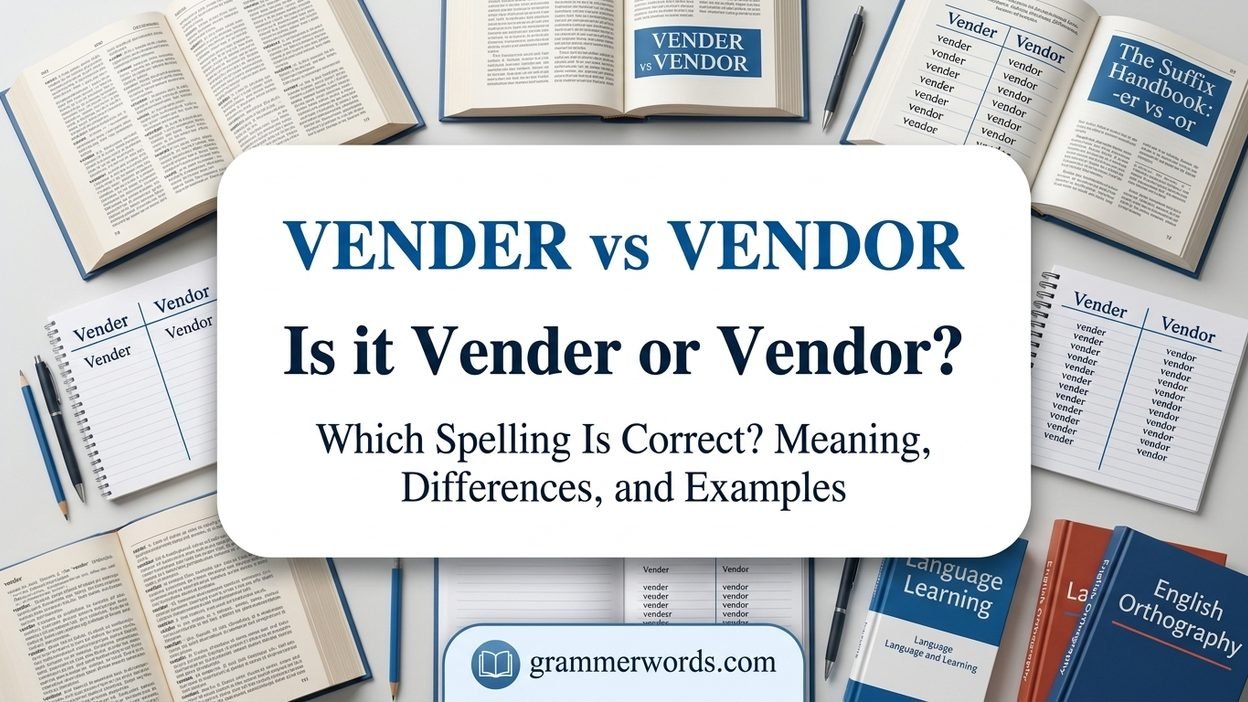
When choosing between vender vs vendor, many writers wonder about the correct spelling. The standard spelling is important in professional writing, especially across business writing and formal communication. However, vender appears in some references, creating spelling confusion for modern readers. Understanding modern English usage helps you make a confident spelling choice.
In American English, vendor is the preferred spelling for a seller or supplier. It commonly describes a person or company that provides goods or services. Therefore, knowing the vendor meaning can improve writing accuracy and communication clarity. This guide explains the vendor spelling, vender spelling, usage, origins, and practical examples.
Quick Answer
Vendor is the preferred spelling in modern English.
Vender is a legitimate variant spelling that means essentially the same thing: a person or business that sells goods or services.
For most contemporary writing, choose vendor.
| Word | Is it a word? | Meaning | Modern usage |
| Vendor | Yes | A person or business that sells goods or services | Standard and very common |
| Vender | Yes | A person who sells goods or merchandise | Correct but uncommon |
For example:
The company selected a new software vendor.
That sentence uses the spelling most readers would expect today.
You might occasionally encounter:
The market vender sold fresh produce.
The second sentence isn’t necessarily misspelled. However, vender is considerably less common in contemporary usage.
The practical rule
If you’re writing a:
- Business email
- Contract
- Resume
- Website
- Product description
- Academic paper
- Technical document
- Marketing page
- General article
use vendor unless you’re deliberately preserving a source’s original spelling.
Comparison Overview
The difference between vender and vendor is mainly one of usage preference rather than meaning.
Both forms describe someone who sells something. The word can refer to an individual street seller or a large corporation supplying sophisticated technology to other businesses.
| Feature | Vendor | Vender |
| Basic meaning | Person or business that sells goods or services | Person or business that sells goods or merchandise |
| Standard modern spelling | Yes | Less common variant |
| Meaningfully different definition | No | No |
| Common in business | Very common | Rare |
| Common in technology | Very common | Rare |
| Common in general English | Very common | Uncommon |
| Plural | Vendors | Venders |
| Recommended for new writing | Yes | Usually no |
One important point often gets lost in spelling discussions: a dictionary entry doesn’t automatically mean two spellings have equal status in everyday writing.
English contains many valid variants that differ dramatically in frequency. A form can be legitimate while still being unusual.
That is exactly what happens with vender.
Main Differences Between Vender and Vendor
At first glance, the difference seems to be one letter. In practical writing, however, that single letter signals a major difference in usage frequency and convention.
Vendor is the dominant modern form
Vendor appears throughout modern commercial, technical, retail, and institutional language.
Consider phrases such as:
- Vendor agreement
- Vendor management
- Vendor payment
- Vendor portal
- Vendor relationship
- Software vendor
- Hardware vendor
- Food vendor
- Third-party vendor
- Approved vendor
- Vendor contract
- Vendor support
These expressions have become established terminology. Replacing vendor with vender would make many of them look unusual.
See Also: Natzi or Nazi: Which Spelling Is Correct? A Complete Guide
For instance:
Our IT department contacted the software vendor about the licensing issue.
The wording feels completely ordinary.
Now compare:
Our IT department contacted the software vender about the licensing issue.
The meaning remains clear. Yet the spelling looks unusual to most modern readers.
Vender has the same basic meaning
Vender isn’t simply a random misspelling invented by someone who forgot how to spell vendor.
It has dictionary recognition as a variant form. Its meaning centers on someone who sells goods or merchandise.
The problem isn’t that vender lacks meaning. The problem is that modern usage strongly favors vendor.
That distinction helps explain why someone can technically write vender without necessarily producing a meaningless word while still making a poor spelling choice for ordinary professional prose.
The difference is primarily conventional
Think of it this way.
Two roads can lead to the same destination. One might be a broad, well-traveled highway while the other is a rarely used side road.
Vendor is the highway. Vender is the side road.
The destination is essentially the same. The reader’s experience isn’t.
What Does “Vendor” Mean?
A vendor is a person, company, or organization that sells goods or services.
The word has a broad range of applications. A vendor might sell handmade jewelry at a local market. A multinational corporation might also act as a vendor when it provides enterprise software to another company.
Vendor in retail
In retail contexts, a vendor can be someone who sells products directly to customers.
Examples include:
- Farmers market vendors
- Food vendors
- Clothing vendors
- Newspaper vendors
- Craft vendors
- Festival vendors
- Street vendors
Example:
The food vendor sold grilled sandwiches throughout the afternoon.
Here, vendor simply means seller.
Vendor in business
Business English uses vendor more broadly.
A company can become a vendor when it provides products or services to another organization.
For example:
The company hired an outside vendor to maintain its office equipment.
The vendor doesn’t necessarily sell directly to ordinary consumers. Instead, it supplies another business.
Vendor in technology
Technology has made vendor especially common.
A software company might call itself a vendor because it provides software to customers. Hardware manufacturers can also act as vendors.
Examples include:
- Cloud vendor
- Software vendor
- Hardware vendor
- Security vendor
- Database vendor
- Technology vendor
- SaaS vendor
- IT vendor
This usage is so established that software vendor sounds completely natural while software vender sounds conspicuous.
What Does “Vender” Mean?
Vender is a variant spelling of vendor.
Its meaning relates to a person who sells something. It doesn’t normally introduce a completely separate commercial role.
That makes the question more nuanced than simply asking whether vender is “wrong.”
Is vender a real word?
Yes.
The word appears in dictionary records as a spelling variant. That means you shouldn’t treat every occurrence of vender as evidence that the writer doesn’t know English spelling.
At the same time, dictionary recognition doesn’t mean you should prefer it.
Modern writers usually encounter vendor much more often. That frequency gives vendor a strong advantage in ordinary communication.
Why does vender look unusual?
English spelling contains many historical inconsistencies. Words don’t always settle on one form immediately. Competing spellings can coexist for long periods before one becomes dominant.
Vender survived as a variant. Vendor became the overwhelmingly familiar form in modern commercial vocabulary.
As a result, readers generally recognize vendor instantly.
Why Is Vendor More Common Than Vender?
The dominance of vendor reflects historical usage and modern linguistic convention.
The word ultimately traces back to Latin vendere, meaning “to sell.” English developed the noun through French and later usage patterns.
The important point isn’t simply the etymology. English has repeatedly adopted related forms with different endings, and established usage eventually determines which form becomes conventional.
Over time, vendor became entrenched across commerce and business English.
That entrenchment created a snowball effect.
Once companies, contracts, dictionaries, software documentation, and institutions consistently used vendor, subsequent writers naturally followed the same convention.
Language often works this way. Usage becomes habit. Habit becomes convention. Convention becomes the form readers expect.
Vender vs Vendor in American English
American English strongly favors vendor.
You’ll see it across ordinary and professional contexts:
The vendor delivered the equipment on Tuesday.
We need to evaluate each vendor before renewing the contract.
The company became an authorized vendor for several retailers.
Our software vendor released a security update.
In American business writing, vendor is the overwhelmingly natural choice.
Common American business phrases
Here are some expressions where vendor is firmly established:
- Vendor management
- Vendor selection
- Vendor evaluation
- Vendor onboarding
- Vendor compliance
- Vendor pricing
- Vendor invoice
- Vendor payment
- Vendor agreement
- Vendor contract
- Vendor risk
- Vendor relations
Using vender in these expressions can make otherwise polished writing look inconsistent or unfamiliar.
Vendor vs Vender in British English
British English also uses vendor.
This point matters because spelling discussions sometimes create the impression that vender represents a British-American difference. That isn’t a reliable way to understand these words.
British English has its own spelling differences in many areas. For example, colour and color differ across British and American conventions.
Vendor vs vender doesn’t work that way.
The mainstream form remains vendor in both major varieties of English.
So if you’re writing for readers in the United States, United Kingdom, Canada, Australia, or another English-speaking market, vendor is generally the safest standard form.
Vendor vs Vender in Business Writing
Business writing rewards clarity and familiarity.
When a reader scans a contract or email, unusual spelling creates friction. Even tiny interruptions can make formal documents feel less polished.
That’s why vendor makes sense in professional communication.
Vendor contracts
A company might write:
The vendor must comply with all applicable security requirements.
Vendor payments
A finance department might say:
Vendor payments are processed within 30 days of receiving an approved invoice.
Vendor management
A procurement team could write:
Effective vendor management helps organizations monitor cost, quality, and compliance.
Vendor relationships
A manager might write:
Strong vendor relationships can improve communication during supply disruptions.
In each example, vendor fits established business terminology.
Replacing it with vender doesn’t change the underlying meaning. It simply introduces an uncommon spelling that most readers don’t expect.
Vendor vs Vender in Technology
Technology provides some of the clearest examples of why conventional spelling matters.
The word vendor appears constantly in IT documentation and procurement language.
A company might purchase software from a software vendor. It might compare several cloud vendors before moving its infrastructure. An IT department could negotiate a support agreement with a hardware vendor.
Common technology terms
| Phrase | Meaning |
| Software vendor | Company that develops or sells software |
| Hardware vendor | Company that supplies computer or electronic hardware |
| Cloud vendor | Company providing cloud computing services |
| Security vendor | Company supplying cybersecurity products or services |
| Third-party vendor | External company providing goods or services |
| Vendor lock-in | Dependence on a particular provider that makes switching difficult |
| Vendor support | Technical or operational assistance provided by a supplier |
Consider the phrase vendor lock-in.
It has become an established technology and business term. Writing vender lock-in would look noticeably unusual even though readers could understand it.
That illustrates an important principle: established terminology often matters as much as dictionary correctness.
Vendor vs Seller vs Supplier vs Merchant
Another useful distinction involves words that overlap with vendor.
A vendor is a seller. Yet seller, supplier, merchant, and retailer don’t always carry precisely the same emphasis.
| Term | Core idea | Typical context |
| Vendor | Person or organization selling or supplying something | Business, retail, technology |
| Seller | Person or entity that sells something | General and e-commerce contexts |
| Supplier | Organization providing goods or materials | Procurement and manufacturing |
| Merchant | Person or business engaged in trade | Commerce and retail |
| Retailer | Business selling directly to consumers | Consumer markets |
| Distributor | Business distributing products to other businesses or sellers | Supply chains |
Vendor vs supplier
These words often overlap.
A supplier typically emphasizes providing goods or materials, particularly within a supply chain.
A vendor can have a broader role.
For example, a company selling accounting software to another company is commonly called a software vendor. Calling it a supplier isn’t necessarily impossible. However, vendor fits the established terminology better.
Vendor vs seller
Seller is more general.
On an online marketplace, someone might be described as a seller. In a corporate procurement system, the same relationship may be described using vendor.
Context determines which word sounds most natural.
Vendor vs merchant
Merchant often carries a more traditional commercial sense. It can describe someone engaged in buying and selling goods.
Vendor tends to work more naturally in modern business and service environments.
Vender vs Vendor in Everyday Examples
The easiest way to understand the distinction is to see how the word behaves in real sentences.
Retail
The vendor arranged fresh vegetables on the market stall.
Events
Several local vendors participated in the weekend food festival.
Technology
The company switched to a new cloud vendor.
Business procurement
The purchasing team reviewed three vendors before signing the agreement.
Online commerce
The marketplace allows each vendor to manage its own product listings.
Professional communication
Please contact the vendor if the replacement equipment doesn’t arrive today.
In all these examples, vendor sounds natural because it matches modern usage.
Common Mistakes With Vender and Vendor
Several misconceptions repeatedly cause confusion.
Mistake: Assuming vender is completely incorrect
This is too absolute.
Vender exists as a recognized variant. Calling every instance of it a spelling error oversimplifies the issue.
A better explanation is:
“Vender” is a valid but uncommon variant. “Vendor” is the standard modern choice.
Mistake: Assuming the words have different meanings
They generally don’t.
The spelling difference doesn’t normally signal two different types of sellers.
Mistake: Treating dictionary status as equal popularity
A dictionary can record multiple forms without suggesting that speakers use them equally often.
Think about it like a museum.
A museum can preserve an object without suggesting that people still use it every day.
Likewise, a dictionary can document a variant without making it the preferred modern spelling.
Mistake: Switching spellings within one document
Consistency matters.
If a business document uses vendor twenty times and suddenly uses vender once, the reader may assume the latter is a typo.
Choose one form and stick with it.
For contemporary writing, that form should normally be vendor.
When Should You Use Vendor?
In almost every situation where you’re creating new modern English text, vendor is the practical choice.
Use it in:
- Business documents
- Emails
- Reports
- Contracts
- Websites
- Technical documentation
- Resumes
- Academic writing
- Marketing material
- News articles
- Product descriptions
- General correspondence
A simple editing rule
When proofreading, search for vender.
If you didn’t intentionally reproduce a historical spelling or preserve someone else’s wording, consider changing it to vendor.
That small edit can make the document align better with contemporary usage.
When Might You See Vender?
Although uncommon, vender can appear in several situations.
Historical material
Older texts may preserve spelling conventions that differ from current preferences.
Dictionary entries
Dictionaries may list vender as a variant.
Quotations
If a writer is quoting a source exactly, changing vender to vendor could alter the original wording.
Personal or regional usage
Some writers may simply prefer the variant because they encountered it first or learned it from a particular source.
The important distinction is between recognizing a form and choosing a form for fresh writing.
Vendor vs Vender: Example Sentences
The following examples show why vendor generally works better in modern prose.
Professional examples
We need to approve the new vendor before placing the order.
The vendor provided updated pricing for the next quarter.
Our procurement team is reviewing several potential vendors.
The software vendor released a critical security patch.
Please send the completed form to the vendor management department.
Everyday examples
A local vendor was selling handmade candles.
We bought lunch from a street vendor near the station.
The event organizers invited several food vendors.
Examples with vender
The dictionary lists vender as a variant spelling of vendor.
The historical document uses vender instead of the more familiar vendor.
Notice the difference in function. Modern examples naturally use vendor. Discussions about the spelling itself may mention vender because the variant is the subject of discussion.
Vendor Plural and Related Forms
The plural of vendor is straightforward:
vendor → vendors
Examples:
The company works with several vendors.
Vendors must submit their invoices by Friday.
The same pattern applies to vender:
vender → venders
However, because vendor dominates modern usage, vendors is overwhelmingly the form readers are likely to expect.
Common vendor compounds
Business English frequently combines vendor with another noun.
Examples include:
- Vendor agreement
- Vendor contract
- Vendor database
- Vendor directory
- Vendor invoice
- Vendor list
- Vendor portal
- Vendor payment
- Vendor policy
- Vendor relationship
- Vendor risk
- Vendor selection
- Vendor support
These compounds reinforce the importance of using the established spelling consistently.
How to Remember the Correct Spelling
Here’s the simplest rule:
When in doubt, use “vendor.”
You don’t need an elaborate mnemonic.
Associate vendor with familiar phrases such as vendor contract, software vendor, and food vendor. Once you recognize how deeply the spelling appears in modern commercial language, the choice becomes much easier.
A useful mental shortcut is to remember that the -or form is the standard form you’ll see across contemporary business English.
Vender vs Vendor: Usage and Frequency
Usage frequency provides an important piece of the puzzle.
When one spelling appears consistently across dictionaries, business terminology, technical documentation, institutional writing, and everyday communication, readers become accustomed to it.
Vendor has reached that level of conventionality.
Meanwhile, vender remains recognizable but much less familiar.
Search-engine frequency can illustrate this difference, but it shouldn’t determine whether a word is grammatically correct. Google Trends measures search interest, not dictionary validity or linguistic correctness.
That distinction matters.
Someone might search vender vs vendor precisely because they’re unsure which spelling to use. High search interest in the query doesn’t mean either spelling is more correct.
For linguistic claims, dictionaries and documented usage provide stronger evidence.
A Practical Case Study: Choosing a Spelling for a Business Website
Imagine a small company creating a page for businesses that supply office equipment.
The writer initially uses:
Our company works with trusted office equipment venders across the region.
The sentence is understandable. Yet the spelling may cause some readers to pause.
A revised version says:
Our company works with trusted office equipment vendors across the region.
The second version immediately matches familiar business terminology.
Now imagine that the page contains related phrases:
- Vendor partnerships
- Vendor pricing
- Vendor support
- Vendor agreements
The consistent vendor spelling creates a coherent terminology system across the entire page.
This isn’t about making language artificially formal. It’s about removing unnecessary friction.
A Practical Case Study: Technology Procurement
Consider an IT department evaluating three companies that provide cloud infrastructure.
A procurement report might say:
| Company role | Natural terminology |
| Cloud provider | Cloud vendor |
| Software company | Software vendor |
| Hardware manufacturer | Hardware vendor |
| External cybersecurity company | Security vendor |
| External service provider | Third-party vendor |
The report benefits from vendor because that spelling aligns with established technology terminology.
Using vender wouldn’t necessarily change the meaning. It would make the document look less conventional.
For technical writing, that distinction matters because readers often scan documents quickly. Familiar terminology improves comprehension.
Is Vender an American Spelling?
Vender can appear in American English, but it isn’t the standard spelling most American writers choose.
The same applies broadly to contemporary British English.
It’s therefore misleading to frame the difference as a simple American-versus-British spelling distinction.
A better explanation is that vendor is the dominant modern form across major varieties of English while vender survives as a less common variant.
Is Vender a Spelling Mistake?
Not necessarily.
The answer depends on what you mean by “mistake.”
If you’re asking whether vender is an invented or meaningless form, the answer is no.
If you’re asking whether it’s the spelling most editors would recommend for modern professional writing, the answer is also clear: vendor is usually the better choice.
That distinction resolves much of the confusion.
Frequently Asked Questions
Is vendor or vender the correct spelling?
Vendor is the standard spelling and preferred spelling in modern English usage. Vender is a valid but uncommon spelling variant.
Do vendor and vender have the same meaning?
Yes, vendor meaning and vender meaning are essentially the same. Both describe a seller or supplier of goods or services.
Is vender a spelling mistake?
Not always. Vender is a recognized dictionary word, but vendor is the more widely accepted form in professional writing and everyday communication.
Which spelling should I use in business writing?
Use vendor in business writing, business emails, contracts, reports, and other professional communication. It provides greater writing clarity and matches established business terminology.
Is vendor used in both American and British English?
Yes. Vendor is the common standard form in both American English and British English. Vender may appear as a variant, but it is much less common.
Final Takeaway
For most modern English usage, vendor is the standard spelling and safest spelling choice for professional writing, business writing, and everyday communication. While vender is a valid but less common variant, vendor offers greater writing clarity, consistency, and familiarity across American English, business, technology, and general contexts.