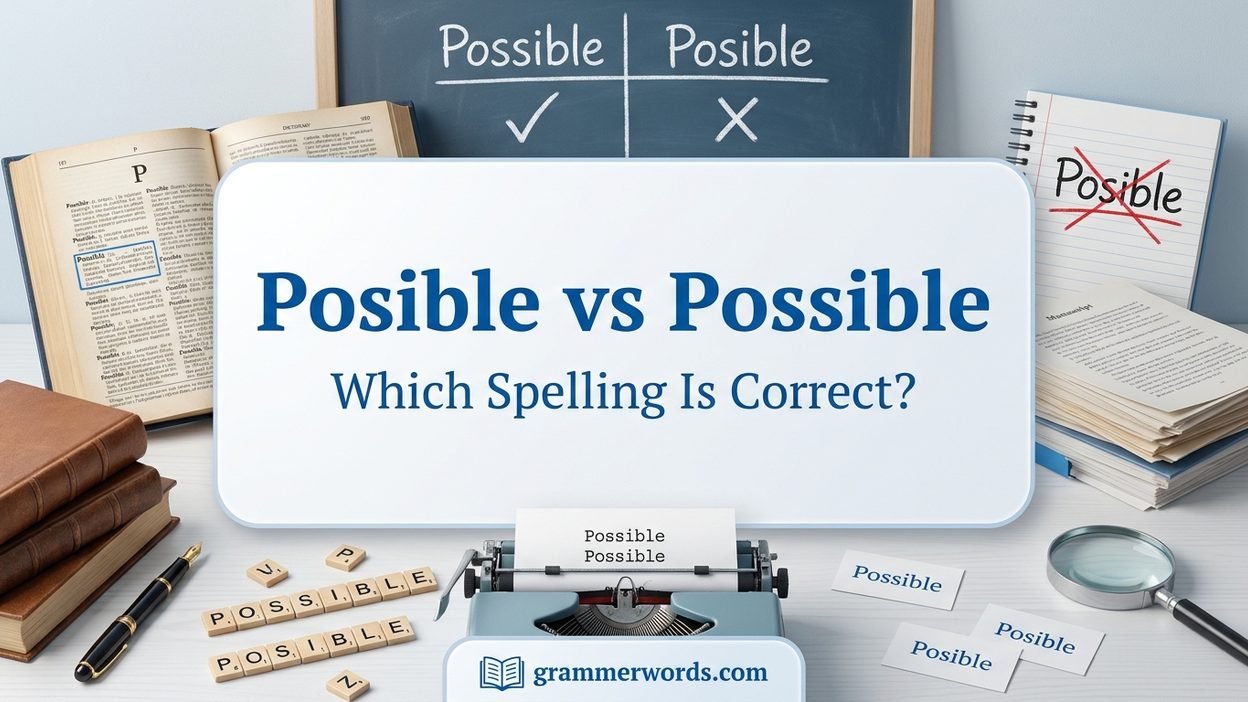
When comparing possible vs posible, the correct English spelling is possible, with two consecutive s letters. Although posible may look familiar, it is a posible misspelling in English, often caused by typing quickly or missing a letter. Understanding the possible meaning and correct English spelling helps you avoid common spelling mistakes. Moreover, knowing the English versus Spanish spelling can prevent confusion when learning languages or writing professionally.
The word possible describes something that can happen, can exist, or can be done under certain conditions. However, Spanish uses posible with just one s, which explains this common spelling confusion. Whether you write emails, notes, or business documents, choosing the standard English spelling improves writing clarity and professional communication. This guide explains the possible definition, correct usage, and practical examples to help you write with confidence.
Quick Answer
Possible is the correct spelling in standard English.
Posible is generally a spelling error when you’re writing in English. It becomes correct in certain other languages. For example, posible is the standard Spanish spelling for “possible.”
Here is the basic distinction:
| Spelling | English | Spanish | Meaning |
| possible | Correct | Not the standard Spanish form | Capable of happening or being done |
| posible | Incorrect | Correct | Possible |
Examples
Correct English:
Is it possible to finish the project today?
We need to consider every possible outcome.
Anything is possible if the conditions are right.
Incorrect English:
Is it posible to finish the project today?
The difference comes down to one letter. In standard English, the word contains two s’s: possible.
Comparison Overview
The easiest way to understand posible vs. possible is to compare their spelling, language, grammar, and meaning.
| Feature | Posible | Possible |
| Standard English spelling | No | Yes |
| Standard American English | No | Yes |
| Standard British English | No | Yes |
| Spanish spelling | Yes | No |
| English part of speech | Not standard English | Adjective |
| Basic English meaning | — | Able or likely enough to happen, exist, or be done |
| Related noun | — | Possibility |
| Related adverb | — | Possibly |
| Common phrase | — | As soon as possible |
So if you’re writing an English email, essay, text message, report, application, or social media post, choose possible.
Main Differences Between Posible and Possible
The biggest difference between posible and possible isn’t meaning. It is the language and spelling convention involved.
Possible Is the Standard English Spelling
English uses possible with two consecutive s letters.
The spelling appears in everyday expressions such as:
- as soon as possible
- if possible
- whenever possible
- where possible
- the best possible option
- every possible solution
- the earliest possible date
- the worst possible outcome
These expressions appear across casual conversation, business communication, journalism, academic writing, and formal documents.
Posible Is Not Standard English
When someone writes posible in an English sentence, readers will normally understand the intended word. Still, standard English spelling requires the second s.
For example:
“Is it posible?”
The meaning remains obvious. The spelling does not.
A spelling mistake doesn’t always prevent understanding. It can still make writing look careless or distract the reader. That matters more in professional, academic, and formal contexts.
Posible Is Correct in Spanish
There is one major linguistic wrinkle.
Posible is a real Spanish word. Spanish uses posible where English uses possible.
For example, the Spanish expression “Es posible” means “It is possible.”
That distinction matters for bilingual writers. Someone who knows Spanish may naturally remember the spelling posible and accidentally carry it into an English sentence.
The issue therefore isn’t that posible is a meaningless collection of letters. It belongs to another language’s standard vocabulary.
What Does Possible Mean?
Possible is an adjective. It describes something that can happen, exist, be true, or be achieved.
The word covers several closely related ideas.
Something That Can Happen
If an event is possible, circumstances allow it to happen.
A delay is possible because of the weather.
The sentence doesn’t say that a delay will happen. It only says that the circumstances make one capable of happening.
Something That Can Be Done
Possible can also describe an action that can be completed.
Is it possible to change the appointment?
Here, the speaker asks whether changing the appointment can actually be arranged.
Something That Could Be True
The word can describe an explanation or situation that hasn’t been established as fact.
That is one possible explanation.
This use is especially common in research, journalism, science, and analytical writing.
Something That Could Exist
Possible can describe something that could exist even if it doesn’t exist right now.
Scientists are exploring possible applications for the technology.
The word possible leaves room for uncertainty. It doesn’t guarantee an outcome.
Possible Does Not Mean Probable
One of the most useful distinctions involves possible and probable.
Something can be possible without being probable.
Consider this example:
It is possible that the flight will arrive early.
That statement says an early arrival could happen.
Now compare it with:
It is probable that the flight will arrive early.
That statement suggests an early arrival has a stronger likelihood.
The distinction can be summarized like this:
| Word | Core idea | Example |
| Possible | It can happen | “A delay is possible.” |
| Probable | It is reasonably expected to happen | “A delay is probable.” |
| Plausible | It seems reasonable or believable | “That explanation is plausible.” |
| Potential | It has capacity or possibility for development | “The idea has potential.” |
This difference becomes important in precise writing. Saying that something is possible doesn’t automatically mean you think it is likely.
Possible vs. Plausible
Possible and plausible overlap in some situations. They don’t mean exactly the same thing.
If something is possible, it doesn’t violate the known conditions that would make it happen.
If something is plausible, it also tends to appear reasonable or believable.
For example:
It is possible that the missing document was filed incorrectly.
That statement simply leaves the explanation open.
Now consider:
It is a plausible explanation that the missing document was filed incorrectly.
The second sentence goes further. It suggests the explanation makes sense based on the available information.
This distinction helps writers avoid overstating evidence.
Possible vs. Potential
The words possible and potential also have different roles.
Possible often focuses on whether something can happen.
Potential often focuses on capacity, future development, or an unrealized opportunity.
Compare these sentences:
A solution is possible.
The solution has potential.
The first sentence focuses on feasibility. The second suggests that the solution could become valuable or effective.
In business writing, for example, you might describe a new product as having potential. You could then discuss the possible results of launching it.
Why Does Possible Have Two S’s?
The spelling of possible can feel counterintuitive because English pronunciation doesn’t always make every letter equally noticeable.
In ordinary speech, the two s letters occur within the same part of the word. Speakers don’t pause between them and pronounce them as two dramatically separate sounds.
That can make the spelling easier to forget.
A useful visual strategy is to remember the opening as:
poss-
Then attach the ending:
poss + ible = possible
The same beginning appears in related English words:
- possible
- possibly
- possibility
- possibilities
This shared spelling gives you a useful pattern rather than a one-word memory trick.
Common Mistakes With Possible
The most common error is straightforward:
posible → possible
However, people make several other typing and spelling mistakes.
| Incorrect form | Correct form |
| posible | possible |
| possable | possible |
| possibel | possible |
| possilbe | possible |
| posssible | possible |
| possibilty | possibility |
These errors usually involve missing, misplaced, or substituted letters.
Why “Posible” Is Easy to Miss
The spelling mistake often survives casual proofreading because the sentence still looks familiar.
Consider:
“It is posible to make changes.”
The reader can understand the sentence instantly. The brain often recognizes the intended word before consciously checking every letter.
That’s why visual proofreading helps. Instead of reading only for meaning, look specifically at words you frequently misspell.
How to Remember the Correct Spelling
The simplest reminder is this:
Possible has two S’s.
You can also connect the spelling to possibility.
Look at the shared beginning:
- possible
- possibility
- possibly
- possibilities
The poss- pattern stays visible.
Another useful method involves breaking the word into two visual chunks:
poss + ible
This isn’t meant to be a strict pronunciation guide. It’s simply a spelling aid.
When you type the word quickly, mentally checking poss- can prevent the most common error.
Possible and Its Related Word Forms
Understanding related forms makes the spelling easier to retain.
Possible
Possible is an adjective.
There are several possible answers.
It describes a noun or noun phrase.
Possibly
Possibly is an adverb.
She could possibly arrive earlier.
It modifies an action, statement, or idea.
Possibility
Possibility is a noun.
There is a possibility of rain.
It refers to a potential event, outcome, condition, or option.
Possibilities
Possibilities is the plural form.
We need to consider all the possibilities.
Notice that all four words preserve the poss- beginning.
That shared spelling provides a stronger memory anchor than trying to memorize possible in isolation.
Common Expressions With Possible
Certain phrases appear so frequently that learning them can make the correct spelling almost automatic.
As Soon as Possible
As soon as possible means at the earliest practical opportunity.
Please send the completed form as soon as possible.
The abbreviation ASAP is common in informal and workplace communication. However, the full phrase can sound more polished in formal writing.
If Possible
If possible means that something is requested only when circumstances allow it.
Please arrive early if possible.
This phrase can make a request sound less rigid.
Whenever Possible
Whenever possible means whenever circumstances allow.
Use public transportation whenever possible.
It often appears in guidelines, recommendations, and instructions.
Where Possible
Where possible means in situations where something can reasonably be done.
The company reduces paper use where possible.
This expression appears frequently in professional and administrative writing.
The Best Possible
This phrase emphasizes the highest or most suitable outcome available under the circumstances.
We want to find the best possible solution.
It doesn’t necessarily mean a perfect solution. Instead, it points toward the strongest available option.
Possible in Everyday Conversation
In ordinary conversation, possible appears in questions, requests, explanations, and expressions of uncertainty.
For example:
“Is it possible to meet tomorrow?”
“Would it be possible to move the appointment?”
“Anything is possible.”
“That’s possible, but we need more information.”
“It’s possible that she forgot.”
The word works well because it leaves room for uncertainty without making a strong claim.
That quality makes possible especially useful when you don’t have enough evidence to say that something definitely will or won’t happen.
Possible in Emails and Workplace Writing
Professional communication frequently uses possible when discussing deadlines, scheduling, requests, and alternatives.
Compare these two sentences:
Send me the file today.
Please send me the file today if possible.
The second version leaves room for practical limitations. It still communicates the desired deadline.
Another common structure is:
Please provide the earliest possible delivery date.
Here, possible modifies delivery date. The phrase asks for the earliest date that can realistically be offered.
Formal Examples
- “Please respond at your earliest possible convenience.”
- “We will provide an update as soon as possible.”
- “Please consider all possible alternatives.”
- “The meeting can be moved if possible.”
- “We are reviewing every possible solution.”
The spelling remains possible regardless of how formal the context becomes.
Possible in Academic and Technical Writing
Academic writers often use possible to avoid presenting uncertain conclusions as established facts.
For example:
“Several possible explanations could account for the result.”
That wording leaves room for further investigation.
Scientific and technical writing frequently distinguishes among what is possible, what is supported by evidence, and what is likely.
This distinction matters because possibility alone doesn’t establish truth.
For instance:
“One possible explanation is that the sample experienced contamination.”
That statement proposes a reasonable avenue for investigation. It doesn’t claim that contamination definitely occurred.
Possible in Social Media and Text Messages
Casual digital communication often uses shorter structures.
Examples include:
“Is tomorrow possible?”
“Dinner tonight? Is that possible?”
“Anything’s possible.”
“Can you make it earlier if possible?”
Text messages may omit words or punctuation. The spelling of possible doesn’t change.
A fast conversation doesn’t create a separate informal spelling. Posible remains a misspelling when the message is written in English.
A Practical Case Study: Why Context Matters
Imagine someone writes this sentence:
“Is it posible to reschedule the interview?”
A reader can easily understand the question. Yet the spelling contains an error.
Now imagine the same writer sends this version:
“Is it possible to reschedule the interview?”
The meaning stays exactly the same. The second version follows standard English spelling.
Now change the language.
In Spanish, “¿Es posible?” is correct. Spanish uses posible rather than English possible.
This small comparison demonstrates an important point: spelling belongs to a language system. A sequence of letters isn’t inherently correct or incorrect in every language.
British English vs. American English
There is no standard US-versus-UK spelling difference between possible and posible.
Both American English and British English use:
possible
This differs from words that genuinely have variant spellings across the two major English varieties.
For example:
| American English | British English |
| color | colour |
| organize | organise |
| center | centre |
| traveling | travelling |
The word possible does not follow this pattern.
So if you’re writing for an American audience or a British audience, use possible.
Is “Posible” Ever Correct?
Yes. The answer depends on the language.
In standard English, posible isn’t the correct spelling of the adjective meaning “capable of happening or being done.”
In Spanish, however, posible is a normal and correct word.
This distinction is particularly relevant for bilingual communication. A Spanish speaker may encounter posible constantly and then accidentally carry that spelling into English.
The safest approach is simple: identify the language you’re writing in before choosing the spelling.
A Quick Editing Test
When you’re unsure about posible vs. possible, use this three-step check.
Step One: Identify the Language
If you’re writing in English, the standard form is possible.
If you’re writing in Spanish, posible may be correct.
Step Two: Check the Double S
Look at the beginning:
poss-
If you’ve written pos-, you’ve probably dropped an s.
Step Three: Check Related Words
Think of:
- possibility
- possibly
- possibilities
If those words are familiar, the shared poss- beginning can help you recover the correct spelling.
Posible vs. Possible: Example Sentences
Here are several examples that show the correct English usage.
Questions
- “Is it possible to change the reservation?”
- “Would it be possible to speak tomorrow?”
- “Is a refund possible under these conditions?”
Statements
- “A solution is possible.”
- “Several outcomes are possible.”
- “It is possible that the schedule will change.”
Requests
- “Please respond as soon as possible.”
- “Arrive early if possible.”
- “Choose the earliest possible appointment.”
Academic Writing
- “Several possible explanations require further investigation.”
- “The researchers considered multiple possible causes.”
Professional Writing
- “We will provide the information as soon as possible.”
- “Please select the earliest possible date.”
Facts to Remember
A few facts capture the entire issue:
- Possible is the standard English spelling.
- Posible is generally incorrect in standard English.
- Posible is a correct Spanish word.
- American and British English both spell the English word possible.
- Possible functions primarily as an adjective.
- The related noun is possibility.
- The related adverb is possibly.
- Possible and probable don’t have the same meaning.
- Something can be possible without being likely.
- The spelling contains two consecutive s letters.
- Common phrases include as soon as possible, if possible, and whenever possible.
Frequently Asked Questions
Which Is Correct: Posible or Possible?
Possible is the correct English spelling, with two consecutive s letters. The word posible is incorrect in standard English, but it is the correct Spanish spelling for the same meaning.
What Does Possible Mean?
Possible is an English adjective that describes something that can happen, exist, be true, or be done. For example, “Is it possible to finish today?” asks whether completing something today can happen.
Why Do People Spell Possible Incorrectly?
People often make this spelling mistake by missing a letter while typing quickly. Also, Spanish speakers may confuse the English spelling with posible, which uses one s.
How Can You Remember the Correct Spelling?
Remember that possible has two s’s. Related words such as possibility, possibly, and possibilities also begin with poss, making the spelling easier to recall.
Is Possible Spelled Differently in American and British English?
No. Both American English and British English use possible with two s’s. Neither standard variety uses posible as the correct English spelling.
Final Takeaway
When comparing posible vs possible, remember that possible is the correct spelling in both American English and British English, with two s’s. Although posible is correct in Spanish, it is a spelling mistake in English. To avoid this error, remember related words like possibility, possibly, and possibilities, which all keep the poss- pattern. Use possible in emails, essays, and daily writing to keep your message clear and correct.