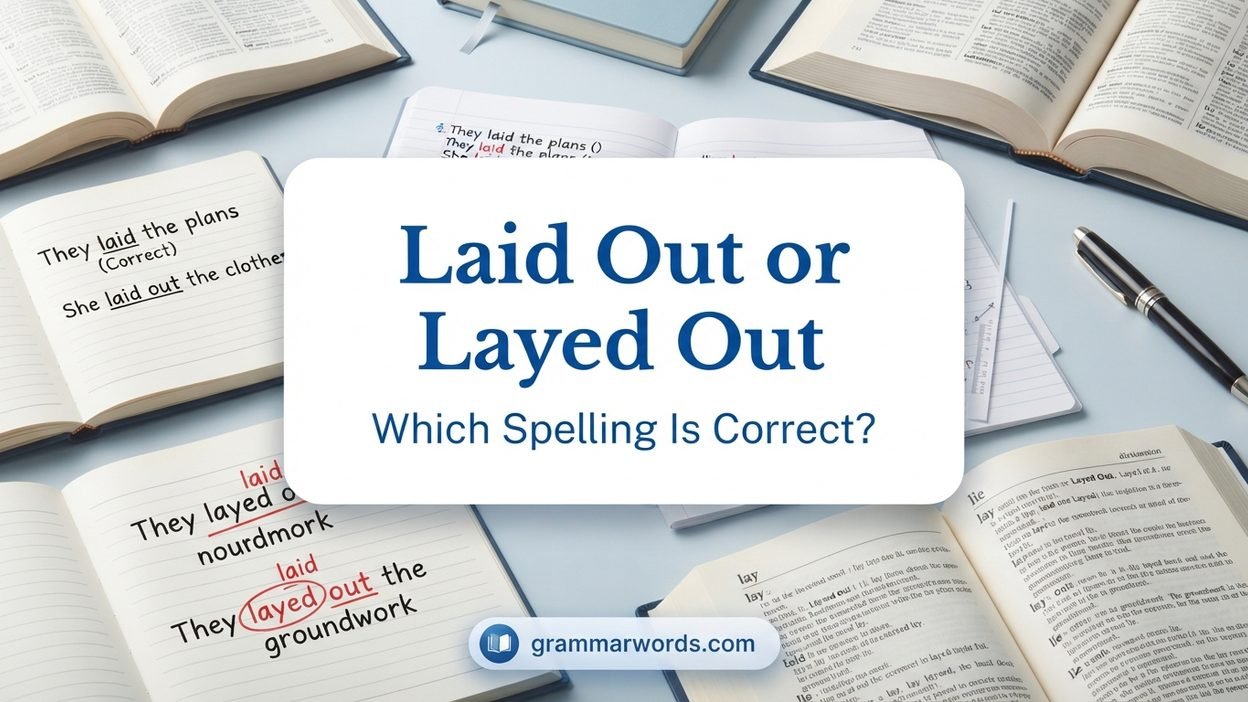
Choosing between laid out and layed out can confuse even fluent English speakers. The correct spelling is laid out, which follows the standard form used in standard English. This common grammar mistake often happens because the verb lay has an irregular past tense and past participle form. Understanding these verb forms makes the rule simple and helps prevent future spelling mistakes.
In everyday writing, professional writing, and published content, using the correct form improves writing clarity and credibility. The phrasal verb lay out means to arrange, present, or explain something clearly, while laid out describes a completed action. This guide explains laid out vs layed out, shows real examples, and clarifies why layed is wrong. It also helps language learners understand this confusing verb pattern and use laid out correctly in sentences.
Quick Answer
Laid out is correct.
Layed out is incorrect in standard modern English when you mean the past form of lay out.
The basic pattern is:
| Form | Correct example |
| lay out | “Please lay out the documents.” |
| laid out | “She laid out the documents.” |
| laying out | “She is laying out the documents.” |
| have laid out | “They have laid out the evidence.” |
| will lay out | “They will lay out the plan tomorrow.” |
| layed out | Not the standard form |
The key verb pattern is even easier to remember:
lay → laid → laid
So when lay out moves into the past tense, it becomes laid out.
For example:
Present: “I lay out the materials every morning.”
Past: “I laid out the materials yesterday.”
There isn’t a British-versus-American spelling difference here. Both varieties use laid out.
Comparison Overview
The difference between laid out and layed out isn’t a matter of style. One is the established standard form while the other is a common spelling error.
| Phrase | Standard English? | Typical use |
| laid out | Yes | Completed action |
| layed out | No | Common misspelling |
| lay out | Yes | Present or base form |
| laying out | Yes | Ongoing action |
| has laid out | Yes | Present perfect |
| had laid out | Yes | Past perfect |
| will lay out | Yes | Future construction |
Consider these examples:
- “The designer laid out the brochure.”
- “The designer will lay out the brochure tomorrow.”
- “The designer is laying out the brochure now.”
- “The designer has laid out the brochure already.”
Notice how the verb changes with the sentence structure. Laid belongs with completed actions and perfect constructions. Lay follows modal verbs such as will.
That small distinction eliminates most errors.
Main Differences Between Laid Out and Layed Out
The main difference is simple: laid out is the established grammatical form while layed out is not the standard form of the verb lay.
“Laid Out” Is the Correct Form
The phrase laid out comes from the phrasal verb lay out.
Cambridge defines lay something out as arranging something on a flat surface. It also records meanings involving clear explanation and spending money.
For example:
“She laid out the photographs across the table.”
Here the person completed the action of arranging the photographs.
The same form works with abstract ideas:
“The report laid out the evidence clearly.”
Now laid out means that the report presented or explained the information in an organized way.
“Layed Out” Doesn’t Follow the Verb Pattern
The temptation to write layed makes sense at first glance. Many English verbs form their past tense by adding -ed.
For example:
- walk → walked
- explain → explained
- arrange → arranged
- organize → organized
However, English contains many irregular verbs. Lay belongs to that group.
Its past form is laid rather than layed.
So:
“She laid out the plans.”
Not:
“She layed out the plans.”
The incorrect version may still appear in informal online writing. That doesn’t make it a standard spelling.
Why Is “Laid Out” Correct?
The answer becomes clearer when you look at the verb behind the phrase.
The verb lay has these important forms:
| Verb form | Word |
| Base form | lay |
| Present form | lay |
| Past tense | laid |
| Past participle | laid |
| -ing form | laying |
This gives us the following pattern:
lay → laid → laid → laying
When you add out to the verb you get:
lay out → laid out → laid out → laying out
That’s why layed out doesn’t fit the standard conjugation.
Cambridge’s American Dictionary explicitly identifies laid as both the past tense and past participle of lay.
A Useful Memory Trick
Think of lay as a verb with a two-step past pattern:
lay today → laid yesterday → laid already
For example:
- “I lay out the materials every morning.”
- “I laid out the materials yesterday.”
- “I have laid out the materials already.”
Once that pattern sticks, layed out starts to look as unusual as it actually is.
What Does “Laid Out” Mean?
The phrase has several meanings. Context determines which meaning the reader understands.
1. Arranged or Positioned
The most literal meaning involves placing things in an organized arrangement.
“She laid out the clothes for the next morning.”
The clothes were arranged in advance.
You could use the same construction for books, tools, food, photographs, furniture, documents, or other physical objects.
“He laid out the tools beside the machine.”
Cambridge defines this use as arranging something on a flat surface or organizing something according to a pattern or design.
2. Explained Clearly
Laid out can also describe an explanation.
“The lawyer laid out the facts.”
Here nobody placed physical objects on a table. Instead, the lawyer presented the facts in an organized way.
This meaning appears frequently in professional writing:
- “The report laid out the proposed changes.”
- “The manager laid out the company’s expectations.”
- “The document laid out the requirements.”
- “The researcher laid out the main arguments.”
Cambridge specifically defines this use as explaining something clearly.
3. Designed or Formatted
The phrase also appears in publishing, graphic design, web development, and related fields.
“The designer laid out the magazine.”
That sentence means the designer arranged the elements of the publication.
You could also say:
“The developer laid out the page with a simple grid.”
This use has a particularly practical connection with the noun layout.
Compare:
- “The designer laid out the page.”
- “The page has a clean layout.”
The verb describes the action. The noun describes the resulting arrangement.
4. Spent Money
In informal English lay out can mean spending money. The past form therefore becomes laid out.
“They laid out thousands of dollars for repairs.”
Cambridge records this meaning as an informal use involving spending money.
This meaning can sound more conversational than simply saying spent.
For instance:
“We laid out a lot of money to renovate the kitchen.”
The speaker emphasizes the substantial amount of money involved.
“Lay Out” vs. “Laid Out”
This distinction causes another common mistake.
Lay out and laid out aren’t competing spellings. They serve different grammatical roles.
Use “Lay Out” for the Base or Present Form
Use lay out when the sentence calls for the base form.
Examples include:
“Please lay out the documents.”
“I usually lay out my clothes the night before.”
“They plan to lay out the proposal tomorrow.”
The third example is especially useful. After to, English uses the base form:
to lay out
not:
to laid out
Use “Laid Out” for a Completed Action
Use laid out when you’re describing something that happened in the past.
“She laid out the documents yesterday.”
You also use laid out with perfect constructions:
“She has laid out the documents.”
“She had laid out the documents before the meeting.”
The form stays laid.
Use “Laying Out” for an Ongoing Action
When an action is happening now or was happening over a period of time, use laying out.
“She is laying out the documents now.”
The -ing form comes from lay, giving us laying rather than layinged or another variation.
Common Mistakes With “Laid Out”
Once you understand the verb pattern, the most frequent errors become much easier to spot.
Mistake 1: Writing “Layed Out”
This is the central error.
Incorrect:
“The teacher layed out the instructions.”
Correct:
“The teacher laid out the instructions.”
The reason isn’t complicated. Laid is the past tense and past participle of lay.
Mistake 2: Using “Laid Out” After “Will”
Consider this sentence:
“The manager will laid out the new procedure.”
It sounds wrong because the modal verb will requires the base form.
The corrected version is:
“The manager will lay out the new procedure.”
Compare the two:
| Incorrect | Correct |
| will laid out | will lay out |
| to laid out | to lay out |
| can laid out | can lay out |
| should laid out | should lay out |
| must laid out | must lay out |
After a modal verb such as will, can, should, or must, use lay out.
Mistake 3: Confusing “Laying Out” With “Laid Out”
These forms describe different grammatical situations.
Ongoing:
“The designer is laying out the brochure.”
Completed:
“The designer laid out the brochure.”
The first sentence describes an action in progress. The second describes an action that has already happened.
Mistake 4: Confusing “Lay” and “Lie”
This is where things get genuinely tricky.
The verbs lay and lie have different meanings and different grammatical patterns.
Generally:
- lay means to put or place something.
- lie means to recline or be in a resting position.
Compare:
“Lay the book on the desk.”
“Lie on the couch.”
The past tense creates the famous complication:
- lay → laid
- lie → lay
- lie → lain as the past participle
So someone might say:
“Yesterday, I lay on the couch.”
That doesn’t mean the person placed themselves on the couch in the same grammatical sense as lay a book on the table.
This distinction explains why the family of lay, laid, lie, and lain can feel like a linguistic maze. The forms overlap in ways that aren’t immediately intuitive.
Read More: Fliers or Flyers: Which Spelling Is Correct?
Laid Out or Layed Out in American English
American English uses laid out.
There isn’t a separate American spelling called layed out.
Cambridge’s American Dictionary identifies laid as the past tense and past participle of lay. Its entry also gives laid out as the past form used for arranging or designing something.
So in American writing, these are standard:
- “The books were laid out alphabetically.”
- “She laid out the evidence.”
- “They laid out the costs.”
- “The designer laid out the website.”
This applies to ordinary conversation as well as formal writing.
Laid Out or Layed Out in British English
British English also uses laid out.
This isn’t one of those cases where American and British English choose different spellings. Both use the same past form.
Cambridge’s British English entry gives laid as the relevant form of lay and provides examples involving arrangement and explanation.
That means you don’t need to wonder which regional spelling to choose.
Whether you’re writing for readers in New York, London, Chicago, Manchester, or elsewhere, the standard form remains:
laid out
Is “Layed” Ever Correct?
For the ordinary verb lay, you shouldn’t use layed as its standard past form.
That distinction matters because English contains unusual words and specialized terms that can resemble familiar verb forms. A writer shouldn’t assume that every form ending in -ed works simply because many English verbs use that pattern.
For the phrase in question, the standard form is firmly established:
lay out → laid out
The same form appears in dictionary entries covering American and British English.
Examples of “Laid Out” in Everyday Writing
Seeing the phrase in different contexts makes the rule easier to remember.
Planning
“She laid out the schedule before the meeting.”
Here laid out means organized or presented the schedule.
Physical Arrangement
“He laid out the ingredients on the kitchen counter.”
The ingredients received a physical arrangement.
Business Communication
“The director laid out the company’s priorities for the next quarter.”
Here the phrase means explained clearly.
Academic Writing
“The paper laid out three possible explanations.”
The paper presented its arguments in an organized manner.
Graphic Design
“The designer laid out the brochure before sending it to print.”
The designer arranged the visual elements.
Web Design
“The team laid out the page so visitors could find the navigation easily.”
Here laid out refers to the structure and placement of page elements.
Financial Context
“The company laid out a substantial amount for new equipment.”
Here the phrase means spent money. Cambridge recognizes this as an informal meaning of lay out.
“Laid Out” in Different Grammatical Constructions
A quick comparison can make the pattern almost automatic.
| Construction | Example |
| Simple present | “I lay out the materials.” |
| Simple past | “I laid out the materials.” |
| Present continuous | “I am laying out the materials.” |
| Present perfect | “I have laid out the materials.” |
| Past perfect | “I had laid out the materials.” |
| Future | “I will lay out the materials.” |
| Infinitive | “I need to lay out the materials.” |
| Passive | “The materials were laid out.” |
Notice the two forms that often cause trouble:
will + lay out
have + laid out
Those patterns follow normal English grammar. The word after will stays in its base form. The word after have uses the past participle.
Laid, Lay, Lie, and Lain Compared
If laid out still feels confusing, the broader verb family deserves a closer look.
| Verb | Form | Example |
| lay | Present/base | “Lay the keys on the table.” |
| laid | Past of lay | “She laid the keys on the table.” |
| laid | Past participle of lay | “She has laid the keys there.” |
| lie | Present/base | “I lie on the sofa.” |
| lay | Past of lie | “I lay on the sofa yesterday.” |
| lain | Past participle of lie | “I have lain there for an hour.” |
The crucial point is that lay has two different grammatical relationships worth remembering.
When lay means “put something somewhere,” its past form is laid.
When lie means “recline,” its past tense is lay.
That overlap creates much of the confusion.
Oxford’s dictionary treatment of these verbs distinguishes their forms and uses.
A Simple Test for Choosing “Laid Out”
When you’re unsure, ask yourself three questions.
Did the action already happen?
If yes, laid out may be the form you need.
“She laid out the proposal yesterday.”
Does the sentence use “will,” “can,” “should,” or another modal?
If yes, use lay out.
“She will lay out the proposal tomorrow.”
Does the sentence describe an action happening right now?
If yes, use laying out.
“She is laying out the proposal now.”
This three-question test handles most everyday situations without requiring you to memorize a page of grammar terminology.
Case Study: Choosing the Right Form
Imagine a project manager preparing a presentation.
On Monday, she plans the structure:
“I will lay out the presentation tomorrow.”
On Tuesday, she starts arranging the slides:
“I am laying out the presentation now.”
On Wednesday, the work is finished:
“I laid out the presentation yesterday.”
After sending it to her team, she can say:
“I have laid out the main arguments clearly.”
The subject hasn’t changed. The task hasn’t changed either. Only the grammatical time and structure have changed.
That’s the heart of the issue.
Lay out, laying out, and laid out aren’t alternate spellings. They’re different forms of the same phrasal verb.
Is “Laid Out” One Word or Two?
Laid out is written as two words when used as the verb phrase.
For example:
“She laid out the documents.”
However, the related noun layout is normally written as one word.
Compare:
| Verb phrase | Noun |
| “She laid out the page.” | “The page has a clean layout.” |
| “He laid out the brochure.” | “The brochure’s layout looks balanced.” |
This distinction is useful in writing about design, publishing, websites, presentations, and documents.
The verb describes what someone did. The noun describes the arrangement itself.
What About “Laid Out” in Passive Sentences?
The phrase appears frequently in passive constructions.
For example:
“The documents were laid out on the desk.”
Here laid remains the past participle of lay.
You can also say:
“The evidence was laid out clearly.”
Or:
“The furniture had been laid out before the guests arrived.”
The passive construction doesn’t change the spelling.
This is another reason laid out appears so often in formal writing. Reports and instructions frequently describe how something has been arranged or presented without focusing on the person who performed the action.
Why People Write “Layed Out”
The spelling layed out is understandable as an error. English often trains writers to expect past-tense verbs to take -ed.
A learner who knows:
- play → played
- work → worked
- arrange → arranged
might naturally assume:
- lay → layed
But English has a deep collection of irregular verbs that refuse to follow that pattern.
Other familiar examples include:
- go → went
- buy → bought
- teach → taught
- take → took
- write → wrote
- lay → laid
So layed looks plausible at first. It simply doesn’t match the standard conjugation of lay in this context.
Quick Reference: Correct and Incorrect Examples
| Sentence | Status | Why |
| “She laid out the clothes.” | Correct | Past tense |
| “She layed out the clothes.” | Incorrect | Layed isn’t the standard past form |
| “She will lay out the clothes.” | Correct | Base form after will |
| “She is laying out the clothes.” | Correct | -ing form |
| “She has laid out the clothes.” | Correct | Past participle |
| “She had laid out the clothes.” | Correct | Past participle |
| “She needs to lay out the clothes.” | Correct | Base form after to |
| “She needs to laid out the clothes.” | Incorrect | Infinitive requires lay |
Frequently Asked Questions
Is “laid out” the correct spelling?
Yes. Laid out is the correct spelling and standard usage in English grammar. Layed out is a common spelling error and should be avoided in professional writing.
Why is “layed out” wrong?
Layed out is a nonstandard variant because lay is an irregular verb. Its past tense and past participle forms use laid, giving us laid out.
What does “laid out” mean?
Laid out means something was arranged, presented, or explained clearly. For example, you can have laid out plans, laid out furniture, or an laid out arrangement.
Is “laid out” a phrasal verb?
Yes. Lay out is a phrasal verb with several different uses, including arranging things and explaining ideas. Its past participle form is laid out.
How can I remember “laid out” correctly?
Remember the verb forms: lay, laid, laid. Therefore, when you describe a completed action, use laid out, not layed out.
Final Takeaway
The correct spelling is laid out, not layed out, because lay is an irregular verb with laid as both its past tense and past participle. Therefore, use laid out in everyday English, professional writing, and clear communication. Remembering this simple verb pattern helps avoid a common spelling mistake and improves writing accuracy and confidence.