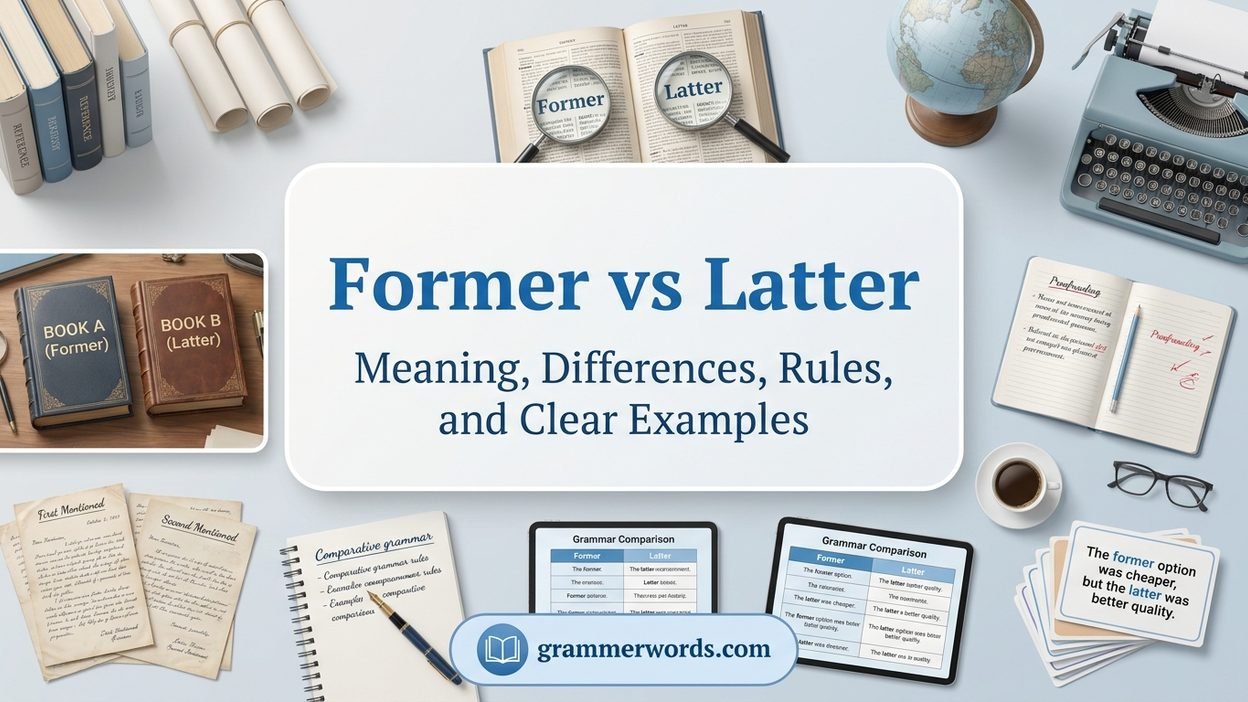
Choosing between former and latter becomes easy once you understand the small distinction that separates them. The words point backward to things already mentioned. In their most common paired use, former refers to the first of two items while latter refers to the second.
For example, consider this sentence: “You can take the train or the bus. I recommend the latter.” The two options are the train and the bus. Since the bus appears second, the latter means the bus.
That simple rule explains most uses. However, both words have additional meanings that can trip up even confident writers. Former can mean “previous” or “once held a particular status.” Latter can describe a later part of a period. Understanding those distinctions helps you write with precision rather than relying on a memorized shortcut.
This guide breaks down former vs. latter, shows how each word works in real sentences, explains common mistakes, and gives practical rules for choosing the clearest option.
Quick Answer
Former means the first of two people, things, groups, choices, or ideas that you have already mentioned.
Latter means the second of two people, things, groups, choices, or ideas that you have already mentioned.
A useful memory trick is:
- Former = first
- Latter = second
- Former and first both begin with F
- Latter and last both begin with L
Consider this example:
“The company considered hiring another employee or outsourcing the project. The former would increase payroll.”
Here, the former refers to hiring another employee because that option appeared first.
Now switch the reference:
“The company considered hiring another employee or outsourcing the project. The latter would reduce internal workload.”
Here, the latter refers to outsourcing because it appeared second.
Cambridge Dictionary defines the former as the first of two previously mentioned people, things, or groups. It defines the latter as the second of two previously mentioned people, things, or groups.
The rule in one sentence
If two things appear in order, former points to the first and latter points to the second.
That is the core distinction.
Comparison Overview
| Feature | Former | Latter |
| Basic meaning | First of two | Second of two |
| Usually refers to | Something mentioned earlier in a pair | Something mentioned second in a pair |
| Example | “Tea and coffee were offered. I chose the former.” | “Tea and coffee were offered. I chose the latter.” |
| Other major meaning | Previous or once held a status | Nearer the end of a period |
| Common phrase | “the former” | “the latter” |
| Best used with | Two clearly identified items | Two clearly identified items |
| Main danger | Confusing it with “previous” | Confusing it with “later” |
The words are opposites in their two-item reference function. You don’t need to use both in the same sentence. Either one can work independently when the two-item context remains obvious.
For instance:
“The restaurant offers indoor and outdoor seating. The latter overlooks the garden.”
Only the latter appears. The reader still understands that it means outdoor seating because the sentence establishes two choices.
Likewise:
“The company offers remote and hybrid positions. The former requires less commuting.”
Here the former means remote positions.
Main Differences Between Former vs. Latter

The most important difference comes down to position.
When you mention two things, their order creates a reference system. The first item becomes the former. The second becomes the latter.
Imagine two boxes placed on a table:
Box A → Box B
If the sentence names Box A first and Box B second:
- Box A = former
- Box B = latter
The words don’t describe which option is better, newer, cheaper, larger, or more important. They simply identify where each item appeared in the pair.
Example with people
“Maria spoke with Daniel and James. The former had more experience.”
The former refers to Daniel because Daniel appears first.
“Maria spoke with Daniel and James. The latter had more experience.”
The latter refers to James because James appears second.
Example with ideas
“The article discusses simplicity and precision. The former improves readability.”
Here the former means simplicity.
“The article discusses simplicity and precision. The latter becomes especially important in technical writing.”
Here the latter means precision.
Example with choices
“You can pay annually or monthly. The latter gives you more flexibility.”
The second option is monthly payment. Therefore the latter means monthly.
The trick is almost mechanical. Find the two nouns or noun phrases. Then check their order.
What Does “Former” Mean?
Former has more than one established meaning. Context determines which meaning applies.
The first meaning concerns position within a pair. In this use, the former means the first of two previously mentioned items. Oxford traces this sense to an older word meaning “first.”
For example:
“The proposal compares traditional classrooms with online courses. The former require physical attendance.”
Here the former refers to traditional classrooms.
The second major meaning concerns the past.
When you say:
“She is a former employee.”
you aren’t identifying the first of two employees. Instead, you’re saying she used to be an employee but isn’t one now.
The same pattern appears in:
- former president
- former colleague
- former employer
- former champion
- former address
- former owner
- former student
- former partner
Cambridge Dictionary gives this sense as something or someone connected with an earlier time or a position held in the past.
Former as “first”
“The two plans were discussed. The former received more support.”
Former = first plan.
Former as “previous”
“She met her former manager at the conference.”
Former = previous manager.
These meanings look similar on the page but perform completely different grammatical jobs.
What Does “Latter” Mean?
Latter also has more than one meaning.
Its most familiar use identifies the second of two previously mentioned things.
“The company compared cash payments with installment plans. The latter appealed to younger customers.”
The latter refers to installment plans.
Oxford lists this two-item reference as a primary meaning of latter. The dictionary also records a separate time-related meaning involving something nearer the end of a period.
That second meaning appears in phrases such as:
- the latter half of the year
- the latter stages of the competition
- the latter part of the century
- during the latter years of his career
In these expressions, latter doesn’t mean the second item in a pair. It means nearer the end of a period.
Latter as “second”
“The report compares public and private transportation. The latter receives less attention.”
Here latter = private transportation.
Latter as “later part”
“Sales increased sharply during the latter half of the year.”
Here latter means the part closer to the end of the year.
That distinction matters because latter and later aren’t interchangeable.
Former vs. Latter Examples in Real Sentences
Real examples make the rule easier to remember because the relationship becomes visible.
Everyday choices
“I can make pasta or rice. I’ll choose the former.”
The former means pasta.
“I can make pasta or rice. I’ll choose the latter.”
The latter means rice.
Workplace communication
“The team considered hiring internally or recruiting externally. The former would take less time.”
The former refers to internal hiring.
“The team considered hiring internally or recruiting externally. The latter would create a larger candidate pool.”
The latter refers to external recruitment.
Academic writing
“The study examines qualitative and quantitative methods. The latter relies heavily on numerical data.”
The latter means quantitative methods.
Academic writing often uses these terms because they can reduce repetition. Still, clarity should remain the priority. The MLA Style Center specifically warns that readers can become frustrated when they have to search backward to determine what former or latter refers to.
Technology
“The application has a desktop version and a browser version. The latter requires no installation.”
The latter means the browser version.
Travel
“We considered Boston and Philadelphia for the weekend. The former was easier to reach by train.”
The former means Boston.
Business decisions
“The company could reduce prices or increase advertising. The latter might strengthen demand without changing the product.”
The latter means increasing advertising.
See Also: Wracking or Racking? The Correct Spelling, Meaning
How to Use Former and Latter Correctly
Correct usage begins with a clear antecedent. An antecedent is the word or phrase that another expression refers back to.
Consider:
“The company discussed remote work and a four-day week. The former received strong support.”
The antecedents are:
- remote work
- a four-day week
The former therefore points to remote work.
Now consider:
“The company discussed remote work and a four-day week. The latter received strong support.”
The latter points to a four-day week.
Follow these steps
- Find the two items.
- Identify their order.
- Use former for the first.
- Use latter for the second.
- Check that the reference remains obvious.
That last step matters more than many grammar explanations suggest.
A sentence can be technically correct and still be unpleasant to read.
Former vs. Latter: Common Mistakes
Several errors appear repeatedly because the words look intuitive until context gets complicated.
Mistake: Reversing the meanings
Incorrect understanding:
“The former means the second option.”
Correct:
The former means the first option.
Remember the F = first shortcut.
Mistake: Treating latter as “later”
These words look related because they share several letters.
They don’t perform the same job.
“I’ll call you later.”
Here later means at a subsequent time.
“The latter option costs less.”
Here latter identifies the second option.
The spelling difference is tiny. The meaning difference is substantial.
Mistake: Using former and latter for unclear lists
Consider:
“The company offers consulting, software, training, and support. The latter is growing quickly.”
What does latter mean?
A reader might interpret it as support because support comes last. Some dictionaries recognize broader uses of latter. However, traditional style guidance strongly favors using former and latter for a clearly defined pair. Canada.ca and Pennsylvania State University both recommend restricting the pair to two items for clear writing.
A clearer sentence would be:
“The company offers consulting, software, training, and support. Support is growing quickly.”
Or:
“The company offers consulting, software, training, and support. The fourth service is growing quickly.”
See Also: Kill or Be Killed: Meaning, Origin, Usage, Examples
Mistake: Making readers search backward
Compare these sentences:
“The company redesigned its pricing model after reviewing customer feedback and studying competitor behavior. The latter revealed several opportunities.”
The reader must determine what latter refers to. The sentence contains multiple possible reference points.
A clearer version is:
“The company redesigned its pricing model after reviewing customer feedback and studying competitor behavior. The competitor analysis revealed several opportunities.”
The repeated noun adds a few words. It also removes the ambiguity.
Can You Use Former and Latter for More Than Two Things?
For careful writing, use former and latter with two items.
This recommendation appears across several established writing resources. Pennsylvania State University advises avoiding the terms when more than two members of a list are involved. Canada.ca gives the same practical guidance.
Suppose you write:
“The conference covered marketing, finance, operations, and human resources. The former received the most attention.”
The reader can’t reliably determine what former means. There are four candidates.
A better version is:
“The conference covered marketing, finance, operations, and human resources. Marketing received the most attention.”
If you need to identify positions, use explicit ordinal terms:
- the first
- the second
- the third
- the fourth
- the last
Better structure for a longer list
| Number of items | Better reference |
| 2 | former / latter |
| 3 | first / second / third |
| 4 | first / second / third / fourth |
| Many | Repeat the noun or use a precise description |
This approach isn’t about declaring every broader use of latter ungrammatical. Actual dictionary usage is more flexible in some contexts. The practical point is simpler: precision beats cleverness when the reader has to identify an item in a list.
Former vs. Latter vs. First vs. Last
These pairs overlap but aren’t identical.
Former specifically identifies the first member of a pair.
First can identify the first member of a pair or the first member of a much longer sequence.
Latter traditionally identifies the second member of a pair.
Last identifies the final member of a sequence.
For example:
“We discussed apples and oranges. I preferred the former.”
This works naturally.
With three items:
“We discussed apples, oranges, and bananas. I preferred the first.”
That version removes the ambiguity.
Consider another example:
“The course covers grammar, vocabulary, pronunciation, and writing. The fourth section is the most practical.”
Here fourth gives the reader an exact position.
The broader lesson is useful beyond this particular grammar point: don’t force a compact expression to do a job that a precise expression handles better.
Former vs. Latter vs. Previous vs. Subsequent
The word former can confuse readers because it has a separate meaning connected to time.
Compare:
“The former option costs less.”
Here former means the first of two options.
“Her former employer moved to another city.”
Here former means her previous employer.
Now consider previous:
“The previous chapter explains the basic theory.”
This means the chapter that came before the current chapter.
Subsequent works in the opposite temporal direction:
“Subsequent research challenged the original conclusion.”
It means research that came afterward.
The distinction looks like this:
| Word | Main idea |
| Former | First of two or previous |
| Latter | Second of two or later part of a period |
| Previous | Earlier in sequence or time |
| Subsequent | Later in sequence or time |
This difference becomes especially important in academic writing. A reader needs to know whether a word identifies position within a pair or position in time.
Former vs. Latter vs. Earlier vs. Later
Earlier and later usually describe time or sequence.
“The earlier study used a smaller sample.”
“The later study included more participants.”
These sentences describe chronological order.
By contrast:
“The study compares surveys and interviews. The latter produced richer responses.”
Here latter identifies the second item in a pair.
The distinction is subtle but useful:
- Earlier → farther back in time
- Later → farther forward in time
- Former → first of two or previous
- Latter → second of two or nearer the end of a period
Don’t treat former/latter as fancy replacements for earlier/later. They often refer to different relationships.
Are Former and Latter Formal Words?
Yes. They often sound more formal than everyday alternatives.
In casual conversation, someone might say:
“I prefer the second one.”
A formal report might say:
“I prefer the latter.”
Neither sentence is inherently better. The appropriate choice depends on the audience and context.
Former and latter appear comfortably in:
- Academic papers
- Technical reports
- Business writing
- Legal documents
- Formal correspondence
- Analytical essays
- Historical writing
They can also appear in ordinary writing. However, conversational English often favors direct repetition.
For example:
“I ordered the chicken and the pasta. I liked the pasta better.”
That sounds perfectly natural.
You could write:
“I ordered the chicken and the pasta. I preferred the latter.”
That is grammatically sound. It simply has a more formal texture.
A useful writing principle
Formal does not mean clearer.
If latter forces the reader to stop and remember the previous sentence, repeating the noun may produce better prose.
The MLA Style Center makes essentially this point when discussing passages that require readers to reread earlier material to identify what the terms reference.
How to Remember Former vs. Latter
The easiest mnemonic is almost embarrassingly simple:
Former = First
Latter = second
The first letters provide a useful memory hook:
- Former → First
- Latter → Last in the pair
Just be careful with the second shortcut. Latter does not mean “the last item in every possible list.” In careful modern usage, it most reliably identifies the second of two.
The three-second test
When you encounter former or latter, ask:
What are the two things being discussed?
Then ask:
Which one appeared first?
If it appeared first, choose former.
If it appeared second, choose latter.
That tiny mental checklist solves most cases.
When You Should Avoid Former and Latter
Sometimes the smartest choice is not to use either word.
Avoid them when the reference could become ambiguous. Avoid them when several nouns compete for the reader’s attention. Also avoid them when the referenced items appear several sentences earlier.
Most importantly, avoid them when repeating the noun would make the sentence instantly understandable.
Compare:
“The museum acquired paintings from France and Italy after negotiating with two private collectors. The latter were particularly interested in modern works.”
What does the latter mean?
France and Italy? The collectors? The sentence contains multiple possible antecedents.
A clearer version might say:
“The museum acquired paintings from France and Italy after negotiating with two private collectors. The collectors were particularly interested in modern works.”
The sentence becomes longer by only one word. Its meaning becomes much harder to misread.
Use a direct noun when:
- The sentence contains several noun phrases.
- The antecedent isn’t nearby.
- The reader shouldn’t have to reread.
- You’re writing instructions.
- You’re writing website copy or user-interface text.
- The audience may include learners of English.
- Precision matters more than stylistic economy.
Good writing isn’t a contest to eliminate every repeated noun. Strategic repetition often improves comprehension.
Former and Latter in Professional and Academic Writing
Professional writers often use former and latter to avoid repetitive phrasing.
Imagine a report comparing two production systems:
“The report evaluates centralized manufacturing and distributed manufacturing. The former requires fewer facilities while the latter can shorten delivery times.”
The terms work because the pair is obvious. Each word points directly back to one of two clearly defined systems.
Now imagine the same report contains five systems:
“The report evaluates centralized manufacturing, distributed manufacturing, contract production, licensing, and joint ventures. The latter has expanded rapidly.”
The sentence becomes murky.
A reader may interpret latter as the final item. Another reader may wonder whether it refers to several items grouped together. The ambiguity isn’t worth the stylistic savings.
A practical editing test
After writing former or latter, remove the preceding sentence mentally.
If you can’t immediately identify the two referenced items, the construction probably needs revision.
You can also ask:
Would repeating the noun make this sentence easier to understand?
If the answer is yes, repeat it.
That isn’t bad writing. It is reader-friendly writing.
Case Study: Fixing an Ambiguous Sentence
Consider this sentence:
“The company compared online advertising, television advertising, social media campaigns, and email marketing. The latter produced the highest return.”
At first glance, the sentence seems understandable. The latter appears to refer to email marketing because it comes last.
Yet the traditional former-latter construction doesn’t give you a reliable pair here. Four items appear in the list.
A clearer revision is:
“The company compared online advertising, television advertising, social media campaigns, and email marketing. Email marketing produced the highest return.”
The second version repeats two words. In exchange, it eliminates the interpretive work.
This principle appears in technical-writing guidance from Pennsylvania State University. Its guidance specifically recommends avoiding former and latter when more than two list members appear or when the antecedent isn’t clear.
Former vs. Latter: More Examples
Here are several examples that cover common situations.
| Sentence | Meaning |
| “We considered renting or buying. We chose the former.” | Former = renting |
| “We considered renting or buying. We chose the latter.” | Latter = buying |
| “The report compares speed and accuracy. The latter matters more here.” | Latter = accuracy |
| “The report compares speed and accuracy. The former matters more here.” | Former = speed |
| “He is a former teacher.” | Former = previous teacher |
| “Sales increased during the latter half of the year.” | Latter = second part of the year |
| “The two proposals differ sharply. The former is cheaper.” | Former = first proposal |
| “The two proposals differ sharply. The latter is easier to implement.” | Latter = second proposal |
Notice how former and latter change meaning according to context.
The phrase former teacher has nothing to do with a first-and-second pair. Meanwhile, the former proposal identifies the first of two proposals.
Former vs. Latter: Quick Practice
Test yourself before looking at the answers.
Example one
“The restaurant offers indoor seating and patio seating. The latter is quieter.”
Answer: patio seating.
It appears second.
Example two
“The company compared hiring locally with recruiting internationally. The former would reduce relocation costs.”
Answer: hiring locally.
It appears first.
Example three
“The course covers reading, writing, speaking, and listening. The latter is assessed through presentations.”
This sentence is less precise than it should be.
Better: “The speaking section is assessed through presentations.”
Why? The original sentence contains four items. A specific noun removes the ambiguity.
Example four
“She worked for the company for six years. She later joined a former employer.”
Here former employer means an employer she worked for previously.
It does not mean the first of two employers.
Example five
“The latter stages of the tournament attracted the largest audiences.”
Here latter refers to the later part of the tournament.
It isn’t identifying the second item in a pair.
Frequently Asked Questions
What is the difference between former and latter?
The former refers to the first of two items mentioned, while the latter refers to the second. Understanding this difference between former and latter helps you avoid confusion and improve sentence clarity.
How do you use former and latter in a sentence?
Use former and latter usage when discussing two people, things, or choices. For example, “I prefer tea to coffee; the former is lighter, while the latter is stronger.”
What does former mean in English?
The former meaning refers to the first item mentioned or something that held a position in the past. For example, “My former teacher now works at another school.”
Final Takeaway
Understanding former vs latter makes your writing clearer and helps prevent common English grammar mistakes. Remember, former refers to the first item mentioned, while latter points to the second. By learning the former and latter rules and practicing clear example sentences, you can improve word usage, avoid confusion, and write with greater confidence.