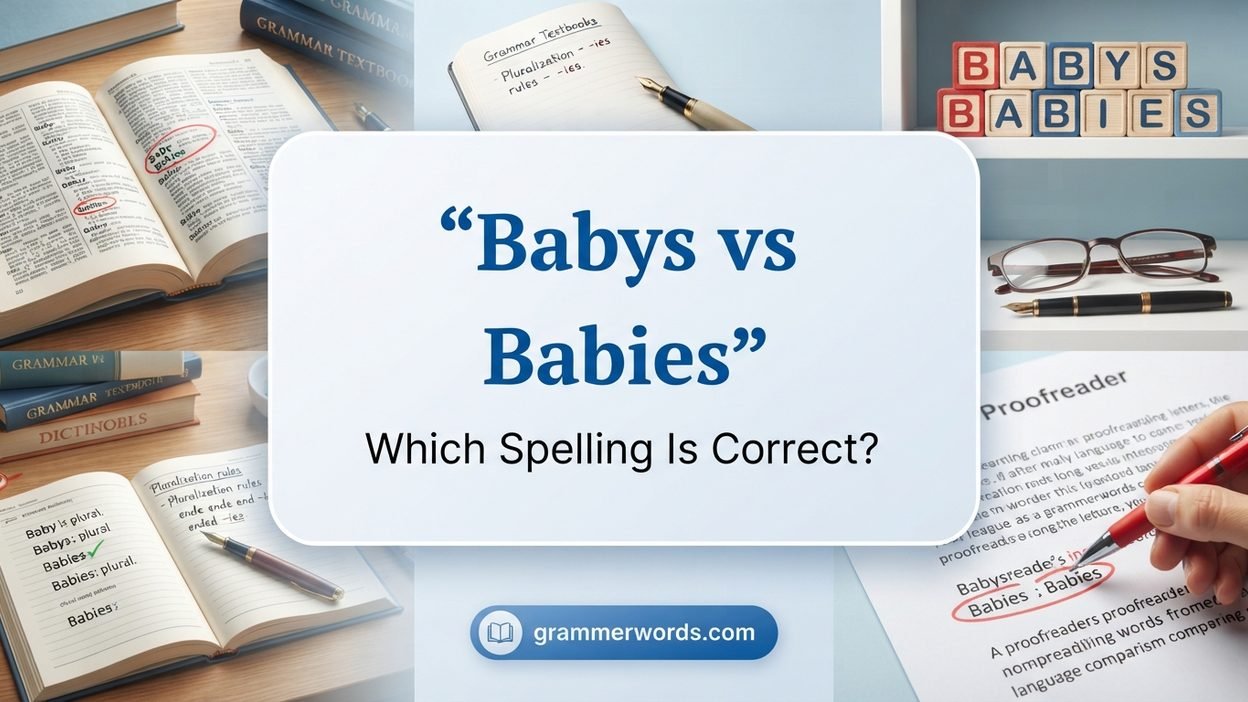
Have you ever wondered whether babys or babies is the correct plural of baby? The correct babies spelling follows simple English spelling rules that many writers find confusing. In standard English, you change the y to i and add es when a noun ends with a consonant followed by y. Therefore, baby to babies follows this rule, while babys is an incorrect plural form.
Understanding babys vs babies helps improve your English grammar, writing accuracy, and clear communication. However, baby’s and babies’ have different meanings because they show possessive forms, not ordinary plurals. This guide explains how to spell babies, explores useful spelling examples, and shares practical tips for avoiding spelling mistakes. These simple rules can help you write with confidence in everyday and formal writing.
Quick Answer
Babies is the correct plural spelling of baby.
Babys is incorrect in standard English.
The spelling changes because baby ends in a consonant followed by y. To make this type of word plural, English usually changes the y to i and adds es.
So:
baby → babies
Here are the essential forms at a glance:
| Form | What it means | Example |
| baby | One infant or young child | The baby is sleeping. |
| babies | More than one baby | The babies are sleeping. |
| baby’s | Something belonging to one baby | The baby’s toy is missing. |
| babies’ | Something belonging to multiple babies | The babies’ toys are missing. |
| babys | Incorrect standard spelling | Don’t use this as the plural. |
A useful shortcut is simple:
If you mean more than one baby, write “babies.”
Comparison Overview
The easiest way to understand babys or babies is to compare the forms side by side.
| Word | Singular or plural? | Possessive? | Correct? | Example |
| baby | Singular | No | Yes | The baby smiled. |
| babies | Plural | No | Yes | The babies smiled. |
| baby’s | Singular | Yes | Yes | The baby’s shoes are tiny. |
| babies’ | Plural | Yes | Yes | The babies’ shoes are tiny. |
| babys | Incorrect plural | No | No | Use babies instead. |
| babys’ | Incorrect | Attempted plural possessive | No | Use babies’ instead. |
| babies’s | Incorrect | Incorrect possessive | No | Use babies’ instead. |
Notice something important: apostrophes don’t create ordinary plurals.
That’s one of the biggest sources of confusion. Writers sometimes see an apostrophe in words such as baby’s and assume the apostrophe has something to do with making a noun plural. It doesn’t.
The apostrophe marks possession in baby’s and babies’.
Main Differences Between Babys or Babies
The central difference between babys and babies is straightforward: one is incorrect and the other is the standard plural form.
However, understanding why the spelling changes gives you a much stronger grasp of the rule.
“Baby” Means One
The word baby is a singular countable noun.
You use it when you’re talking about one baby.
Examples:
- The baby is crying.
- A baby needs regular care.
- The baby fell asleep.
- That baby has bright eyes.
- Her baby just started walking.
Because you’re talking about one person, the noun remains baby.
“Babies” Means More Than One
When you talk about two or more babies, use babies.
Examples:
- The babies are sleeping.
- Several babies attended the class.
- The babies need their bottles.
- The twins are beautiful babies.
- Newborn babies require careful attention.
The spelling changes from baby to babies.
The pronunciation also reflects the plural form. The ending adds an extra syllable compared with the singular word.
“Babys” Is Not the Standard Plural
The spelling babys looks tempting because many English plurals simply add s.
For example:
- cat → cats
- dog → dogs
- book → books
- chair → chairs
That pattern doesn’t apply to baby.
English spelling rules treat many nouns ending in consonant + y differently. Instead of adding only s, the word changes its final y.
Therefore:
baby → babies
not:
baby → babys
Why the “Y” Changes
Here’s the useful rule.
When a noun ends in a consonant + y, the usual plural pattern changes y to i and adds es.
Examples include:
- baby → babies
- city → cities
- family → families
- story → stories
- party → parties
- country → countries
- library → libraries
The same pattern explains all of these spellings.
This isn’t just a special rule for the word baby. It’s part of a broader English spelling pattern.
Why Does Baby Become Babies?
The spelling babies comes from a long-standing English plural pattern. Modern English inherited and developed many spelling conventions from earlier forms of the language.
For everyday writing, however, you don’t need to study the historical development of English to use the rule correctly.
You only need to identify the final two letters.
In baby, the final y comes after b, which is a consonant.
That gives us:
consonant + y → ies
So:
baby → babies
The same process appears in words such as city → cities and family → families.
The Important Exception: Vowel + Y
Here’s where the rule gets more interesting.
Not every word ending in y changes to ies.
If a word ends in a vowel + y, English usually keeps the y and simply adds s.
Compare these examples:
| Singular | Plural | Pattern |
| baby | babies | consonant + y |
| city | cities | consonant + y |
| family | families | consonant + y |
| boy | boys | vowel + y |
| toy | toys | vowel + y |
| day | days | vowel + y |
| key | keys | vowel + y |
| journey | journeys | vowel + y |
This comparison gives you a reliable way to remember the spelling.
Look at the letter immediately before y.
If it’s a consonant, the word will often change y → ies.
If it’s a vowel, the word will usually take s without changing the y.
Read More: Yea or Nay? Meaning, Correct Usage, Spelling, and Natural Examples
Babys or Babies: Common Spelling Mistakes
The most common mistake is writing babys when the intended meaning is plural.
That’s easy to fix.
Incorrect: The babys are sleeping.
Correct: The babies are sleeping.
However, several other forms can cause trouble.
“Baby’s” Is Not the Plural
The spelling baby’s usually shows possession.
For example:
The baby’s blanket is on the chair.
This means the blanket belongs to one baby.
It doesn’t mean multiple babies.
Compare:
- The baby is sleeping.
- The baby’s blanket is soft.
- The babies are sleeping.
- The babies’ blankets are soft.
Each form serves a different purpose.
“Babies’” Is the Plural Possessive
When several babies own or are associated with something, use babies’.
For example:
The babies’ parents arrived early.
Here, babies is already plural. Since the plural ends in s, the possessive apostrophe goes after the s.
This creates:
babies + ‘ = babies’
“Babies’s” Is Incorrect
You don’t normally write babies’s for the possessive form.
The plural noun already ends in s. Add the apostrophe after that final s.
So:
babies’
not:
babies’s
This distinction becomes much easier when you separate the ideas of plural and possession.
Baby vs. Babies vs. Baby’s vs. Babies’
These four forms deserve special attention because they frequently appear together.
Baby
Use baby when you’re referring to one baby.
Example:
The baby is sleeping in the crib.
The noun is singular.
Babies
Use babies when you’re referring to two or more babies.
Example:
The babies are sleeping in the nursery.
The noun is plural.
Baby’s
Use baby’s when something belongs to one baby or relates to one baby.
Example:
The baby’s bottle is on the table.
There is one baby. The bottle belongs to that baby.
Babies’
Use babies’ when something belongs to or relates to multiple babies.
Example:
The babies’ bottles are on the table.
There are multiple babies. Their bottles are being discussed.
A Simple Meaning Test
When you’re unsure, ask yourself two questions:
- How many babies are there?
- Am I showing ownership?
If there’s one and no possession:
baby
If there are several and no possession:
babies
If there’s one and something belongs to that baby:
baby’s
If there are several and something belongs to them:
babies’
This two-question method can eliminate most mistakes.
How “Babies” Works in Sentences
Grammar becomes easier when you see the word doing real work in a sentence.
Consider these examples:
- The babies are asleep.
- We watched the babies play.
- The doctor examined the babies.
- Their parents brought the babies home.
- The babies smiled at each other.
- Several babies were born at the hospital that morning.
Notice the verb in these sentences.
Because babies is plural, it generally takes plural verb forms in standard English.
Compare:
The baby is sleeping.
with:
The babies are sleeping.
That distinction matters beyond spelling. Choosing the correct noun form can affect the rest of the sentence.
Agreement With “Baby” and “Babies”
The singular and plural forms often change the verb as well.
| Subject | Correct verb | Example |
| baby | is | The baby is awake. |
| babies | are | The babies are awake. |
| baby | has | The baby has a toy. |
| babies | have | The babies have toys. |
| baby | was | The baby was crying. |
| babies | were | The babies were crying. |
This makes babies more than a spelling issue.
When you change baby to babies, you may also need to adjust the verb.
For example:
Incorrect: The babies is sleeping.
Correct: The babies are sleeping.
The plural noun requires the appropriate plural verb.
Babys or Babies in Everyday Writing
You might encounter this spelling question while writing something as ordinary as a text message.
That’s precisely why the distinction matters. You don’t need elaborate grammar terminology to communicate clearly. You just need the right form for the situation.
Text Messages
Informal writing still benefits from correct spelling.
Examples:
- “The babies finally fell asleep.”
- “We bought some clothes for the babies.”
- “The baby’s blanket is in the car.”
- “The babies’ room is almost finished.”
A quick message doesn’t need to sound formal. It should still make the intended meaning clear.
Social Media
Captions often use casual language. The same spelling rules apply.
Examples:
“These babies are growing so fast!”
“The baby’s first birthday is coming up.”
“Our babies’ favorite toys are everywhere.”
The context changes. The spelling doesn’t.
Emails
Professional or personal emails should use the form that matches the meaning.
For example:
The babies are scheduled for their checkups tomorrow.
Or:
Please bring the baby’s medical records.
The first sentence discusses multiple babies. The second discusses something associated with one baby.
Formal Writing
Academic, medical, educational, and professional writing should use babies as the standard plural.
For example:
Premature babies may require specialized medical care.
The plural form fits because the sentence discusses babies as a group.
Casual Conversation
In everyday speech, people rarely think about the spelling while talking. Writing creates the problem because the difference becomes visible.
If you hear someone say the word, context usually tells you whether they mean one baby or several.
When you write it, however, you need the correct spelling.
A Practical Case Study: One Small Apostrophe Changes the Meaning
Consider this short example:
The baby’s toys were scattered across the floor.
This sentence refers to toys belonging to one baby.
Now change it slightly:
The babies’ toys were scattered across the floor.
This sentence refers to toys belonging to multiple babies.
Finally:
The babies were playing with toys.
Now there’s no possession at all.
These three sentences look remarkably similar. Yet the noun forms communicate different information.
That’s why understanding baby, babies, baby’s, and babies’ is more useful than simply memorizing that babys is wrong.
A Quick Memory Trick for “Babys or Babies”
Here’s a simple way to remember the answer:
Baby has a consonant before the Y. Change Y to I and add ES.
So:
baby → babies
You can apply the same idea to:
- city → cities
- family → families
- country → countries
- story → stories
- party → parties
Then remember the contrasting pattern:
boy → boys
Why doesn’t boy become boies?
Because o is a vowel. The word ends in a vowel + y, so the normal plural simply adds s.
The Three-Step Check
When you see a noun ending in y, use this quick process:
- Find the final Y.
- Look at the letter immediately before it.
- Choose the plural pattern.
For baby:
- Final letter: y
- Previous letter: b
- b is a consonant
- Change y to i
- Add es
- Result: babies
It’s quick once you’ve practiced it a few times.
Is “Babys” Ever Correct?
In standard English, babys isn’t the correct plural of baby.
If you see babys in ordinary English writing, the writer almost certainly intended babies.
There can be unusual contexts in which a string of letters appears as part of a name, username, brand, title, or other proper noun. Those cases don’t change the standard grammatical plural.
For ordinary writing, the rule is clear:
One baby. Two or more babies.
Do American and British English Spell “Babies” Differently?
No.
Both American English and British English use babies as the standard plural spelling of baby.
The plural spelling doesn’t change based on the English variety.
Some English words do have different American and British spellings. For example, color and colour differ across the two varieties. The plural of baby isn’t one of those cases.
So whether you’re writing for an American audience or a British audience, use:
babies
Frequently Asked Questions
What Is the Correct Plural of Baby?
The correct plural of baby is babies, not babys. According to standard English spelling rules, change the final y to i and add es because a consonant comes before y.
Why Does Baby Change to Babies?
The word baby ends in a consonant followed by y. Therefore, baby pluralization follows the rule of changing y to i and adding es, just like city to cities.
What Is the Difference Between Baby’s and Babies’?
Baby’s shows possession by one baby, while babies’ shows possession by multiple babies. However, babies is the ordinary plural and does not need an apostrophe.
Is Babys Ever Correct in American or British English?
No, babys is not the standard plural spelling in either American English or British English. Both varieties use babies, so this spelling stays the same across both conventions.
How Can You Remember Whether to Write Babys or Babies?
Use this simple spelling rule: consonant plus y changes to ies, as in baby to babies. However, when a vowel comes before y, simply add s, as in boy to boys.
Final Takeaway
In conclusion, babies is the correct plural of baby, while babys is incorrect in standard English. To remember the rule, change y to i and add es when a consonant comes before y, as in baby to babies. Also, use baby’s for one baby’s belongings and babies’ for things that belong to several babies. With these simple English spelling rules, you can avoid common spelling mistakes and write with confidence.