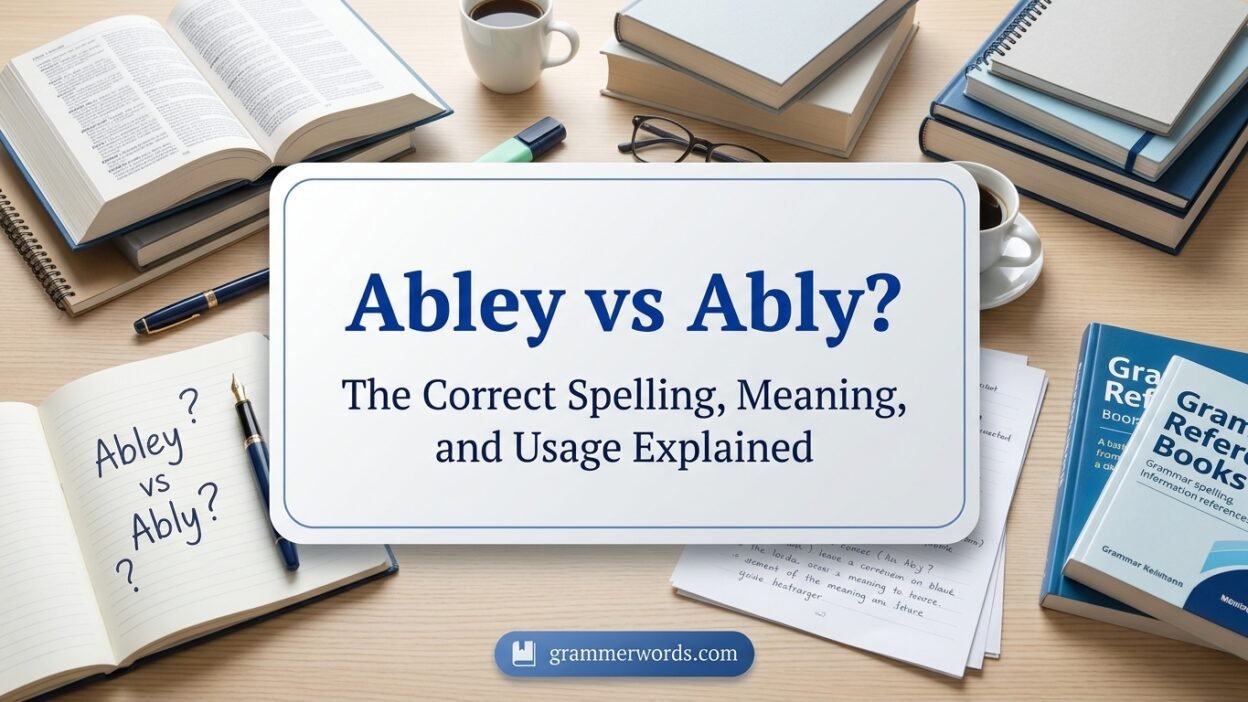
Have you ever wondered whether abley or ably is the correct spelling? Both forms look similar, but only one follows standard English spelling rules. The confusion often starts with able, making abley seem like a natural choice. However, ably is the correct standard spelling in modern English. It means skillfully, competently, or in an able manner. Therefore, choosing the right form helps maintain writing accuracy and communication clarity.
This distinction matters in business communication, formal writing, essays, emails, and professional documents. Moreover, understanding this linguistic pattern helps you avoid a common misspelling and maintain a professional tone. Although Abley can appear as a surname or proper noun, it is incorrect as an everyday adverb. This guide explains the meaning, usage, and spelling difference with clear examples.
Quick Answer
Ably is the correct spelling. Abley is not the standard spelling of the adverb formed from able.
The easiest way to remember the difference is this:
- Able = capable of doing something
- Ably = in a capable or skillful manner
- Ability = the capacity or skill to do something
- Abley = a common spelling mistake for ably
Consider these examples:
She is able to lead the team.
Here, able functions as an adjective.
She ably led the team.
Here, ably functions as an adverb because it describes how she led the team.
This distinction matters because able and ably aren’t interchangeable. The spelling changes because the grammatical function changes.
| Word | Word class | Basic meaning | Example |
| able | Adjective | Capable | He is able to help. |
| ably | Adverb | In a capable way | He ably handled the task. |
| ability | Noun | Capacity or skill | His ability impressed everyone. |
| abley | Nonstandard spelling | Usually intended to mean “ably” | Avoid this spelling in standard English. |
So if you’re deciding between abley or ably, choose ably.
Comparison Overview
The confusion becomes clearer when you look at how each word behaves in a sentence.
| Feature | Able | Ably | Abley |
| Standard English word | Yes | Yes | No as the standard adverb |
| Part of speech | Adjective | Adverb | Usually a misspelling |
| Meaning | Capable | In a capable manner | Usually intended as “ably” |
| Example | She is able to help. | She helped ably. | She helped abley. |
| Appropriate in formal writing | Yes | Yes | No |
| Used in American English | Yes | Yes | Not as the standard form |
| Used in British English | Yes | Yes | Not as the standard form |
The key distinction is grammatical.
Able describes a person, thing, or state. Ably describes an action.
That small difference explains why the two words often appear in related sentences.
Able
Use able when you want to say that someone has the capacity to do something.
Examples:
- “Maria is able to solve complex problems.”
- “The team was able to finish early.”
- “He is able to communicate clearly.”
- “They were able to complete the work.”
In these sentences, able connects with a form of to be and usually appears before to + verb.
Ably
Use ably when you want to explain the manner in which someone performs an action.
Examples:
- “Maria solved the problem ably.”
- “The team managed the project ably.”
- “He represented the company ably.”
- “They handled the negotiations ably.”
Here, ably modifies the verb. It tells readers that the action happened competently or skillfully.
Abley
The form abley often appears when writers apply a perfectly understandable spelling assumption to the word able.
The assumption goes like this:
able + ly = abley
That looks reasonable at first glance. However, standard English uses ably instead.
See Also: Kurt or Curt: What’s the Difference and Which Spelling Is Correct?
Main Differences Between Abley or Ably
The central difference isn’t actually between two legitimate alternative spellings. Instead, you’re choosing between the standard word “ably” and a nonstandard spelling “abley.”
“Ably” is the standard form
When someone performs an activity ably, they perform it with competence or skill.
For example:
- “The manager ably guided the department.”
- “The attorney ably presented the case.”
- “She ably handled the difficult conversation.”
- “The technician ably diagnosed the problem.”
The word often carries a slightly polished tone. That’s why it appears frequently in professional writing and formal descriptions of performance.
“Abley” usually signals a spelling error
If you see abley in ordinary English prose, the writer will usually mean ably.
The mistake is easy to understand. English has many adverbs formed by adding -ly to adjectives:
- careful → carefully
- quick → quickly
- clear → clearly
- skillful → skillfully
So a writer may naturally expect:
- able → abley
English doesn’t follow that pattern here. The standard form drops the final e before adding -ly.
Why the distinction matters
A single letter can change whether a word looks standard or mistaken.
Compare:
“She ably managed the department.”
with:
“She abley managed the department.”
The first sentence reads naturally. The second immediately looks like a spelling error to most proficient English readers.
That matters especially in professional settings. A single unusual spelling can distract readers from an otherwise strong piece of writing.
What Does “Ably” Mean?
Ably means in a capable, competent, skillful, or effective manner.
It comes from the adjective able. When you use ably, you’re focusing on someone’s performance rather than simply stating that they possess an ability.
For example:
“James is able to manage the project.”
This tells us that James has the capability.
Now compare:
“James managed the project ably.”
This tells us something about how he performed.
The second sentence gives the reader an evaluation of his execution. It suggests that he handled the responsibility competently.
Common meanings of “ably”
Depending on the context, ably can suggest:
- competently
- skillfully
- effectively
- successfully
- efficiently
- capably
These aren’t perfect synonyms in every situation. However, they overlap strongly in many sentences.
For example:
“She ably defended her position.”
This suggests that she defended her position with competence and skill.
The word doesn’t necessarily mean she performed flawlessly. Ably generally communicates capable performance rather than perfection.
How “Able” Becomes “Ably”
One of the most useful things to understand about ably is its spelling pattern.
The adjective is:
able
The adverb is:
ably
The final e disappears before the -ly ending.
This isn’t something you should treat as a simple mathematical formula. English spelling contains several word-building patterns that interact with pronunciation and historical spelling conventions.
Still, remembering the pair helps:
able → ably
You can also compare the related forms:
| Base word | Related form |
| able | ably |
| capable | capably |
| probable | probably |
| gentle | gently |
| simple | simply |
These examples show why spelling patterns can feel inconsistent. English doesn’t always let you create an adverb by mechanically attaching -ly to the visible spelling of an adjective.
A useful memory trick
Think of the phrase:
able → ably
The final e gets out of the way.
That gives you a simple visual rule:
Don’t write “abley” when you mean “in an able manner.” Write “ably.”
See Also: 18+ Better Ways to Say “In My Opinion” (Formal, Professional & Everyday Alternatives)
Able vs. Ably vs. Ability
These three words belong to the same word family. Their meanings connect closely, yet their grammatical functions differ.
Able
Able is an adjective.
It describes someone’s capacity or capability.
Examples:
- “She is able to speak three languages.”
- “The system is able to process the request.”
- “He wasn’t able to attend the meeting.”
Ably
Ably is an adverb.
It describes the manner of an action.
Examples:
- “She ably represented the organization.”
- “He ably solved the technical problem.”
- “The committee ably addressed the issue.”
Ability
Ability is a noun.
It refers to a person’s capacity, skill, or power to do something.
Examples:
- “Her ability to explain complex ideas impressed the audience.”
- “The job requires strong analytical ability.”
- “His ability improved with experience.”
A quick test can help:
Can the word describe a thing or person? You may need able.
Does the word describe how an action happens? You may need ably.
Are you naming a skill or capacity? You may need ability.
Why Is “Abley” a Common Spelling Mistake?
The mistake comes from a logical assumption.
Many English adverbs use -ly directly:
- slow → slowly
- careful → carefully
- quiet → quietly
- honest → honestly
Because able ends in the same general vowel-letter pattern as many adjectives, writers may instinctively create abley.
However, the standard spelling is ably.
Another source of confusion comes from pronunciation. When spoken naturally, the difference between the adjective and adverb isn’t always as visually obvious as it is in writing.
There’s also a broader lesson here: English spelling doesn’t always behave like a plug-and-play system.
You can often identify useful patterns. Yet some common word forms still need to be learned as complete vocabulary items.
How to Use “Ably” in a Sentence
The easiest way to use ably is to place it near the verb that describes the action.
Professional examples
- “She ably managed the department during the transition.”
- “The director ably explained the new policy.”
- “He ably handled the client’s concerns.”
- “The consultant ably guided the organization through the change.”
Academic examples
- “The author ably explains the theory.”
- “The researcher ably connects the two concepts.”
- “The paper ably examines the historical evidence.”
Everyday examples
Although ably often sounds formal, it can appear in ordinary writing.
- “She ably handled the situation.”
- “He ably fixed the problem.”
- “They ably organized the event.”
In casual conversation, however, many speakers would simply say well or skillfully.
For example:
“She handled the situation well.”
sounds more conversational than:
“She ably handled the situation.”
Neither is inherently wrong. The difference mostly concerns tone and emphasis.
Ably vs. Well: What’s the Difference?
Ably and well can overlap, but they don’t communicate exactly the same thing.
Well is broad. It can describe successful performance, health, quality, accuracy, or many other states depending on context.
Ably is more specific. It focuses on competence or capability in performing an action.
Compare:
“He performed well.”
This simply says his performance was good.
“He performed ably.”
This emphasizes that he demonstrated competence while performing.
The distinction becomes clearer in professional writing. A manager might write:
“She ably led the team through a difficult transition.”
The sentence doesn’t merely say that the outcome was good. It highlights her ability to lead effectively.
When “well” sounds better
Use well when you’re writing casually or when you want the simplest possible expression.
When “ably” works better
Use ably when you want to emphasize competence or give your sentence a more formal tone.
Ably vs. Capably vs. Competently
Several adverbs sit close to ably in meaning. Their subtle differences can help you choose the most precise word.
| Word | Main emphasis | Typical impression |
| ably | Skillful or capable performance | Polished |
| capably | Demonstrated capacity | Neutral |
| competently | Adequate and effective skill | Neutral or formal |
| skillfully | Strong practical skill | More emphatic |
| effectively | Producing the intended result | Results-focused |
| well | Good overall performance | Broad and conversational |
Consider three versions:
“She ably managed the project.”
This emphasizes capable management.
“She capably managed the project.”
This emphasizes her ability to handle the responsibility.
“She effectively managed the project.”
This emphasizes the results of her management.
The words overlap. Their emphasis differs.
See Also: Any Time or Anytime:What’s the Difference with Examples
Common Mistakes With Abley and Ably
The spelling mistake isn’t the only problem that can arise. Writers sometimes confuse the entire word family.
Mistake: Writing “abley”
Incorrect:
“She handled the assignment abley.”
Correct:
“She handled the assignment ably.”
Mistake: Using “ably” where “able” belongs
Incorrect:
“She is ably to solve the problem.”
Correct:
“She is able to solve the problem.”
Here, the sentence needs an adjective after is.
Mistake: Using “able” where “ably” belongs
Incorrect:
“He managed the department able.”
Correct:
“He managed the department ably.”
The sentence needs an adverb because the word describes how he managed the department.
Mistake: Confusing “ably” with “ability”
Incorrect:
“Her ably to solve problems is impressive.”
Correct:
“Her ability to solve problems is impressive.”
Here, the sentence needs a noun because ability names the capacity itself.
“Abley” or “Ably” in American and British English
There isn’t a meaningful American-versus-British spelling difference here.
Ably is standard in both American English and British English.
Likewise, able and ability remain standard in both varieties.
That means you don’t need to switch between ably and abley depending on your audience. Regional spelling isn’t the explanation for this particular confusion.
If you’re writing for an American audience, use ably.
If you’re writing for a British audience, use ably.
The same standard spelling applies.
Is “Abley” Ever Correct?
In standard English prose, abley isn’t the correct spelling for the adverb meaning “in an able manner.”
However, language appears in many settings beyond conventional prose. You might encounter an unusual spelling as part of a:
- username
- surname
- business name
- fictional name
- brand
- invented term
- typo reproduced in a quotation
That doesn’t turn abley into the standard adverb.
Context matters. A proper name or invented label can use almost any spelling. Standard English usage follows a different set of expectations.
So if you’re writing a sentence such as:
“The manager handled the situation ___.”
The standard completion is ably.
Real-World Usage of “Ably”
The word ably has a particularly natural home in descriptions of performance.
Workplace writing
Professional documents often need language that describes competence without sounding exaggerated.
“She ably coordinated the project across several departments.”
This sentence communicates competence without claiming that she was perfect.
Leadership
The word works well when describing someone who takes responsibility for a group or task.
“He ably led the team during the transition.”
Here, ably focuses on his performance as a leader.
Academic writing
Writers can use ably to describe a successful explanation or analysis.
“The author ably connects historical evidence with the broader argument.”
The word adds a concise assessment of the author’s execution.
Reviews and criticism
It can also appear when someone evaluates a performance, book, presentation, or other work.
“The speaker ably addressed the audience’s main concerns.”
Again, the emphasis falls on competence.
A Simple Case Study: Able vs. Ably
Imagine a company needs someone to lead a difficult client meeting.
Before the meeting, a manager might say:
“Jordan is able to handle the meeting.”
This statement focuses on capacity. Jordan has the necessary ability.
After the meeting, someone might say:
“Jordan ably handled the meeting.”
Now the focus shifts to performance. Jordan demonstrated that ability during the actual event.
The two sentences describe closely related ideas. Their grammatical structures create different meanings.
| Situation | Natural wording | What it emphasizes |
| Before an event | Jordan is able to handle it. | Capability |
| During or after performance | Jordan ably handled it. | Competent execution |
| Discussing the skill itself | Jordan has the ability to handle it. | Capacity |
This distinction gives you a practical way to remember the entire word family.
Is “Ably” Formal or Informal?
Ably is perfectly standard English, but it often sounds more polished than well.
You might hear:
“She did the job well.”
more often in casual conversation.
In a formal review, you might see:
“She ably performed the responsibilities associated with the role.”
The second version has a more professional register.
That doesn’t mean ably is outdated. It remains useful when the context calls for precise language about competence.
However, don’t force it into every sentence. If well communicates the idea more naturally, use well.
Good writing isn’t about choosing the fanciest word. It’s about choosing the word that fits.
Pronunciation of “Ably”
The pronunciation of ably follows its standard spelling rather than the mistaken visual form abley.
The word has two syllables, with the stress on the first syllable.
For learners, it helps to think of ably as a compact form connected directly to able rather than trying to pronounce every letter in the spelling as though the word were able + ly.
This is another reason the spelling can surprise learners. English often compresses related word forms in ways that aren’t obvious from the written letters alone.
Quick Guide to Choosing the Right Word
When you’re writing and hesitate between abley or ably, use this checklist.
Choose “able” when:
- You mean capable.
- The word describes a person or thing.
- The structure uses to + verb.
- You’re describing potential or capacity.
Example:
“She is able to complete the assignment.”
Choose “ably” when:
- You mean in a capable manner.
- The word describes an action.
- You want to emphasize competent performance.
- The sentence needs an adverb.
Example:
“She completed the assignment ably.”
Choose “ability” when:
- You need a noun.
- You’re talking about someone’s capacity or skill.
Example:
“Her ability to solve problems is impressive.”
Avoid “abley” when:
- You’re writing standard English.
- You mean “in an able manner.”
- You’re preparing professional, academic, or published content.
Use “ably” instead.
Final Takeaway
When choosing between abley or ably, always use ably to describe skillful or competent performance. Remember, able means capable, ably describes how someone performs an action, and ability refers to a skill or capacity. Although Abley may appear as a surname or proper noun, it is not the correct standard spelling. By remembering this simple spelling rule, you can improve your writing accuracy, maintain a professional tone, and communicate with greater confidence.